

“ENVIRONMENTAL BENEFITS OF BIOMASS PELLETS”
“Why should biomass pellets be used?”
Biomass pellets should be used for several compelling reasons, especially in the context of sustainable energy and environmental protection. Here’s why:
✅ 1. Renewable Energy Source
Biomass pellets are made from organic materials like sawdust, agricultural residues, or wood chips. These materials can be replenished over time, making pellets a sustainable alternative to fossil fuels.
✅ 2. Lower Carbon Emissions
When burned, biomass pellets release carbon dioxide, but this is part of the natural carbon cycle — the CO₂ released is roughly equal to what the plants absorbed while growing. This results in lower net greenhouse gas emissions compared to coal or oil.
✅ 3. Waste Reduction
Pellets are often made from waste products such as sawdust, wood shavings, or crop residues. Using them helps reduce landfill waste and promotes circular economy practices.
✅ 4. High Energy Efficiency
Biomass pellets have high energy density and low moisture content, which makes them more efficient than raw biomass. This results in better combustion and higher heat output per unit of weight.
✅ 5. Versatile Applications
They can be used in household heating systems, industrial boilers, and power plants, making them a flexible energy source.
✅ 6. Cost-Effective (in some regions)
In areas with abundant biomass waste, pellets can be a cheaper alternative to fossil fuels, especially when factoring in carbon taxes or subsidies for renewable energy.
✅ 7. Energy Security
Using locally produced biomass pellets reduces dependence on imported fossil fuels, enhancing energy security and supporting local economies.
✅ 8. Ash as Fertilizer
The ash produced from burning biomass pellets can often be used as a natural fertilizer, adding value to the process.
Key Features of Biomass Pellets
- Renewable Source
Made from organic, biodegradable materials like sawdust, wood chips, and crop residues. - High Energy Density
Compact and energy-rich, providing more heat per unit than raw biomass. - Low Moisture Content
Typically 6–10%, which improves combustion efficiency and reduces smoke. - Environmentally Friendly
Lower net CO₂ emissions; part of the natural carbon cycle. - Uniform Size & Shape
Consistent pellet size ensures efficient handling, storage, and burning. - Low Ash Production
Produces minimal ash during combustion, which can often be used as fertilizer. - Easy Handling & Transport
Dense and compact form allows for cost-effective storage and transportation. - Versatile Fuel
Suitable for residential stoves, industrial boilers, and power generation. - Cost-Effective
Especially where biomass waste is abundant and fossil fuel prices are high. - Supports Waste Management
Utilizes agricultural and industrial by-products, reducing environmental burden.
🌟 Most Attractive Points of Biomass Pellets
🔋 1. Clean & Renewable Energy
Biomass pellets are made from natural, renewable sources — helping replace fossil fuels without depleting the planet’s resources.
🌍 2. Low Carbon Footprint
Burning pellets emits much less CO₂ compared to coal or oil — making them climate-friendly and ideal for net-zero goals.
💰 3. Converts Waste into Wealth
Turns wood waste, crop residues, and sawdust into valuable fuel — reducing pollution and creating new economic opportunities.
🔥 4. High Efficiency, Low Emissions
Pellets burn hotter and cleaner than raw biomass, with minimal smoke and ash — ideal for modern stoves and industrial use.
🚛 5. Easy to Store & Transport
Their small, uniform shape makes them easy to handle, package, ship, and store — no bulky firewood or messy raw materials.
🏠 6. Ideal for Homes & Industry
Biomass pellets can be used in home heating systems, boilers, and even large-scale power plants — extremely versatile.
🇱🇷 7. Energy Independence
Locally produced biomass reduces reliance on imported fuels — strengthening local economies and energy security.
Effective Uses of Biomass Pellets
🏠 1. Residential Heating
- Used in pellet stoves and boilers for clean, efficient home heating.
- Ideal for rural or off-grid homes needing a renewable heat source.
🏭 2. Industrial Boilers & Furnaces
- Powers large-scale heating systems in factories and facilities.
- Replaces coal or oil in industries like textiles, food processing, and chemicals.
⚡ 3. Electricity Generation
- Burned in biomass power plants or co-fired with coal to generate electricity.
- A key part of renewable energy mixes in many countries.
🧱 4. Brick & Ceramic Kilns
- Provides a consistent and high-temperature heat source.
- Reduces the environmental impact of traditional kiln fuels.
🏨 5. District Heating Systems
- Supplies centralized heat to multiple buildings or urban areas.
- Used in eco-friendly city heating projects across Europe and Asia.
🚜 6. Agricultural Drying
- Used in drying grains, tea leaves, tobacco, and more.
- Offers a clean, low-cost alternative to diesel-based dryers.
🌿 7. Eco-Friendly Cooking Solutions
- In some regions, used in pellet cookstoves for cleaner indoor cooking.
- Reduces indoor air pollution and deforestation.
Effective uses of biomass pellets:
| Use | Description | Benefits |
|---|---|---|
| Residential Heating | Pellet stoves and boilers for home warmth | Clean, efficient, renewable heat |
| Industrial Boilers | Powering large boilers in factories | Replaces fossil fuels, cost-effective |
| Electricity Generation | Biomass power plants and co-firing with coal | Renewable power, reduces emissions |
| Brick & Ceramic Kilns | High-temp heat source for kilns | Consistent heat, eco-friendly |
| District Heating | Centralized heat for urban areas | Energy-efficient, scalable |
| Agricultural Drying | Drying grains, tea, tobacco | Low-cost, cleaner alternative |
| Eco-Friendly Cooking | Pellet cookstoves for cleaner indoor cooking | Reduces pollution, safer |
🌿 Biomass Pellets Awareness: Powering a Greener Future
Did you know?
Biomass pellets are a renewable, eco-friendly fuel made from natural waste materials like wood chips and agricultural residues. Using biomass pellets helps:
- Reduce greenhouse gas emissions and fight climate change
- Transform waste into clean energy, reducing landfill and pollution
- Support local economies by creating jobs and reducing fuel imports
- Provide affordable, efficient heating and electricity
- Promote sustainable energy for homes, industries, and communities
Environmental Impact of Biomass Pellets
✅ Positive Effects
- Carbon Neutrality:
Biomass pellets release CO₂ when burned, but this carbon was absorbed by plants during growth, creating a closed carbon cycle that helps reduce net greenhouse gas emissions compared to fossil fuels. - Waste Reduction:
They utilize agricultural residues, sawdust, and other organic waste, preventing these materials from decomposing and releasing methane in landfills. - Lower Air Pollutants:
Pellets have low moisture and ash content, resulting in cleaner combustion with fewer particulates, sulfur, and nitrogen oxides compared to coal. - Soil Health:
Ash leftover from pellet combustion can be used as a nutrient-rich fertilizer, returning minerals to the soil.
🌿 Ingredients of Biomass Pellets
- Wood Residues
- Sawdust
- Wood chips
- Shavings from lumber mills
- Bark and other wood processing by-products
- Agricultural Residues
- Straw (wheat, rice, barley)
- Corn stalks and husks
- Peanut shells
- Coconut shells and husks
- Energy Crops
- Switchgrass
- Miscanthus
- Elephant grass
- Other Biomass Materials
- Coffee grounds
- Palm kernel shells
- Olive pits
- Sugarcane bagasse
- Binders (Optional)
- Sometimes natural binders like starch or lignin (naturally occurring in wood) are used to help pelletize.
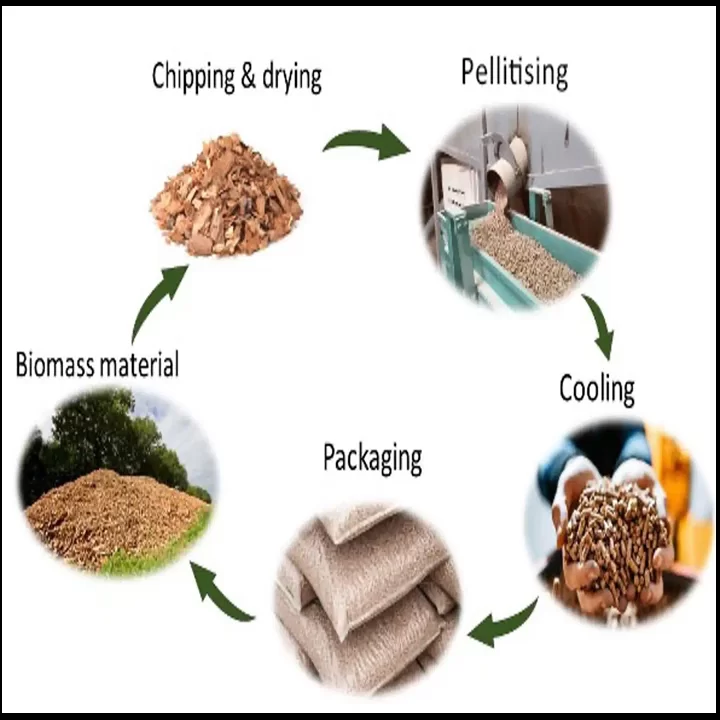
🏭 Biomass Pellet Production Procedure
1. Raw Material Collection
Gather biomass materials such as sawdust, wood chips, or agricultural residues.
2. Drying
Reduce the moisture content of the raw materials to about 6-10% for efficient pelletizing and combustion. This is typically done using drying machines or natural drying.
3. Grinding
Crush or grind the dried biomass into a fine, uniform powder to ensure consistent pellet quality.
4. Pelletizing (Compression)
- The ground biomass powder is fed into a pellet mill.
- Under high pressure and heat, the material is compressed through small holes in a die, forming dense cylindrical pellets.
- The natural lignin in biomass acts as a binder, holding the pellet together without additives.
5. Cooling
Pellets come out hot and soft from the pellet mill. They are cooled down to harden and stabilize their shape.
6. Screening
Remove fines (small broken pieces) and dust to ensure uniform pellet size and quality.
7. Packaging & Storage
The finished pellets are packed into bags or bulk containers, ready for transport and use.
🌟 Conclusion: Why Biomass Pellets Matter
Biomass pellets offer a clean, renewable, and efficient energy solution that addresses many environmental and economic challenges. By turning waste materials into a valuable fuel, they reduce greenhouse gas emissions, support sustainable waste management, and promote energy independence. With their versatile applications—from home heating to industrial power generation—biomass pellets are a key player in the transition towards a greener, more sustainable future.
Embracing biomass pellets means investing in eco-friendly energy that benefits our planet, economy, and communities.
I very lucky to find this web site on bing, just what I was looking for : D too saved to my bookmarks.
Have Any Questions?
+91-9370999191 +919930909020
For more details kindly contact on this number
9226719191/9226339191