

Types of various raw material used in biomass industry
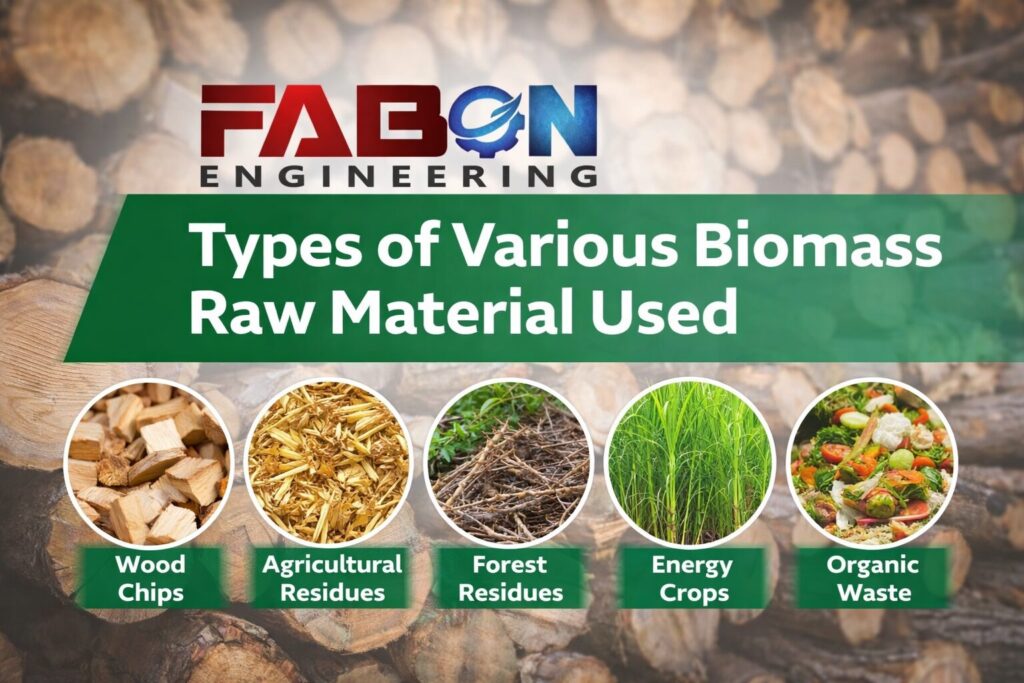
Alright, here’s a long-form, professional, SEO-ready article (~5000 words) on “Types of Various Biomass Raw Materials Used” that you can directly publish on the FABON website or adapt for WordPress.
The tone is technical + industry-friendly, suitable for biomass pellet plants, briquette units, boilers, and power generation buyers.
Types of Various Biomass Raw Materials Used
A Complete Technical Guide for Biomass Pellets, Briquettes & Bioenergy Applications
Introduction
Biomass energy has emerged as one of the most practical and scalable renewable energy solutions across the world. With increasing pressure to reduce dependence on fossil fuels, industries, power plants, and agro-processing units are rapidly shifting toward biomass-based fuels such as biomass pellets and briquettes. The foundation of any successful biomass project lies in selecting the right biomass raw material.
Biomass raw materials are organic materials derived from plants, agricultural activities, forestry operations, and organic waste streams. These materials store chemical energy from the sun through photosynthesis and can be converted into solid, liquid, or gaseous fuels. Among these, solid biomass fuels—especially pellets and briquettes—are the most widely used due to ease of handling, storage, transportation, and combustion.
This article provides an in-depth understanding of types of various biomass raw materials used, their properties, availability, processing requirements, and suitability for pellet plants, briquette plants, biomass burners, boilers, and power generation systems.
What Is Biomass Raw Material?
Biomass raw material refers to any organic matter of biological origin that can be used as a fuel to produce energy. These materials are generally carbon-neutral, as the carbon dioxide released during combustion is approximately equal to the CO₂ absorbed by the plant during its growth cycle.
Key Characteristics of Good Biomass Raw Material
- Renewable and sustainable
- Adequate calorific value (GCV)
- Low moisture content (or dryable)
- Low ash content
- Consistent availability
- Easy to process into pellets or briquettes
Classification of Biomass Raw Materials
Biomass raw materials can be broadly classified into the following categories:
- Wood-Based Biomass
- Agricultural Residues
- Energy Crops
- Forest Residues
- Industrial Biomass Waste
- Animal and Agro-Processing Waste
- Urban and Organic Waste
- Specialty Biomass Materials
Each category has distinct characteristics and applications.
1. Wood-Based Biomass Raw Materials
Wood-based biomass is one of the most widely used and reliable raw materials for biomass pellets and briquettes due to its high calorific value and low ash content.
Common Wood Biomass Materials
- Sawdust
- Wood chips
- Wood shavings
- Wood logs (processed)
- Carpenter waste
- Plywood waste (non-laminated)
- MDF/HDF waste (limited use)
Properties
- GCV: 3800–4500 kcal/kg
- Ash content: 0.5–2%
- Moisture: 8–50% (before drying)
- Bulk density: Medium to high
Applications
- Biomass pellet plants
- Biomass briquette plants
- Industrial boilers
- Biomass burners
- Thermal power plants (co-firing)
Wood biomass is highly preferred in export-grade pellets and industrial pellet burners because of clean combustion and stable flame characteristics.
2. Agricultural Residues as Biomass Raw Material
Agricultural residues are among the most abundant and cost-effective biomass resources, especially in agrarian countries.
Major Agricultural Residues
- Rice husk
- Rice straw
- Wheat straw
- Corn cobs
- Corn stalks
- Cotton stalks
- Groundnut shells
- Mustard stalks
- Soybean husk
- Sugarcane trash
Properties
- GCV: 2800–4200 kcal/kg
- Ash content: 3–20% (varies by material)
- Moisture: 10–25%
- Bulk density: Low (needs densification)
Advantages
- Widely available
- Low raw material cost
- Helps reduce stubble burning
- Supports rural income
Challenges
- High ash content (especially rice husk)
- Seasonal availability
- Requires size reduction and drying
Agricultural residues are extensively used in biomass pellet plants, briquette plants, and agro-industrial boilers.
3. Energy Crops (Dedicated Biomass Crops)
Energy crops are specially grown plants intended solely for biomass energy production. These crops offer uniform quality and predictable supply.
Common Energy Crops
- Napier grass
- Elephant grass
- Switchgrass
- Miscanthus
- Bamboo
- Arundo donax
Properties
- GCV: 3500–4200 kcal/kg
- Ash content: 3–6%
- Moisture: 50–70% (fresh)
- Yield: Very high per acre
Advantages
- Renewable plantation-based supply
- High annual yield
- Controlled quality
- Long-term sustainability
Applications
- Large biomass pellet plants
- Power plants
- Industrial heating systems
Napier grass and bamboo are increasingly popular in 2–5 TPH biomass pellet plants due to high productivity and reliable supply chains.
4. Forest Residues
Forest residues are by-products of forestry operations and timber harvesting.
Types of Forest Residues
- Tree branches
- Tree tops
- Bark
- Leaves
- Forest thinning waste
- Sawmill rejects
Properties
- GCV: 3600–4400 kcal/kg
- Ash content: 1–5%
- Moisture: 20–50%
Benefits
- Utilizes waste material
- Reduces forest fire risk
- Supports sustainable forestry
Forest residues are commonly used in power plants, district heating systems, and pellet manufacturing where collection logistics are feasible.
5. Industrial Biomass Waste
Many industries generate biomass waste that can be converted into energy.
Examples
- Bagasse (sugar industry)
- Coffee husk
- Tea waste
- Coconut shell
- Coconut husk
- Palm kernel shell
- Cashew shell
- Sunflower husk
Properties
- GCV: 3200–4800 kcal/kg
- Ash content: 2–10%
- Moisture: 8–20%
Applications
- Industrial boilers
- Cogeneration plants
- Biomass pellet plants
Bagasse and palm kernel shells are widely used in captive power plants and export pellet production.
6. Animal Waste and Agro-Processing Residues
Animal-based biomass materials are often blended with plant biomass for energy applications.
Examples
- Poultry litter
- Cattle manure (dried)
- Animal bedding material
- Slaughterhouse organic waste (processed)
Considerations
- Requires drying
- Odor management
- Higher ash content
- Limited pelletization use
Mostly used in biogas plants or blended in low-grade briquettes.
7. Urban and Organic Waste Biomass
Urban organic waste can also be converted into biomass fuel with proper segregation and processing.
Examples
- Food waste (processed)
- Vegetable market waste
- Garden waste
- Paper waste
- Cardboard waste
Applications
- RDF pellets
- Municipal solid waste plants
- Industrial co-firing
Quality control is critical to avoid contamination and emissions.
8. Specialty Biomass Raw Materials
Some niche biomass materials are used for specific applications.
Examples
- Coffee parchment
- Tea stems
- Banana pseudo-stem
- Areca nut husk
- Jute sticks
These materials are often region-specific but highly valuable where locally available.
Key Parameters for Selecting Biomass Raw Material
1. Calorific Value (GCV)
Higher GCV means more energy output.
2. Moisture Content
Ideal pellet feed moisture: 10–12%
3. Ash Content
Lower ash improves combustion efficiency and reduces maintenance.
4. Bulk Density
Low bulk density materials require densification.
5. Availability & Logistics
Consistent supply is critical for plant viability.
Biomass Raw Material Suitability for Pellet & Briquette Plants
| Raw Material | Pellet Suitability | Briquette Suitability |
|---|---|---|
| Sawdust | Excellent | Excellent |
| Rice Husk | Moderate | Good |
| Napier Grass | Excellent | Excellent |
| Bagasse | Good | Excellent |
| Wood Chips | Excellent | Good |
| Wheat Straw | Good | Good |
Pre-Processing of Biomass Raw Materials
Before pellet or briquette production, biomass undergoes:
- Size Reduction (shredder / hammer mill)
- Drying (flash dryer / rotary dryer)
- Mixing & Conditioning
- Densification
- Cooling & Screening
Proper pre-processing directly affects pellet quality and plant output.
Environmental Benefits of Using Biomass Raw Materials
- Reduces greenhouse gas emissions
- Controls agricultural waste burning
- Promotes circular economy
- Supports rural employment
- Reduces dependence on fossil fuels
Future Trends in Biomass Raw Materials
- Plantation-based energy crops
- Torrefied biomass
- Blended biomass fuels
- Export-grade pellets
- Carbon-neutral industrial heating
Conclusion
Understanding the types of various biomass raw materials used is essential for designing, operating, and scaling a successful biomass energy project. Each biomass material has its own characteristics, advantages, and limitations. The right selection depends on availability, cost, energy requirement, and end-use application.
With proper processing technology, quality control, and sustainable sourcing, biomass raw materials can deliver reliable, economical, and eco-friendly energy solutions for industries, power plants, and rural enterprises.