

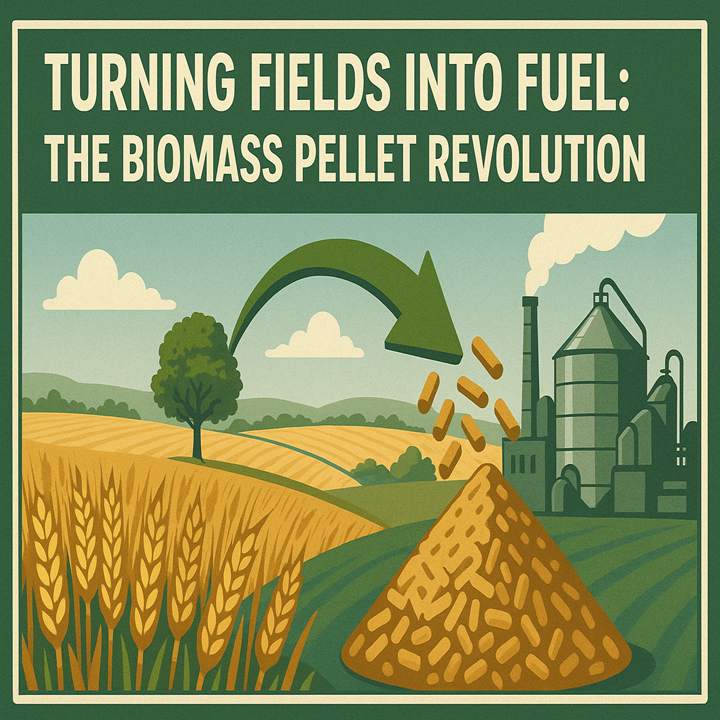
“TURNING FIELDS INTO FUEL: THE BIOMASS PELLET REVOLUTION”
Introduction
In the rapidly changing energy landscape of India and the world, the notion of converting agricultural fields into fuel is no longer futuristic—it’s happening now. With breakthroughs in technology and supportive policy frameworks, biomass-pellet manufacturing is emerging as a compelling route for transforming farm residues and forestry waste into high-density, high-value fuel. At the heart of this transformation is the robust industrial value chain: from raw material collection, pellet manufacturing, and thermal utilisation, to carbon-management and export potential. For plant owners, boiler operators, industries seeking greener fuels and equipment manufacturers, the biomass-pellet revolution offers a powerful opportunity.
In this blog we will explore the full spectrum of the biomass pellet story—why it matters, how it works, what feedstocks and machines are involved (with a spotlight on FABON), the business economics, policy incentives, and how you can position yourself ahead of the curve. If you are considering setting up a pellet plant, retrofitting boilers, or integrating biomass into your energy mix — this is your technical and strategic guide.
1. Why Biomass Pellets? The Strategic Drivers
1.1 Abundant Raw Material – Waste Turned Asset
India generates huge volumes of agricultural and forestry residues: straw from paddy and wheat, husk from rice milling, sawdust and wood-waste from timber operations, plantation prunings, energy crops like napier grass, and more. These materials often are under-utilised or disposed by burning. Converting them into biomass pellets gives a dual benefit: waste gets monetised, and fuel‐value is extracted.
For instance, a recent study estimated that globally, agricultural residues available for pellet production could displace approximately 917 million tons of coal equivalent annually.
1.2 Fuel Cost Reductions & Energy Security
Against the backdrop of rising fossil fuel prices and import dependency, biomass pellets present a locally‐sourced alternative. They offer competitive calorific value, lower cost per kg of energy output (in many cases). One Indian estimate reports pellets priced at just ₹12-15 per kg, with fuel cost savings of up to 65-70%.
1.3 Environmental & Policy Imperatives
Governments in India are emphasising renewable and clean energy sources. Pelletisation of biomass aligns with circular economy principles, carbon reduction goals, and rural employment creation. The domestic market size for biomass pellets in India is projected to expand significantly — the Indian wood pellet market, for example, was valued at US$ 457.6 million in 2024 and a forecast to reach US$ 722.2 million by 2033, at a CAGR of 5.20%.
On the global front, the biomass pellets market is projected to grow from ≈ US$ 12.3 billion in 2025 to US$ 23.5 billion by 2035 (CAGR ~6.7%).
1.4 Industrial & Thermal Applications
Pellets are not just for residential stoves – they are increasingly being used in industrial boilers, process heating, combined heat and power (CHP), co-firing in thermal plants, and export markets. In India, the rise of biomass co-firing mandates in coal plants is driving demand.
1.5 Export Potential & Global Value Chain
India can not only serve domestic demand but also serve as a supplier to global pellet markets. With the right supply chain and quality standards, export opportunities to Asia, Europe and the Middle East exist.
2. The Biomass Pellet Value Chain: From Fields to Fuel
2.1 Raw Material Collection & Pre-processing
The journey begins with feedstock collection: agricultural residues (paddy straw, wheat straw, bagasse, husk), forestry residues (sawdust, wood-chips), energy crops (napier grass). For example, napier grass is emerging as a “super crop” for pellet production thanks to high yield and fast growth.
Key steps:
- Harvesting and gathering of residue
- Transportation to the plant
- Drying / moisture reduction (ideally <10% moisture)
- Size reduction (chipping, cutting, hammer-milling)
2.2 Pellet Manufacturing (Machine & Process)
Here is where the real value addition happens: converting pre-processed biomass into uniform, high-density pellets. The typical process:
- Feeding the prepared biomass into pellet machine
- Compression through die and rollers
- Cooling & screening
- Bagging / storage
This is the stage where equipment matters: pellet machines by companies like FABON deliver high throughput, optimized die and roll assemblies, consistent pellet quality, low downtime, and after-sales service support.
2.3 Quality Parameters & Standards
Important quality metrics include:
- Moisture content (≤10%)
- Pellet diameter & length (commonly 6-8 mm diameter, 10-30 mm length)
- Bulk density (~650-1300 kg/m³)
- Calorific value (~4,500-5,000 kcal/kg for pellets) Ash content, volatile matter, mechanical durability
2.4 Storage, Handling & Transportation
Pellets must be stored in dry conditions, protected from moisture uptake. Bulk and bagged formats are used. Efficient logistics from plant to end-user (boiler, power plant, export container) are vital to maintain economics.
2.5 Utilisation: Industrial & Thermal End-Use
End-use scenarios:
- Industrial boilers: replacing coal or furnace oil for steam generation
- Co-firing in thermal power plants: blending pellets with coal
- CHP units and district heating systems
- Residential/commercial heating (for smaller scale)
- Export markets: processed pellets transported abroad
2.6 By-products & Circularity
The residue after pelletisation (fine dust, screenings) can be used as biomass ash, soil amendment, or feedstock for bio-char. The entire chain embodies circularity.
3. Business Case & ROI for Pellet Manufacturing
3.1 Investment & Cost Structure
Key cost heads:
- Land & civil works
- Pellet machine & ancillary equipment (dryers, conveyors, storage bins)
- Raw material sourcing & logistics
- Utilities (electricity, diesel for transport)
- Labour & operations
- Bagging/packaging (if marketed)
- Environmental approvals and certifications
3.2 Revenue & Economics
Revenue streams include:
- Sale of pellets (domestic + export)
- Carbon credits / Emission Reduction Certificates (where applicable)
- Sale of by-products (ash, fines)
- Government incentives/subsidies
Example: With pellets selling at competitive rates compared to imported fossil fuels and industries seeking cost savings, payback periods for well-run plants can be attractive.
3.3 Cost Savings for End-Users
Boiler owners using pellets instead of furnace oil/coal can significantly reduce fuel cost and carbon footprint. One analysis estimated up to 65-70% fuel cost savings when switching to pellets priced at ₹12-15 per kg.
3.4 Market Growth & Demand Forecasts
- The Indian biomass pellets market is expected to grow, with multiple sources estimating CAGRs in the 5-7% range.
- Key growth drivers: surplus agricultural residues, co-firing mandates, export demand, industrial shift to cleaner fuels.
- For example, India’s biomass co-firing requirement is driving demand for pelletised straw and other residues.
3.5 Risk & Mitigation
Key risks:
- Feedstock supply chain volatility (seasonality, moisture, logistics)
- Technology/machine downtime or quality issues
- Market price fluctuations and competition
- Regulatory/permit delays
- Logistics and storage challenges
Mitigation strategies:
- Multi-feedstock sourcing (agri + forestry + energy crops)
- High-quality pellet machines (like those provided by FABON) with service support
- Forward contracts with end-users (industries/boilers/power plants)
- Sound logistics planning and buffer storage
- Quality certification and alignment with end-user needs
4. Why Choose FABON Engineering as Your Partner
4.1 Proven Expertise & Technology
FABON offers a range of pellet-making machines engineered for heavy-duty industrial use, designed with high-durability components, precision dies & rollers, and automation features. Whether you’re setting up a 1 TPH plant or larger capacities, the machine design allows flexibility in feedstock types (wood, straw, husk) and output specifications.
4.2 One-Stop Solution Provider
FABON not only supplies pellet machines but also supports the entire value chain: feeding systems (hammer mills, shredders), dryers, conveyors, storage, and ancillary equipment. This integrated approach simplifies project execution and avoids mismatch between components.
4.3 After-Sales Service & Warranty
A key differentiator: FABON offers a 1-year warranty on machines, plus robust after-sales service coverage (spares, technical training, remote monitoring). For a business where uptime and quality are critical, this provides peace of mind.
4.4 Customisation & Modular Scalability
FABON understands that feedstock availability, plant layout, and demand vary widely. Their machines are customised in terms of capacity (from small to large TPH), feedstock flexibility, and layout (block design, compact models). Scalability means you can start small and expand.
4.5 Location Advantage & Supply Chain Readiness
Being based in India, FABON offers local manufacturing, local spares availability, and readiness for domestic and export markets — reducing lead-time, logistics cost, import duties and making the business case more compelling.
4.6 Supporting Your ROI & Business Strategy
By selecting high-efficiency equipment, ensuring low downtime, and maximising pellet quality, FABON helps ensure your plant meets user expectations (industries require consistent pellet size, low ash, high durability) — which in turn supports pricing, repeat business and plant profitability.
5. Feedstocks & Quality Matters: What Works in India
5.1 Feedstock Typology
- Agricultural residues: paddy straw, wheat straw, rice husk, sugarcane bagasse.
- Forestry residues: sawdust, wood-chips, plantation prunings.
- Energy crops: Napier grass, bamboo, other fast-growing grasses. For example, napier grass is being used as a high-yield raw material for pellet production.
5.2 Key Quality Parameters for Feedstock
- Moisture content: Ideally below 10% for pelletisation.
- Particle size: Uniform feed to pellet machine improves efficiency.
- Bulk density and ash content: Lower ash improves calorific value and boiler performance.
- Seasonal availability & logistics: Clustering collection within a radius improves economics.
5.3 Calorific Value & Pellet Performance
A well-produced biomass pellet in India typically offers 4,500-5,000 kcal/kg. An example comparison table:
| Fuel Type | Approx. Calorific Value | Cost/kg* | Comments |
| Biomass Pellets | ~4,500–5,000 kcal/kg | ₹12-15/kg (est) | Low cost, renewable |
| Furnace Oil / Diesel | ~10,000 kcal/kg | Much higher cost | Imported, volatile |
| Coal | ~6,000–7,000 kcal/kg | Varies | Fossil, carbon-intensive |
*Indicative values for India.
5.4 Compatibility with End-Use Systems
For industrial boilers or co-firing systems, pellet quality is critical: uniform size, low moisture, low ash, physical durability (to avoid dust). Poor quality pellets can lead to clinkering, higher maintenance, conversion issues. Hence, machine design & quality control (as provided by FABON) matter.
6. Policy, Incentives & Market Trends in India
6.1 Government Framework & Support
- The Indian Government’s biomass market is supported by various schemes, renewable energy targets, and incentives.
- The “buyers guide” for biomass pellets indicates key trends: mandatory biomass co-firing in thermal power plants up to 5-10% blending.
- Policies aiding pellet production include subsidies, tax incentives, preferential procurement, and support for rural clusters.
6.2 Market Growth & Forecasts
- Indian biomass market: valued ≈ USD 2.5 billion in 2024, expected to grow at ~5.2% CAGR during 2025-2035.
- India wood pellet market: ~USD 457.6 million in 2024; projected to reach USD 722.2 million by 2033 (5.20% CAGR).
- Global pellet market: projected CAGR ~6.04% between 2025-2033.
6.3 Key Market Drivers
- Agricultural residue availability and supply chain maturation
- Increasing adoption of co-firing and industrial biomass fuel substitution
- Export opportunities and foreign demand for sustainable pellets
- Technological advancements in pellet manufacturing that drive down cost and increase quality
6.4 Challenges to Address
- Feedstock logistics: collecting, drying, transporting residues from wide geographical spread
- Quality assurance: uniform pellet size, low moisture, low ash
- Competition from alternative fuels or energy sources
- Need for end-user equipment compatibility and boiler modifications
- Policy/regulatory uncertainty and incentives that may change
7. Implementation: Setting Up a Pellets Plant – Step-by-Step
7.1 Site Selection & Raw Material Logistics
- Choose a location with dependable feedstock supply within a radius (e.g., 50-100 km)
- Access to transport, utilities (electricity), dry storage yard
- Proper infrastructure for raw material feed (pre-processing yard, drying area)
7.2 Plant Layout & Equipment Selection
- Drying system (if required) to bring down moisture content
- Size reduction unit (hammer mill, shredder)
- Pellet machine (core): select model capacity, input flexibility (FABON offers various models)
- Cooler, screener, magnetic separator (if required)
- Storage for finished pellets (bags or bulk)
- Conveyors, elevators, bagging unit (if applicable)
- Power supply and control panel
7.3 Quality Control & Testing
- Establish lab or partner with lab to test pellet properties: moisture, calorific value, ash, size distribution
- Regular monitoring ensures you meet end-user specifications (especially industrial clients)
7.4 Marketing & Offtake
- Target industrial boilers (textile mills, paper & pulp, bricks, food processing), co-firing units, exports
- Offer pellet quality certificate, calorific value guarantee
- Create supply contracts or tie-ups with industries seeking biomass fuel
7.5 Operations & Maintenance
- Ensure preventive maintenance of pellet machine (dies, rollers)
- Monitor raw material quality and throughput
- Keep backup stocks of critical spares (FABON spares support helps here)
- Maintain storage dry, control dust
7.6 Financial Planning & ROI
- Estimate raw-material cost, machine investment, utility costs, labour & logistics
- Estimate pellet price (domestic/ export) and revenue
- Calculate payback period, internal rate of return (IRR), break-even volumes
- Build conservative estimates for raw material fluctuations
8. Case Example: How Industries Replace Fossil Fuel with Pellets
Consider an industrial boiler currently using furnace oil. By switching to high-quality biomass pellets:
- Fuel cost reduces due to cheaper per kg cost and local sourcing
- Carbon emissions reduce; potential to earn carbon credits or meet ESG goals
- Supply chain becomes more reliable (local material vs imported fuel)
- Branding advantage: “green manufacturing”
This is where FABON’s pellet machines play a key role – by enabling high-quality pellet output that meets boiler and power plant specifications. A well-run pellet plant can cater to such industrial consumers, giving them fuels with consistent calorific value, low ash and assured logistics.
9. Export Strategy for Indian Pellet Producers
9.1 Understanding Global Demand
Major pellet markets exist in Europe, East Asia, Middle East. Global growth forecasts: USD 9.6 billion in 2024 to USD 16.27 billion by 2033. Indian producers can access these markets by meeting quality, shipping logistics, certification (FSC, ISO) and competitive pricing.
9.2 Quality & Logistics Considerations
- Secure high bulk density, low moisture, uniform size pellets
- Packaging/bulk shipping standards for containerised export
- Compliance with import country regulatory norms (ash limits, specification)
- Use of port logistics, export documentation
9.3 Branding & Supply Chain Strength
By partnering with equipment manufacturers like FABON, exporters can emphasise quality, machine traceability, production standard, and reliability — which helps build trust with overseas buyers.
10. FIRMS LIKE FABON: Differentiators You Should Evaluate
When selecting a pellet-machine supplier (for example FABON), compare these factors:
- Machine capacity vs future scalability
- Feedstock flexibility: ability to process straw, wood, sawdust, etc
- Spare parts availability, after-sales service network
- Energy efficiency, die & roller design, low maintenance
- Turnkey offerings: conveyors, dryers, supply chain integration
- Track record & testimonials from similar installations
- Warranty terms (FABON offers 1-year warranty)
- Local manufacturing advantage for cost, lead-time and spares
11. Sustainability & Circular Economy Benefits
- By converting crop residues into fuel, you reduce open burning (which causes air pollution) and create value for farmers.
- Biomass pellets are considered carbon-neutral in many usage contexts (as the CO₂ released was recently absorbed by biomass growth).
- Helps industries meet ESG goals (zero-waste, renewable fuel use, decarbonisation).
- Supports rural livelihoods and decentralised energy production.
- Enhances energy security by reducing dependence on imported fossil fuels.
12. SWOT Analysis for a Pellet Manufacturing Venture
| Opportunities | Threats |
| Co-firing mandates, export growth | Competing fuels (biogas, solar thermal) |
| Energy crop cultivation & value-chain innovation | Policy/ subsidy changes, regulatory risk |
| Technology advancements reducing unit cost | Feedstock scarcity, climate/seasonal disruptions |
13. Practical Tips for Success
- Feedstock mapping first – know your raw material region, seasons, logistics.
- Quality control from day one – invest in testing and consistent output.
- End-user tie-up early – secure offtake agreements to de-risk.
- Choose a reliable machine partner – e.g., FABON with on-site support, spares, customisation.
- Plan logistics & storage – pellets must be kept dry and transported efficiently.
- Monitor costs diligently – feedstock cost, power consumption, maintenance.
- Stay abreast of policy/regulatory changes – co-firing mandates, subsidies, export norms.
- Build brand & certification – quality matters in both domestic & export markets.
- Consider expansion/up-scaling – design plant with modularity in mind.
- Understand maintenance cycles – regularly service pellet machines, monitor wear & tear, maintain spare inventory.
14. How FABON’s Machines Fit into the • Turning Fields Into Fuel • Revolution
- With FABON pellet machines, you can process diverse biomass feedstocks — whether agricultural residues or wood-based waste — turning a ‘field’ output into a high-value fuel.
- The modular design allows you to ramp from initial capacity to higher TPH as market demand grows.
- FABON’s service network ensures that your pellet plant uptime remains high, directly influencing ROI and supply reliability.
- By choosing FABON, you align your pellet venture with a recognised brand that emphasises machine quality, customisation and after-sales support — a key differentiator when competing in industrial or export markets.
- Thus, your project becomes more than just a machine install—it becomes a strategic business unit converting fields into fuel, aligning with circular economy principles and industrial demand.