

“TINY PELLETS, MASSIVE POTENTIAL: THE POWER OF BIOMASS MACHINES”
Introduction
In a world where industries demand cleaner, cheaper, and more efficient energy solutions, biomass pellets have emerged as one of the most powerful alternatives to fossil fuels. These small, dense pellets—made from agricultural and forestry waste—are driving a global renewable energy shift. Their rising popularity across boilers, burners, furnaces, hot air generators, and industrial heating systems proves one thing:
Tiny pellets can deliver massive energy potential.
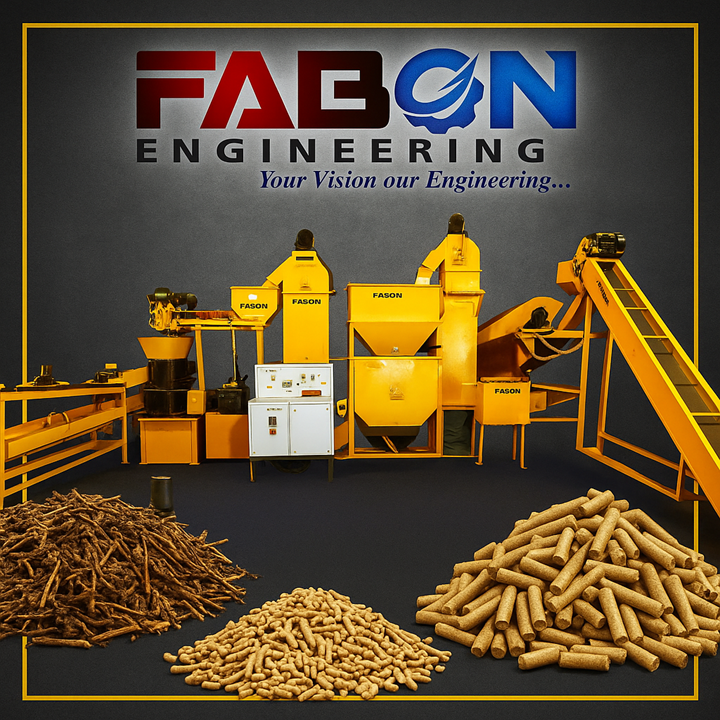
But behind every high-quality biomass pellet lies a powerful machine—designed, engineered, and perfected to convert raw materials into premium fuel. This is where FABON Engineering, one of India’s fastest-growing biomass machinery manufacturers, stands out. With advanced pellet plants, high-performance dryers, heavy-duty hammer mills, shredders, mixers, and pellet burners, FABON is enabling businesses, farmers, and industries to transform low-value waste into high-value energy.
From Napier grass to sawdust, rice husk to groundnut shell—FABON machines can process almost any biomass and turn it into profitable pellets. Whether you’re setting up a 1 TPH pellet plant, upgrading to a ring-die automatic unit, or replacing LPG/diesel with FABON’s biomass burner, the company delivers reliable, efficient, and cost-saving solutions for every scale.
1. The Rise of Biomass Pellets: Why the World Is Switching
Industries are under pressure to reduce emissions, cut energy costs, and comply with ESG norms. Meanwhile, farmers struggle to manage agricultural waste sustainably.
Biomass pellets solve both problems.
1.1 What Makes Pellets So Powerful?
Pellets are:
- High-density (600–750 kg/m³)
- High GCV (3000–4200 kcal/kg depending on material)
- Uniform & consistent fuel
- Low ash (less than 4% for good biomass)
- Easy to store, transport & feed into burners
Pellets are replacing:
- Diesel
- Furnace Oil
- Coal
- LPG
- Firewood
1.2 Why Industries Prefer Pellets
- 60% to 80% fuel cost savings
- Fully automated feeding
- Zero soot, zero smell, low ash
- Faster heating response
- Government incentives for clean energy
- Better compliance with pollution norms
1.3 Global Pellet Boom
Countries like Sweden, Canada, Japan, and South Korea already operate large-scale pellet heating systems. India is now rapidly catching up, especially with the rise of:
- Biomass boilers
- Pellet burners
- Pellet grills
- Industrial heating systems
- Commercial hot air generators
FABON Engineering is at the front line of this growth.
2. Raw Materials: India’s Biggest Energy Goldmine
India is rich in biomass:
- Sawdust
- Wood chips
- Rice husk
- Sugarcane bagasse
- Groundnut shell
- Cotton stalk
- Sunflower husk
- Agricultural crop residue
- Forest waste
- Napier grass (CO-4 & CO-5)
FABON Engineering specializes in converting all these materials into premium-quality pellets.
2.1 Napier Grass — FABON’s Speciality
Few companies in India have perfected Napier grass pelleting. FABON is one of the leaders.
Why Napier?
- Grows year-round
- 30–40 tons yield per acre
- High calorific value
- Easy to dry
- Ideal for pellets and briquettes
FABON currently supplies machinery for 1 TPH to 5 TPH Napier pellet plants across India.
3. How Biomass Machines Work: The Science Behind Pellets
Making pellets looks simple, but requires precise engineering. FABON’s machines ensure consistency, durability, and maximum output.
3.1 The Biomass Pelleting Process
Step 1: Raw Material Cutting / Shredding
Machines involved:
- FABON Wood Chipper
- FABON Shredder
- FABON Crusher
Purpose:
Reduce the size of biomass to 10–20 mm for further processing.
Step 2: Drying
Moisture needs to be brought down to 8–12%.
Machines:
- FABON Flash Dryer
- FABON Rotary Dryer
- FABON Hot Air Generator
Step 3: Pulverizing
Powder should be 2–5 mm.
Machine:
- FABON Hammer Mill (75 HP, 2TPH model or custom)
Step 4: Mixing (Optional)
For adding:
- Binder
- Additives
- Lubrication
Machine: FABON Biomass Mixer
Step 5: Pelleting
The heart of the system.
FABON uses:
- Flat Die Pellet Machines (20 HP, 40 HP, 75 HP, 100 HP)
- Ring Die Pellet Machines (1 TPH to 5 TPH)
Step 6: Cooling
Pellets come out at 70–90°C.
Machine: FABON Pellet Cooler
Step 7: Screening
Removes dust and fines.
Machine: FABON Pellet Screener
Step 8: Packing
Options:
- Manual bag sealing
- Automatic bagging machine
FABON provides all equipment, making it a complete turnkey pellet plant manufacturer in India.
4. FABON Engineering: India’s Trusted Biomass Machine Manufacturer
FABON is not just another machine supplier—
It is a fully integrated engineering powerhouse.
4.1 Why FABON Leads the Market
- 100% Made in India
- ISO 9001:2015 Certified
- Precision-engineered machines
- Strong after-sales service
- Spare parts availability
- Heavy-duty fabrication
- Custom designs for each client
FABON machines are known for:
- Higher output
- Lower electricity consumption
- Longer die life
- Better pellet density
- Zero breakdown performance
- Smooth automation
4.2 Chinese Machines vs FABON Machines
FABON machines are:
- Heavier
- More durable
- Better pellet uniformity
- Stable running even at 20 hours/day
- Service support everywhere in India
Chinese machines typically work 3–6 months before failure.
FABON works reliably for 5–10 years with regular maintenance.
5. FABON Biomass Machine Range (2025 Edition)
5.1 Pellet Machines
- 20 HP Flat Die
- 40 HP Flat Die
- 75 HP Ring Die
- 100 HP Ring Die
- 1–5 TPH Industrial Pellet Plants
5.2 Dryers
- Flash Dryer: 250–2500 kg/hr
- Rotary Dryer: 1–10 TPH
- Hot Air Generators: 200kcal–2million kcal
5.3 Crushers & Mills
- Wood Crusher
- Hammer Mill
- Biomass Grinder
5.4 Conveying & Handling
- Screw conveyors
- Belt conveyors
- Bucket elevators
5.5 Storage & Processing
- Surge tanks
- Cyclone separators
- Dust collectors
5.6 Combustion
- FABON Biomass Burner
- Pellet burner with smoke collector
- Industrial heating systems
5.7 Complete Turnkey Solutions
FABON handles:
- Layout design
- Fabrication
- Installation
- Commissioning
- Training
- After-sales support
6. Industries Using FABON Biomass Solutions
PELLETS produced by FABON machines are used in more than 25 industries, including:
- Food processing
- Pharmaceuticals
- Dairy
- Textiles
- Chemicals
- Hotels
- Laundries
- Poultry farms
- Brick kilns
- Boilers
- Dyers
- Furnaces
- Commercial kitchens
7. ROI & Profitability: Why Biomass Pellets Make Sense
7.1 Cost Savings
| Fuel | Cost per Unit | Efficiency |
| Diesel | ₹110/litre | High cost |
| LPG | ₹95/kg | High cost |
| Furnace Oil | ₹55–60/litre | Moderate |
| Coal | ₹12–15/kg | High pollution |
| Pellets | ₹8–12/kg | High efficiency |
Industries save ₹20–60 lakhs per year after switching to pellets.
7.2 Pellet Plant Profit Margin
- Raw material cost: Low
- Process cost: ₹3–4/kg
- Selling price: ₹10–15/kg
Profit per ton: ₹3000–6000
Even a 1 TPH plant can earn ₹3–5 lakhs/month.
8. Environmental Benefits
Biomass pellets offer:
- 90% reduced CO₂ emissions
- Near-zero sulphur emissions
- Reduced air pollution
- No smoke, no soot
- Better air quality in rural and industrial areas
FABON’s technology ensures pellets meet global emission standards.
9. Why FABON Is the Best Choice for Pellet Plants in India
Key Advantages:
- Heavy-duty steel fabrication
- German-grade bearings
- Precision machining
- Customizable layouts
- 20-hour/day operational capacity
- Service team available PAN-India
- Affordable spare parts
- Energy-efficient motors
FABON installations operate in:
- Maharashtra
- Gujarat
- Rajasthan
- Madhya Pradesh
- Karnataka
- Tamil Nadu
- Telangana
- UP, Bihar, Haryana
- And across India
10. The Future: India’s Biomass Revolution
Government policies (MNRE, EIM, BEE initiatives) are pushing industries to adopt renewable heating.
Future technologies FABON is working on:
- Automated pellet burners
- Smart IoT-enabled dryers
- High-pressure ring die machines
- Napier grass harvesting–pelleting integration
- Pollution-free industrial heating systems
FABON Engineering is shaping India’s clean energy future.
Conclusion: Tiny Pellets. Massive Potential. FABON Power.
Biomass pellets may be small, but their impact is massive—
Economically, environmentally, and industrially.
From cutting costs to reducing emissions, from empowering farmers to strengthening industries, the power of biomass is undeniable.
And FABON Engineering is making this revolution accessible to every corner of India.
Whether you need:
- A complete pellet plant
- A high-performance dryer
- A hammer mill
- A biomass burner
- Or a fully automated 1–5 TPH pellet line
FABON Engineering is your trusted partner.
Your Vision. Our Engineering.