

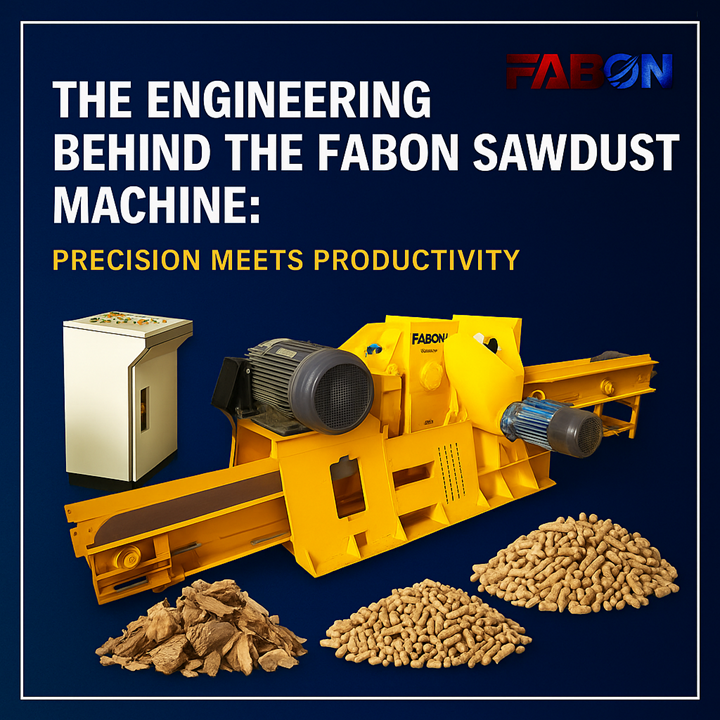
“THE ENGINEERING BEHIND THE FABON SAWDUST MACHINE: PRECISION MEETS PRODUCTIVITY”
Introduction
In the evolving world of biomass processing, furniture waste recycling and board manufacturing, a high-performance sawdust making machine is more than just a grinder—it is a precision engineered system. For manufacturers, board plants and biomass fuel producers in India and abroad, choosing the right equipment can mean the difference between steady production and frequent downtime.
At FABON, we believe that engineering excellence, service reliability and output productivity must go hand in hand. This blog explores the key engineering principles behind our sawdust machine – how precision meets productivity – and how you as a plant-owner or process engineer can derive maximum value through intelligent equipment choice and maintenance.
1. Why Sawdust Machines Matter – Context & Market Drivers
1.1 The value of sawdust as a raw material
Sawdust – the fine particles generated from wood processing – is no longer simply a waste by-product. According to industry data, sawdust is increasingly used in:
- Biomass fuel and briquette or pellet production.
- Particle board, MDF and composite board manufacturing.
- Animal bedding and horticultural substrate.
- Compost, mulch, and soil amendment.
1.2 Rising demand in India & abroad
With India’s push toward renewable energy and circular economy in the wood-industry, machines that convert wood waste into usable material are in high demand. That means higher throughput, better reliability, lower downtime, and advanced engineering.
1.3 Challenges for sawdust machine users
Plant owners typically face:
- Variation in feed material: logs, chipboards, furniture cutoffs, bamboo etc.
- Requirement for consistent particle size (2-12 mm typical) to feed downstream equipment.
- Hardwoods or mixed species which impose wear on blades and shafts.
- Maintenance, spares, and service support in remote areas.
- Energy consumption, vibration, noise, safety and dust control.
Therefore, a machine that is well-engineered, service-friendly, and productivity-oriented will stand out.
2. Engineering Principles of the FABON Sawdust Machine
2.1 Robust structural design
The base frame and housing of a sawdust machine must absorb vibration, align components precisely, and bear heavy load cycles. At FABON:
- Heavy gauge steel welded frame ensures rigidity and minimises deflection under load.
- Precision machining of bearing seats and mounting surfaces ensures minimal misalignment and lower vibration.
- Modular design allows components to be accessible for inspection, maintenance and replacement.
2.2 High-performance shaft & rotor assembly
The heart of the machine is the rotor assembly – the shaft, bearings, blades/knives. Key engineering considerations:
- Shaft material: High-grade alloy steel, dynamically balanced to run smoothly at high RPM.
- Bearing selection: Heavy-duty taper roller or spherical roller bearings sized for radial and axial loads, selected for long bearing life.
- Rotor design: Blades / knives mounted around the rotor in a staggered pattern, optimised for clean cutting of logs, branches, furniture waste or boards.
- Rotor RPM: A higher speed reduces load per cut and improves size uniformity but must be matched to feed system and power motor.
2.3 Feed system & material handling
The efficiency of sawdust production greatly depends on how feed material is introduced and handled:
- Inlet hopper and feed conveyor: Designed to allow consistent material flow, prevent bridging or choking.
- Feed rate control: Variable frequency drives (VFDs) can regulate feed belt speed to match rotor capacity.
- Oversize material breaker: For logs or large blocks, a preceding chipper or breaker may be integrated to reduce material to manageable size for the sawdust machine.
- Discharge and dust extraction: Proper evacuation of processed sawdust, using screw conveyor / belt conveyor + cyclone dust collection, ensures the machine is not clogged and output is consistent.
2.4 Cutting / size control mechanism
Achieving desired output size (for board manufacture or pellet feed) requires engineering finesse:
- Knife geometry: The angle of cut, number of knives, and spacing affect particle size and shape.
- Screen or sieve after rotor: A perforated screen can be used to restrict output size (e.g., 2–12 mm range) by forcing sawdust through the right opening.
- Adjustable gap settings: The machine must allow adjustment of rotor clearance, screen size or knife spacing so the user can calibrate for different materials (softwood, hardwood, furniture waste).
- Homogeneity of output: Uniform particle size improves downstream processes (pelletising, briquetting, board pressing) and reduces reject rate.
2.5 Drive & power transmission
Efficient drive design is essential for productivity and energy efficiency:
- Motor selection: High-efficiency electric motors (TEFC – Totally Enclosed Fan Cooled) sized for expected load, with margin for overload.
- Gearbox & bevel / helical drives: Heavy duty gearboxes ensure torque transmitted to the rotor with minimal losses.
- Coupling alignment: Precision alignment between motor, gearbox and shaft reduces vibration and extends service life.
- Bearing lubrication & cooling: Quarterly or annual maintenance schedules, with oil lubrication or greased bearings as per design.
- Safety features: Guards, emergency stop, interlocks, and dust-ignition safe motors when required (especially for biomass fuel plants).
2.6 Process control, automation & instrumentation
Modern systems embed controls and instrumentation to improve productivity:
- VFDs for motor and feeder belt to match throughput and save energy.
- Load-sensing systems: Monitor current draw of motor, detect overload or feed jamming.
- HMI panel: Display production rates, downtime alerts, blade wear alerts.
- Integration with upstream/downstream: The sawdust machine may link to chipper, dryer, pellet mill; control logic ensures balanced flow of material.
- Safety sensors: For door opening, bearing temperature, dust explosion prevention.
2.7 Safety, dust-control & environmental compliance
Processing wood and producing sawdust carries risks – fine dust is a hazard. According to occupational safety data, wood dust is classified as an IARC Group 1 carcinogen. Engineered design must address:
- Local Exhaust Ventilation (LEV): Hood at feed inlet / rotor area to capture airborne dust at source.
- Dust extraction & cyclone: Prevent accumulation of sawdust in machine housing or plant area to reduce fire/explosion risk.
- Machine guards and interlocks: Rotor enclosure, access doors with safety switches.
- Material safety: Tools to detect foreign objects in feed (metal, stone) to prevent rotor damage.
- Vibration and noise control: Use anti-vibration mounts, acoustic enclosures for operator safety.
3. Productivity-Focused Features of the FABON Sawdust Machine
3.1 Throughput & material flexibility
FABON’s sawdust machine line is designed for capacities ranging from small workshop units to large industrial plants. For example, our 2 000 kg/hr model in Nashik is configured for high output with minimal maintenance. Key productivity enablers:
- Large feed throat: Accepts logs, boards, branches up to specified size without pre-reduction.
- High rotor speed and optimized knife geometry: Ensures faster cuts, less recirculation.
- Minimal human intervention: Automised feed belt, dust extraction and discharge conveyor.
3.2 Downtime minimisation & maintenance friendly design
Productivity is not only about how much you can process—but how little loss you experience from downtime. FABON machines incorporate:
- Quick-change knife holders: Reduce change-out time when knife edges dull or need re-sharpening.
- Modular components: Rotor, screen, bearings can be accessed and replaced approx. 20% faster than conventional designs.
- Bearing monitoring: Condition-monitoring ports built into bearings allow periodic lubrication or oil checks without full disassembly.
- Preventive maintenance schedule integrated into control panel: Alerts for bearing service, belt tension, blade check.
3.3 Energy efficiency
With input power being a major cost in large-scale biomass operations, FABON machines strive for better energy performance:
- Optimised rotor design: Less resistance, cleaner cutting means lower motor current draw.
- Variable speed drive: Adjusts motor speed to match feed rate rather than constant full speed.
- Low-maintenance drive train: Minimised losses from misalignment, worn couplings or inefficient gearboxes.
- Integration with plant control: The machine can slow down or idly run when upstream feed is interrupted, saving power.
3.4 Output quality and consistency
The downstream value of the sawdust matters—whether feeding a pellet press, briquetting machine or board press. FABON machines ensure:
- Uniform particle size across the batch, which leads to uniform drying, consistent pellet/briquette density or board bond strength.
- Minimal oversized chips or under-sized fines, which reduce rejects.
- Clean discharge with minimal contaminant (metal, stone) ingress, thanks to feed-system design and optional metal detector.
3.5 After-sales support & warranty (FABON guarantee)
As a manufacturer, FABON backs its equipment with a 1-year warranty (or as per contract), along with a network of service engineers, spare-parts inventory and remote monitoring options. This means:
- Faster response and hence less downtime.
- Genuine spares available quickly, reducing the risk of fitted low-cost substitutes that degrade performance.
- Training provided for operators on vibration monitoring, knife inspection, dust control and safe operation.
4. Engineering Case Study: Setting Up a FABON Sawdust Machine in a Plant
4.1 Pre-installation planning
When integrating the FABON sawdust machine into your plant, engineering planning is key:
- Conduct a survey of feed material: type (logs, boards, furniture offcuts), size distribution, moisture content.
- Determine required output size and downstream requirement (pellet or board feed). This drives choice of machine model, rotor speed, screen size.
- Design layout for feed conveyor, infeed hopper, sawdust discharge and dust extraction.
- Ensure power supply, foundation design (vibration isolation pads or anchor bolts), dust explosion mitigation measures.
- Provide for service access: clearance around machine, access doors and maintenance platforms.
4.2 Installation & commissioning
- Anchor the base frame on reinforced concrete pad; level to < 0.2 mm deviation over full length to ensure rotor alignment.
- Install motor, gearbox, shaft assembly; perform alignment check (laser or dial indicator).
- Dry run machine without load; monitor vibration (should be < 4.5 mm/s in bearing zone) and motor current (should be within 10% of rated no-load).
- Replace initial knife set after first 50 hours (break-in period) and inspect blades for wear patterns.
- Commission dust extraction system; measure system static pressure and airflow to ensure capture hood meets design velocity (> 2,500–4,000 ft/min as guideline)
- Set up controller logic: feed belt speed matched to rotor speed to maintain constant load, install overload protection.
4.3 Operation & productivity tracking
- Monitor throughput (kg/hr), motor current, bearing temperature, sound/vibration levels.
- Log knife change intervals: ideally >500 hours before significant re-grinding.
- Compare energy consumption: kWh per tonne sawdust. Lower is better.
- Track downtime causes: feed blockage, blade dulling, belt slip, dust clogging. Aim to reduce these year-on-year.
- Output sawdust quality check: sieve analysis (percentage passing 4 mm, 8 mm), removal of metal contamination, moisture post-drying.
4.4 Maintenance & lifecycle engineering
- Monthly: Check bearing temperatures, gear oil level & condition, belt tension, rotor bolts.
- Quarterly: Inspect knife edges, sharpen or replace; check screen perforations; clean dust collector filters and ducts.
- Annually: Full inspection—shaft alignment, gearbox oil change, structural weld inspection (especially on heavy-use machines).
- Lifecycle of major components: knives (500-800 hours typical), bearings (20,000 hours), motor (30,000 hours), structural frame (20+ years if maintained).
By engineering for maintainability from day one, FABON ensures that productivity does not degrade as the machine ages.
5. Design Choices that Differentiate FABON from Generic Machines
5.1 Tailored solutions vs off-the-shelf
Many sawdust machines on the market are standard units adapted from other uses. At FABON, we design machines specifically for the biomass / board / fuel sector, which means:
- Machine feed-throat, rotor size, and knife geometry optimised for variable Indian wood species, furniture off-cuts, agro-waste.
- Flexibility in output size (2–12 mm) as per downstream plant requirement. For example, furniture waste may require different knife spacing compared to solid log.
- Integration with upstream chipper or shredder if required (one-stop solution).
5.2 HMI & automation for Indian plants
FABON machines often come with automation features suited to Indian plant environments:
- VFD control for both feeder and motor to handle variable feed rate and optimise power consumption.
- Alerts for maintenance, remote monitoring capability for plants in remote or rural zones.
- In-built safety features for local environment (dust explosions, voltage fluctuations, frequent feed changes).
5.3 Service, spare parts & support network
In many Indian installations, machine downtime is exacerbated by lack of local spares or poor service. FABON differentiates by:
- Maintaining local spares inventory in Nashik / Maharashtra region.
- Offering annual preventive maintenance contracts (PMC) and training for on-site operators.
- Providing documentation (maintenance manuals, spares list, lubrication schedules) along with the machine.
5.4 Warranty, lifecycle value and ROI focus
FABON’s warranty and service commitment means:
- A 12-month (or specified) warranty covering manufacturing defects, gearbox and structural issues.
- Emphasis on lifecycle cost – the total cost of ownership, not just purchase cost: energy consumption, parts wear, downtime, labour.
- Focus on productivity metrics: higher throughput, less downtime, better output size quality, lower reject rate = higher profitability for the user.
6. Real-World Benefits: Productivity, Cost Savings & ROI
6.1 Productivity metrics
By implementing a well-engineered machine such as FABON’s sawdust unit, plants can expect:
- Throughput of up to 2 000 kg/hr or more (depending on machine model) for typical feed materials.
- Improved output size consistency, meaning less time sorting/cleaning, better downstream utilisation.
- Reduced labour: automated feed, discharge and dust handling means fewer manual interventions.
6.2 Cost savings & waste reduction
- Waste wood, board off-cuts or logs previously discarded become usable feedstock, turning a disposal cost into revenue or internal feedstock.
- Lower energy cost per tonne due to efficient design and control systems.
- Lower maintenance cost due to modular design, easy access and longer intervals between major services.
- Reduced downtime, meaning more operational hours, less production loss.
6.3 Return on Investment (ROI) considerations
When sizing and specifying a sawdust machine, users should evaluate:
- Capital cost of the machine + installation + ancillary systems (feed conveyor, dust extraction, discharge).
- Operating cost: energy per tonne, labour, maintenance parts, downtime.
- Revenue uplift: additional tonne output, quality improvements leading to higher price for material (e.g., pellets vs loose dust), waste disposal savings.
- Break-even period: Often with well-engineered machines the pay-back can be within 12-24 months depending on utilization.
- Lifecycle cost: Over 10-15 years, the better engineered machine yields higher uptime, lower parts cost, less replacement forced by wear.
7. Considerations When Selecting a Sawdust Machine – Engineering Checklist
When you evaluate any sawdust machine—whether FABON or competitor—use this checklist to ensure you’re getting engineered productivity, not just a low price.
- Feed material compatibility: logs, boards, waste furniture – what size & hardness.
- Desired output size: what fraction (e.g., 2-8 mm) and downstream use.
- Throughput required: kg/hr or tonne/day, plus future expansion margin.
- Rotor/knife design: number of knives, type of steel, availability of spares.
- Screen / sifting capability for uniform output.
- Drive & transmission: motor power, gearbox rating, coupling quality, alignment tolerances.
- Dust extraction & safety: hood capture velocity, explosion risk mitigation, machine enclosure design.
- Structural frame & foundation: vibration isolation, anchor bolts, leveling, longevity.
- Control & automation: feed rate control, monitoring system, fault alerts.
- Maintenance access: ease of knife change, bearing inspection, gearbox servicing.
- After-sales support: local spares, trained service engineers, warranty terms.
- Energy efficiency: expected kWh/tonne, potential to save energy via VFDs.
- Total cost of ownership: purchase price + installation + operating cost over 10 years.
If your machine meets the above and provides documentation, service support and spares – you are set for precision + productivity.
8. Why Choose FABON for Your Sawdust Machine
By now it should be clear that engineering matters. Here is a summary of why FABON stands out:
- Footprint in India (Nashik, Maharashtra) means local support, quicker spares and service.
- Equipment engineered specifically for biomass & board applications — not generic shredder retrofitted.
- Strong focus on output quality, energy efficiency and maintenance-friendly design.
- 1-year warranty and structured after-sales support network.
- Proven track record with customers in India and export markets – the machine is field-tested in heavy duty environments.
- Ability to customise model (feed size, output size, capacity) to customer plant needs.
- Emphasis on ROI, productivity, lower downtime and lifecycle cost – not just machine price.
9. Common Myths & Misconceptions – And The Engineering Reality
Myth 1: “Any sawdust machine will do – they all do the same job.”
Reality: Machines vary significantly in engineering quality. Cheap units may have sub-optimal shaft alignment, weaker bearings, less effective knife geometry, leading to higher downtime and higher energy per tonne.
Myth 2: “Bigger motor means more throughput.”
Reality: Throughput is not only motor size but feed system, rotor design, knife geometry, discharge system and dust extraction. Oversizing motor without matching peripherals often wastes energy.
Myth 3: “Maintenance is only for mechanical wear.”
Reality: Many problems come from dust accumulation, poor alignment, feed variation and vibration. Good engineering builds in ease of maintenance, condition monitoring, dust management and access.
Myth 4: “Output size doesn’t matter much.”
Reality: Downstream processes like pellet mills or board presses depend on consistent size. Non-uniform sawdust causes bridging, inconsistent density, reject products. Engineering that ensures size control is critical.
10. Future Trends and Engineering Innovations in Sawdust Machine Design
10.1 Smart sensors & IoT
Advanced machines integrate sensors for vibration monitoring, bearing temperature, dust levels and feed rate. Predictive maintenance means fewer surprises and higher uptime.
10.2 Material handling automation
Robotic feed systems, automatic sizing and sorting of input material (rejecting foreign objects) reduce manual labour and improve safety.
10.3 Energy regeneration
In some plants, waste heat from motors or extraction fans can be captured to pre-dry sawdust, improving downstream fuel value.
10.4 Modular scalable systems
For customers planning expansion, machines designed with plug-and-play modules (extra rotor belts, twin feed inlets, scalable drive motors) allow plant growth without full machine replacement.
10.5 Sustainable design & circular economy
As wood waste becomes a resource, machines will be engineered to integrate with zero-waste plants: input from furniture off-cuts, output feeding pellet plants or board plants, dust capture for re-use, low-emission operation. FABON is aligned with these trends.
“The Engineering Behind The Fabon Sawdust Machine: Precision Meets Productivity” – FAQ
1. What makes the FABON Sawdust Machine engineering superior?
FABON Sawdust Machines are engineered using high-grade MS/SS materials, CNC-cut components, dynamically balanced rotors, and heavy-duty bearings. This ensures long life, high performance, smooth operation, and minimal maintenance.
2. What is the production capacity of FABON Sawdust Machines?
Depending on the model, FABON sawdust machines offer 500 kg/hr to 5 TPH output. Capacity varies according to wood type, moisture content, and feeding system.
3. Which raw materials can be processed in the FABON Sawdust Machine?
The machine can efficiently convert:
- Wood logs
- Hardwood / Softwood
- Wooden slabs
- Coconut shells
- Pallets
- Waste furniture wood
- Eucalyptus, pine, bamboo
- Agricultural wood residues
4. What is the rotor design used in the FABON Sawdust Machine?
FABON uses a heavy-duty hammering rotor with replaceable blades/knives and a high-speed crushing chamber designed for:
- Maximum impact
- Uniform particle size
- High throughput
- Low vibration
5. How is safety ensured in FABON Sawdust Machines?
Safety features include:
- Overload protection
- V-belt safety guards
- Emergency stop switch
- Anti-vibration base
- Enclosed crushing chamber
- Heavy-duty fabrication to prevent operational accidents
6. What is the output size of the sawdust?
Typical output size ranges from 2–8 mm (ideal for biomass pellet machines). Screens of different mesh sizes can be fitted depending on customer requirements.
7. What kind of motor and power requirement does it have?
Power ranges from 20 HP to 100 HP, depending on the model. All motors used are IS-certified, energy-efficient, and designed for 20–24 hours continuous operation.
8. How energy-efficient is the FABON Sawdust Machine?
The machine uses:
- Balanced rotor
- Sharp cutting knives
- High CFM air assistance
- Low friction engineering
This results in lower electricity consumption per ton compared to standard machines in the market.
9. Does FABON provide installation and after-sales service?
Yes. FABON offers:
- On-site installation
- Trial run support
- Operator training
- One-year warranty
- Immediate spares availability
10. Is the machine suitable for pellet plant integration?
Absolutely. FABON Sawdust Machines are widely used in:
- Biomass pellet plants
- Briquette plants
- Boiler fuel preparation
- Animal bedding production
- Wood powder making industries
Engineered for continuous industrial use, they deliver consistent quality sawdust ideal for pelletization.