

Smart Hammer Mills for Biomass Pellet Plants: The Key to Uniform Feedstock, Higher Output and Lower Production Costs
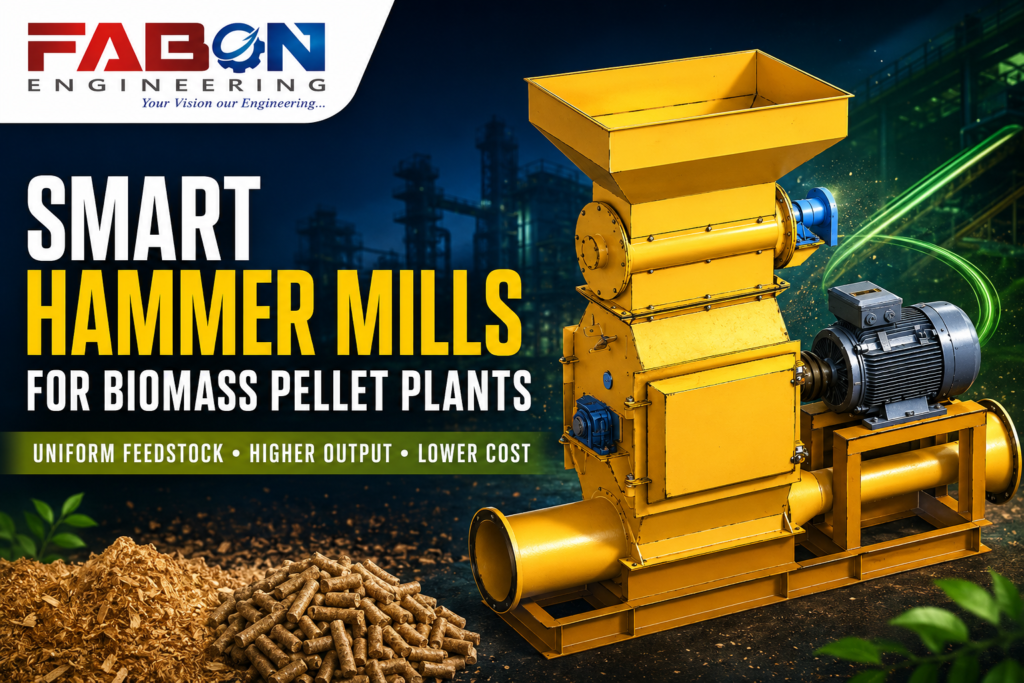
The global transition toward renewable energy has created strong demand for biomass pellets as a cleaner alternative to coal, furnace oil and other conventional fuels. Agricultural residues, forestry waste, sawdust, wood chips, bamboo, crop stalks and other organic materials that were once burned or discarded can now be converted into valuable solid fuel.
However, producing high-quality biomass pellets is not simply a matter of feeding waste material into a pellet machine. Raw biomass must pass through several carefully controlled processing stages. Among these stages, size reduction is one of the most important.
This is where the hammer mill becomes essential.
A hammer mill converts irregular biomass materials into small, relatively uniform particles suitable for drying, mixing, pelletizing and combustion. Its performance directly influences pellet-machine capacity, electricity consumption, die life, pellet density and the amount of fines in the finished product.
An incorrectly selected or poorly maintained hammer mill can become a bottleneck in an otherwise well-designed biomass pellet plant. A properly engineered system, on the other hand, creates a consistent feedstock that helps the entire production line run smoothly.
This article explains how hammer mills work, why particle size matters, how to select the correct machine and how modern hammer-mill technology can improve the productivity and profitability of a biomass pellet business.
Why Hammer Mills Are Trending in the Biomass Industry
Interest in biomass-processing equipment is increasing because industries are searching for practical ways to reduce fossil-fuel consumption and utilise locally available waste.
Biomass is renewable organic material derived from plants and animals. It can be burned directly or processed into more convenient fuels, including pellets and briquettes. The biomass as a renewable energy source that can be converted into useful energy through several processes.
India produces large volumes of agricultural and forestry residues. A considerable portion of this material can be processed into industrial fuel instead of being burned in open fields or left to decay.
Government programmes have also encouraged biomass utilisation. India’s has supported biomass briquette and pellet manufacturing, while the Ministry of Power’s promotes the use of biomass in thermal power plants.
A revised national policy introduced mandatory biomass co-firing requirements for specified thermal power plants, including a 5% obligation from the 2024–25 financial year, according to the. Such developments have increased interest in reliable biomass aggregation, processing and pellet-manufacturing infrastructure.
As the market grows, pellet manufacturers are discovering that the pellet machine alone does not determine plant performance. Upstream equipment—especially shredders, dryers and hammer mills—plays an equally important role.
Current trends influencing hammer-mill demand include:
- Growth in industrial biomass-pellet consumption
- Greater use of agricultural residue as fuel
- Demand for consistent pellet quality
- Development of automated pellet-production lines
- Focus on reducing specific power consumption
- Use of alternative feedstocks instead of sawdust alone
- Increased attention to dust control and plant safety
- Need for traceable production and preventive maintenance
- Integration of sensors, variable-frequency drives and control panels
- Expansion of decentralised biomass-processing businesses
The modern hammer mill is therefore evolving from a basic grinding machine into an integrated part of an intelligent biomass-processing system.
What Is a Hammer Mill?
A hammer mill is a high-speed size-reduction machine. It uses rotating hammers to strike biomass repeatedly until the material becomes small enough to pass through openings in a screen.
The machine normally includes a rotor fitted with swinging or fixed hammers, a grinding chamber, replaceable screens, a feed inlet, a discharge arrangement, bearings, a drive motor and a supporting frame.
When biomass enters the chamber, the rapidly rotating hammers accelerate and impact it. The material is also reduced through collision with the chamber liner, interaction with other particles and, to a lesser extent, shearing action.
Particles that remain larger than the screen openings continue circulating inside the chamber. Once they reach an acceptable size, they pass through the screen and leave the machine.
This simple operating principle makes the hammer mill suitable for processing many types of biomass. Nevertheless, successful grinding depends on matching the rotor, hammer arrangement, screen, motor and feeding system to the properties of the raw material.
A hammer mill designed for dry sawdust may not perform equally well with wet wood chips, long cotton stalks or abrasive rice husk. Feedstock preparation and machine selection must therefore be based on the actual application.
The Role of a Hammer Mill in a Biomass Pellet Plant
A hammer mill generally performs secondary size reduction. Large logs, branches, slabs or bulky agricultural residues usually require primary processing before entering it.
A typical biomass pellet-production line may include:
- Raw-material reception and storage
- Sorting and removal of contaminants
- Primary shredding or chipping
- Drying, where required
- Hammer-mill grinding
- Intermediate storage or conditioning
- Pelletizing
- Pellet cooling
- Screening
- Packing or bulk dispatch
The exact arrangement can vary.
For some feedstocks, material is chipped, dried and then ground. In other systems, coarse wet material is reduced before drying because smaller pieces improve heat transfer. Some production lines use two size-reduction stages, one before the dryer and a finer grinding stage after it.
The correct sequence depends on:
- Initial feedstock size
- Moisture content
- Bulk density
- Dryer design
- Final particle-size requirement
- Fire and dust-control strategy
- Plant capacity
- Available power
- Storage and conveying arrangement
The hammer mill’s main purpose is to create feedstock that the pellet mill can accept consistently. Uniform particles fill the pellet die more evenly, respond more predictably to heat and pressure, and create fewer sudden variations in motor load.
Why Particle Size Matters in Pellet Production
Particle size affects almost every stage of biomass-pellet manufacturing.
Raw biomass is naturally inconsistent. Sawdust may contain fine dust mixed with long splinters. Wood chips may vary in thickness and length. Agricultural residue may contain fibrous stalks, leaves, husks and pith.
If this mixed material enters a pellet machine without controlled grinding, the die holes may receive an uneven supply. Fine particles can compact quickly, while oversized fibres resist flow. The result may be irregular production, excessive motor load, die blockage or weak pellets.
A well-selected hammer mill helps bring the particles into a narrower size range.
Improved material flow
Uniform particles travel more consistently through conveyors, screw feeders, mixers and pellet-mill feeding systems. This reduces surging and uncontrolled fluctuations in the process.
Better die filling
The pellet die performs best when material enters at a controlled rate and has a reasonably consistent structure. Properly ground biomass fills the die openings more evenly.
Improved pellet strength
Particle bonding occurs under pressure, friction and heat. Natural lignin in woody biomass can soften and help bind particles. A controlled particle size creates adequate surface area for bonding while retaining enough structure to produce durable pellets.
Reduced blockages
Oversized particles and long fibres can bridge inside hoppers or interfere with die feeding. Grinding reduces this risk.
More stable pellet-mill load
Large variations in feed size can cause spikes in current. A stable feedstock helps the pellet mill operate closer to its intended capacity.
Better combustion
Uniform pellets generally support predictable handling, feeding and combustion. Final fuel performance also depends on moisture, ash, density, composition and contamination, but consistent grinding contributes to repeatable quality.
Can Biomass Be Ground Too Fine?
Yes. Finer grinding is not automatically better.
Very small particles require more grinding energy. They can increase dust generation, reduce throughput and accelerate component wear. Excessive fines may also create handling problems and increase the load on dust-collection equipment.
Fine material can behave differently inside the pellet mill. In some formulations, it may reduce internal friction or change pellet structure. In others, it can contribute to high die temperature or poor feeding.
For many pellet applications, particles in the approximate range of 3–5 millimetres are commonly considered, but this is not a universal specification. The correct size depends on the biomass, pellet diameter, die design and desired fuel properties.
For example:
- Fine sawdust may require little additional grinding.
- Coarse wood chips need substantial size reduction.
- Long straw fibres may require cutting as well as impact grinding.
- Rice husk behaves differently from softwood because of its structure and mineral content.
- Bamboo may require robust primary reduction before fine grinding.
- Mixed agricultural residue may need screening and blending before pelletizing.
The objective should be the optimum particle-size distribution—not the smallest possible particle.
How a Biomass Hammer Mill Works
Understanding the operating cycle helps plant owners identify where performance is gained or lost.
1. Controlled feeding
Prepared biomass enters through the feed inlet. A screw conveyor, rotary feeder or belt-feeding arrangement may be used to deliver material at a stable rate.
Controlled feeding is essential. If material enters too quickly, the chamber can become overloaded. If feeding is irregular, motor load and output fluctuate.
2. Rotor acceleration
The motor turns the rotor at high speed. The rotor carries multiple hammers arranged to provide balanced coverage across the grinding chamber.
3. Initial impact
As material enters, it is struck by the rotating hammers. Brittle particles fracture quickly, while fibrous material may require repeated impacts.
4. Recirculation
Oversized material remains inside the chamber. It collides with hammers, liners and other particles until it becomes smaller.
5. Screen classification
The screen acts as a sizing control. Particles small enough to pass through its openings leave the grinding chamber. Larger particles remain for additional reduction.
6. Material discharge
Ground biomass is discharged by gravity, mechanical conveying or a pneumatic extraction system. Efficient discharge prevents material from accumulating in the chamber.
7. Dust separation
Where pneumatic conveying is used, a cyclone and bag filter may separate ground biomass from the conveying air. Dust-management design is critical for housekeeping, product recovery and safety.
Major Components of a Hammer Mill
Rotor
The rotor is the central rotating assembly. It must be dynamically balanced and mechanically strong enough to withstand repeated impacts.
Rotor imbalance can cause vibration, bearing damage and structural fatigue. It may result from uneven hammer wear, incorrect hammer replacement, accumulated material or physical damage.
Hammers
Hammers are the primary impact tools. Depending on the design, they may be swinging or fixed. Their thickness, shape, material, number and arrangement influence grinding performance.
Hammer edges gradually wear. Many designs allow the hammers to be turned so that additional edges can be used before replacement.
Grinding chamber
The chamber contains the material during size reduction. Its geometry influences particle circulation and the frequency of impact.
Screens
Screens regulate the maximum particle size leaving the chamber. Hole diameter, open area, thickness and condition all affect capacity.
A screen with smaller holes normally creates finer material but can reduce throughput and increase electricity consumption. A worn or damaged screen may allow oversized particles to escape.
Liners or breaker plates
These surfaces provide additional impact zones and protect the machine body. Worn liners can reduce grinding efficiency.
Bearings
Bearings support the rotating shaft. Lubrication, alignment, contamination control and operating temperature are important for long service life.
Drive motor
The motor supplies the power required for grinding. Correct motor sizing is essential because underpowered equipment can overload frequently, while an oversized motor may increase investment cost without solving problems in feeding, discharge or screen area.
Feed-control system
A feeder regulates material flow. Modern plants may connect it to the hammer-mill motor current so that feed rate automatically decreases when load rises.
Base frame and vibration isolation
The frame supports the mill and drive. Proper foundations, alignment and vibration-control measures help protect mechanical components.
Discharge and aspiration system
A correctly designed extraction system pulls finished particles through the screen, transports the product and reduces recirculation. Poor aspiration can severely limit capacity.
Biomass Materials Suitable for Hammer-Mill Grinding
Hammer mills can process a wide range of prepared biomass, including:
- Wood chips
- Sawmill residue
- Sawdust
- Wood shavings
- Forestry waste
- Bamboo residue
- Groundnut shells
- Mustard stalk
- Cotton stalk
- Corn cobs
- Maize residue
- Sugarcane trash
- Bagasse after suitable preparation
- Rice straw
- Wheat straw
- Soybean residue
- Sunflower stalk
- Coconut residue
- Palm biomass
- Furniture-manufacturing waste
- Plywood residue that is confirmed safe and suitable
- Clean packaging wood
- Selected energy crops
Not every biomass material should be processed without evaluation. Painted, chemically treated, laminated or contaminated wood can create unacceptable emissions or ash. Metal, stones, glass, wire and other foreign objects must be removed.
A responsible pellet manufacturer should understand the source and composition of every feedstock.
Feedstock Characteristics That Affect Grinding
Moisture content
Moisture has a major effect on hammer-mill performance.
Dry, brittle biomass usually breaks more easily. Wet fibrous material tends to bend, smear or accumulate around screens. High moisture can therefore reduce output and increase the risk of choking.
Pellet production commonly requires controlled moisture, often approximately 8–15% at the appropriate processing stage. The optimum value varies with feedstock and equipment.
Moisture should be measured, not estimated by appearance.
Initial particle size
A hammer mill should not be expected to accept material larger than its feed opening or design specification. Oversized wood pieces can damage the feeding system, overload the motor or create blockages.
Fibre structure
Long, flexible fibres can resist impact and may wrap around rotating components. Straw and stalks often need a chopper or shredder before fine grinding.
Hardness
Hardwood typically requires more energy to grind than softer, less dense material. Feedstock mixtures can therefore cause changes in throughput.
Abrasiveness
Rice husk, bark, soil-contaminated residue and certain agricultural materials may accelerate wear. Abrasion-resistant components may be necessary.
Bulk density
Low-density material occupies more volume. Although its mass flow may be modest, the feeding and aspiration systems must handle a high volumetric flow.
Contamination
Sand and stones wear screens and hammers. Metal can damage equipment and create sparks. Magnets, stone traps and screening systems are valuable protective measures.
Relationship Between Moisture, Grinding and Drying
Drying and grinding must be designed as a connected process.
Smaller particles have greater surface area relative to their mass, which can improve drying. However, grinding wet material into fine particles may be difficult, and small dry particles can create more dust.
Three general arrangements are common.
Grinding before drying
Coarse material is reduced before it enters the dryer. This can improve drying uniformity when the raw material is too large for efficient heat transfer. The grinding equipment must be capable of handling the higher moisture.
Grinding after drying
Material is first dried to a grindable condition and then processed through the hammer mill. This arrangement can improve mill capacity, but the dry grinding stage needs effective dust control.
Two-stage size reduction
Large material is first chipped or shredded. It is then dried and passed through a hammer mill for final sizing. This is often a practical configuration for wood-based pellet plants.
The correct solution should be determined through raw-material trials and engineering calculations.
Hammer Mill Capacity: Why Nameplate Output Is Not Enough
A capacity figure such as 1,000 or 2,000 kilograms per hour provides only a reference. Actual output depends on the test material and operating conditions.
Two customers using the same machine can receive different production rates because their feedstock, moisture, screen size and feeding methods differ.
Factors affecting real-world capacity include:
- Feedstock type
- Initial particle size
- Target particle size
- Moisture content
- Screen-hole diameter
- Screen open area
- Rotor speed
- Hammer condition
- Motor power
- Feed consistency
- Aspiration rate
- Discharge efficiency
- Foreign-material content
- Operator practices
- Ambient conditions
- Maintenance condition
When comparing machines, buyers should ask what material was used to establish the rated capacity and what screen size, moisture level and feed size were involved.
A meaningful capacity statement should define the operating conditions.
Motor Power and Energy Consumption
Grinding is one of the major power-consuming operations in a biomass pellet plant. Motor selection must therefore consider both production capacity and energy efficiency.
As an example, FABON Engineering offers hammer-mill configurations such as:
- Approximately 52 HP for output around 1,000 kg per hour
- Approximately 75 HP for output around 2,000 kg per hour
These figures should be treated as application-dependent references. Actual performance depends on feedstock characteristics and the required particle size.
Plant owners should track specific energy consumption:
Specific energy consumption = Electricity used by the hammer mill ÷ Tonnes of acceptable ground biomass produced
Measuring kilowatt-hours per tonne is more informative than considering motor rating alone.
A high-capacity machine operating efficiently may use less energy per tonne than a smaller machine working continuously under overload.
How to Reduce Hammer-Mill Power Consumption
Avoid unnecessary over-grinding
Do not install a screen finer than the pellet process requires. Every additional reduction in particle size consumes energy.
Maintain sharp hammer edges
Rounded, worn hammers create less effective impact and increase recirculation.
Keep screens clean and undamaged
Blocked screen openings reduce discharge area and increase the time material remains in the chamber.
Stabilise moisture
Wet patches can suddenly reduce capacity. A consistent dryer discharge helps maintain grinding efficiency.
Control the feed rate
An automatic feeder can keep the machine near its efficient operating load without repeated overloading.
Improve aspiration
Efficient air movement helps finished particles leave the chamber quickly.
Remove fines before grinding when appropriate
If a substantial portion of the feedstock is already fine enough, pre-screening can prevent unnecessary regrinding.
Reduce oversized incoming material
A chipper or shredder should create material within the hammer mill’s feed specification.
Monitor motor current
Current trends can reveal overfeeding, screen blockage, worn components and changes in raw material.
Matching Hammer-Mill Capacity to Pellet-Mill Capacity
The hammer mill should support the required pellet production rate without becoming a bottleneck.
If a pellet plant is expected to produce one tonne per hour, selecting a grinding system rated at exactly one tonne per hour leaves little margin for raw-material variation, maintenance or lower-than-expected field performance.
However, installing an unnecessarily large hammer mill can increase capital cost and create inefficient operation at very low loads.
Engineers should evaluate:
- Required finished-pellet output
- Pellet-mill utilisation target
- Losses during cooling and screening
- Recycled fines
- Raw-material moisture loss
- Bulk-density changes
- Expected mill downtime
- Product changeovers
- Future expansion
- Feedstock seasonality
Buffer storage between the hammer mill and pellet mill can decouple the two operations. The grinding section can temporarily stop for screen replacement without immediately stopping pellet production, provided adequate ground material is available.
Selecting the Correct Screen
The screen is one of the most influential and frequently changed hammer-mill components.
Screen-hole diameter
Smaller holes generally produce finer particles. They also tend to reduce capacity and increase energy consumption.
Open area
Two screens with the same hole diameter may perform differently if their percentage of open area differs. Greater open area provides more opportunity for finished material to leave the chamber.
Screen thickness
A thick screen can offer durability but may alter flow through the openings.
Hole shape and pattern
Round holes are common, but other designs may be used for particular materials and particle characteristics.
Screen condition
Cracks, excessive wear or enlarged holes can create inconsistent output. Screens should be inspected regularly and replaced before failure.
Plant operators should maintain records showing which screen was used for each feedstock and the resulting capacity, power consumption and pellet quality.
Hammer Design and Maintenance
Hammer condition should be monitored as part of a preventive-maintenance programme.
Wear usually develops at the working edges. As the edges become rounded, the mill may consume more power per tonne and generate a broader particle-size distribution.
Where the design permits, hammers can be reversed or repositioned so that unworn edges are brought into service. This must be done according to the manufacturer’s pattern to maintain rotor balance.
When replacing hammers:
- Use components of the correct material and weight.
- Replace them in balanced sets.
- Follow the specified arrangement.
- Inspect pins, spacers and locking parts.
- Check rotor movement before closing the chamber.
- Confirm that no tools remain inside.
- Run the machine without load and observe vibration.
- Recheck fasteners after the recommended operating period.
Mixing hammers with significantly different weights can create imbalance and dangerous vibration.
Automation and the Smart Hammer Mill
A smart hammer-mill system does not necessarily require complicated technology. Even basic sensors and interlocks can improve reliability.
Useful automation features include:
Motor-current-based feeding
The feeder speed is adjusted according to hammer-mill motor load. When current rises, the controller reduces feed. When load falls, it increases feed within safe limits.
Variable-frequency drives
A variable-frequency drive can provide controlled starting and feeder-speed adjustment. Rotor-speed changes should only be made within limits approved by the manufacturer.
Bearing-temperature sensors
Abnormal bearing temperature may indicate poor lubrication, contamination, misalignment or impending failure.
Vibration monitoring
A rising vibration trend can reveal hammer imbalance, bearing deterioration, looseness or material accumulation.
Screen and access-door interlocks
The machine should not operate while maintenance doors are open.
Level sensors
Sensors in upstream and downstream bins can prevent starvation, overflow and conveyor blockage.
Spark or fire detection
High-risk installations may use spark detection and suppression systems in pneumatic ducts.
Production monitoring
Digital records of runtime, energy consumption, feedstock and output help managers calculate cost per tonne and schedule maintenance.
Automation should support trained operators; it should not replace sound mechanical design or safe operating procedures.
Dust Control and Fire Safety
Dry biomass dust can create serious fire and explosion hazards. Safety must therefore be considered during machine selection, plant layout and daily operation.
Important measures include:
- Effective dust extraction
- Enclosed conveyors where practical
- Regular housekeeping
- Prevention of dust accumulation on motors and structures
- Earthing and bonding of relevant equipment
- Suitable electrical equipment
- Metal separation before grinding
- Bearing-temperature monitoring
- Spark detection where required
- Explosion isolation or venting based on professional risk assessment
- Safe access for cleaning
- Fire detection and firefighting provisions
- Operator training
- Emergency-stop systems
- Lockout and tagout procedures
- Documented inspection routines
Plant owners should obtain a site-specific fire and dust-hazard assessment from qualified professionals. Requirements can vary according to materials, layout, production scale and applicable regulations.
Water should not be applied indiscriminately to electrical equipment or dust fires. Emergency procedures should be developed with competent fire-safety specialists.
Importance of Metal Separation
A small metal object can damage hammers, screens and rotor components. It may also create an ignition source.
Magnets can capture ferrous material before it enters the hammer mill. Depending on feedstock risk, plants may also use metal detectors or other separation systems.
Magnets must be inspected and cleaned. A magnet that is completely covered with collected metal cannot protect the system effectively.
Raw-material suppliers should also be instructed not to mix wire, nails, tools or fabricated metal pieces with biomass.
Common Hammer-Mill Problems and Solutions
Low output
Possible causes include:
- Wet feedstock
- Worn hammers
- Blocked screen
- Screen holes that are too small
- Poor aspiration
- Irregular feeding
- Insufficient motor power
- Oversized incoming material
- Restricted discharge
The operator should evaluate the complete system instead of immediately increasing feed rate.
High power consumption
Possible causes include:
- Overfeeding
- Excessive recirculation
- Very fine screen
- Wet or hard material
- Worn hammers
- Blocked discharge
- Bearing problems
- Incorrect rotor speed
Power consumption should be compared on a per-tonne basis.
Excessive vibration
Possible causes include:
- Uneven hammer wear
- Incorrect hammer arrangement
- Material build-up
- Damaged rotor
- Bearing wear
- Loose foundation
- Coupling misalignment
- Foreign-object impact
A machine with abnormal vibration should not be allowed to continue running until the cause is identified.
Inconsistent particle size
Possible causes include:
- Damaged screen
- Uneven feeding
- Mixed moisture
- Worn hammers
- Incorrect screen installation
- Variation in incoming material
Sampling and sieve analysis can help quantify the problem.
Repeated screen failure
Possible causes include:
- Metal or stones in feedstock
- Incorrect screen fitting
- Excessive vibration
- Improper screen material
- Contact with rotating components
- Operation beyond design limits
Bearing overheating
Possible causes include:
- Incorrect lubrication
- Excess grease
- Insufficient grease
- Contamination
- Misalignment
- Excessive belt tension
- Bearing damage
Material choking
Possible causes include:
- High moisture
- Excessive feed rate
- Poor extraction
- Screen blockage
- Downstream conveyor failure
- Long fibrous material
- Low rotor speed
Interlocks should stop feeding when the discharge system fails.
Preventive Maintenance Schedule
A maintenance plan should be based on operating hours, feedstock abrasiveness and manufacturer recommendations.
Before every shift
- Inspect the surrounding area.
- Check for loose parts and visible damage.
- Confirm safety guards are installed.
- Check the feeder and discharge path.
- Inspect magnets.
- Listen for abnormal noise during start-up.
- Record no-load motor current where applicable.
During operation
- Observe motor current.
- Monitor bearing temperature.
- Check vibration and noise.
- Observe product consistency.
- Confirm dust extraction is operating.
- Watch for leakage around doors and joints.
After the shift
- Clean accumulated biomass dust safely.
- Inspect accessible wear areas after isolation.
- Record operating hours and abnormalities.
- Check for hot spots or unusual odours.
Weekly or at planned intervals
- Inspect hammer wear.
- Inspect screens.
- Check fasteners.
- Examine belts and couplings.
- Inspect bearing seals.
- Verify sensors and emergency stops.
- Examine ducts and cyclones for accumulation.
During planned shutdowns
- Check rotor balance and condition.
- Replace worn components in balanced sets.
- Inspect liners and pins.
- Check shaft alignment.
- Examine foundation and structural welds.
- Service bearings as recommended.
- Verify electrical connections.
- Calibrate monitoring instruments where required.
Maintenance records help identify repeat failures and calculate the true service life of wear components.
Measuring Ground Biomass Quality
Visual inspection is useful but insufficient for process control.
A representative sample can be tested through sieve analysis. The sample is passed through a series of sieves, and the amount retained on each sieve is measured.
This reveals:
- Percentage of oversized particles
- Desired-size fraction
- Fine-particle percentage
- Changes caused by hammer wear
- Differences between feedstocks
- Effect of screen replacement
- Grinding consistency over time
Moisture, bulk density and contamination should also be measured.
These results can be compared with pellet-mill output, pellet durability, fines generation and electricity consumption. Over time, the manufacturer can establish an optimum grinding specification for each raw-material blend.
Effect of Grinding on Pellet Quality
Pellet density
Properly sized particles can pack efficiently inside the die, supporting consistent pellet density.
Durability
A suitable mixture of particle sizes may support mechanical interlocking and bonding. Excessively coarse material can weaken pellets, while extreme over-grinding may increase cost without delivering additional strength.
Surface finish
Uniform feed preparation contributes to smoother, more consistent pellets, although die condition, moisture and temperature also matter.
Pellet length
Length is mainly controlled by the pellet mill and cutter, but unstable feeding caused by poor grinding can indirectly affect output consistency.
Fines
Weak pellets may break during cooling, screening, storage and transport. Correct grinding is one factor in reducing fines.
Die life
Oversized particles, contaminants and inconsistent feed can create uneven stress. Controlled material preparation helps protect the die, though die life also depends on composition, operating conditions and maintenance.
Selecting a Hammer Mill for a Biomass Pellet Project
A buyer should evaluate the entire application before comparing quotations.
Define the raw material
Identify the exact biomass and whether it changes seasonally. A plant using clean sawdust has different needs from one processing mixed crop residue.
Measure incoming size
Record typical and maximum dimensions. Do not base the design on an average alone.
Determine moisture range
Include rainy-season conditions and storage-related variation.
Define the required output size
Ask the pellet-machine supplier what particle-size distribution is recommended for the die and feedstock.
Set realistic capacity
Capacity should include operating margin without creating excessive oversizing.
Check motor and electrical requirements
Confirm voltage, frequency, starting method, connected load and local power availability.
Examine wear components
Ask about hammer, screen and liner materials, replacement procedures, cost and availability.
Review the feeding arrangement
Stable feeding is essential. A good hammer mill with an unsuitable feeder will not deliver consistent performance.
Evaluate aspiration
Confirm air volume, duct size, cyclone, filter and discharge arrangements.
Consider maintenance access
Screens and hammers should be replaceable safely without unnecessary dismantling.
Verify safety features
Review guards, door interlocks, emergency stops, overload protection and dust-control provisions.
Request application-based performance information
Performance should be discussed using a defined feedstock, moisture level, feed size and screen size.
Consider after-sales support
Installation guidance, commissioning, operator training and spare-parts support can be more valuable than a small difference in initial price.
Integrating a Hammer Mill with a Wood Shredder
A wood shredder and hammer mill perform different but complementary jobs.
The shredder handles bulky material such as branches, slabs, wood offcuts and larger residues. It converts them into manageable pieces. The hammer mill then performs finer size reduction.
Sending large wood directly into a fine-grinding hammer mill can reduce capacity and increase wear. Conversely, using only a coarse shredder may not produce particles suitable for pelletizing.
A well-designed line can therefore include:
Wood waste → Shredder or chipper → Dryer → Hammer mill → Pellet mill → Cooler → Screener → Packing
The order may change according to moisture and dryer type, but the principle remains: each machine should perform the size-reduction duty for which it was designed.
Plant Layout Considerations
Equipment arrangement can significantly affect efficiency and safety.
A practical layout should provide:
- Short, direct material flow
- Adequate access for screen and hammer replacement
- Space for lifting and maintenance
- Isolation between dusty and clean areas
- Suitable raw-material and finished-product storage
- Proper ventilation
- Safe electrical-panel location
- Emergency access
- Fire separation where required
- Minimal unnecessary conveying
- Expansion space
- Drainage and weather protection
- Access for trucks and loaders
The hammer mill should not be installed where maintenance doors are blocked by walls, ducts or conveyors.
Economic Benefits of Correct Grinding
The hammer mill creates value indirectly by improving the performance of downstream equipment.
Potential economic benefits include:
- Higher usable pellet output
- Fewer pellet-mill stoppages
- Reduced die blockage
- Lower fines and reprocessing
- Better product consistency
- Reduced labour intervention
- Lower energy consumption per tonne
- Longer life of pellet-mill components
- Improved ability to process lower-cost biomass
- Better production planning
The lowest-priced hammer mill is not necessarily the least expensive over its operating life.
A lifecycle-cost assessment should include:
- Purchase price
- Installation
- Motor and control system
- Conveyors and aspiration
- Electricity
- Hammer and screen replacement
- Labour
- Downtime
- Bearing and belt maintenance
- Product losses
- Expected resale or residual value
If an inexpensive machine causes repeated shutdowns, poor particle size and high electricity consumption, the lost production can exceed the original saving.
Calculating the Cost of Grinding
A simplified grinding-cost calculation can include:
Electricity cost per tonne
= Hammer-mill kWh per tonne × Electricity tariff
Wear cost per tonne
= Cost of hammers, screens and liners ÷ Tonnes processed before replacement
Labour cost per tonne
= Grinding-section labour cost ÷ Tonnes produced
Maintenance cost per tonne
= Maintenance expenditure ÷ Tonnes processed
Total direct grinding cost
= Electricity + wear parts + labour + maintenance
Downtime and production losses should also be considered.
This calculation helps managers compare screens, hammer materials, feedstock blends and operating practices objectively.
Business Opportunities in Biomass Pellet Manufacturing
A reliable grinding system can support several business models.
Industrial fuel pellets
Pellets can be supplied to boilers, furnaces and other compatible thermal-energy users.
Thermal-power-plant supply
Biomass co-firing policies have created demand opportunities, subject to purchaser specifications, contracts and applicable regulations.
Contract grinding
An entrepreneur can provide size-reduction services to pellet manufacturers or biomass aggregators that do not own suitable equipment.
Raw-material preparation
Ground biomass can be supplied as a prepared feedstock to pellet or briquette plants.
Captive fuel production
Factories producing wood or agricultural residue can convert their own waste into fuel for suitable boilers.
Decentralised rural processing
Small processing hubs can aggregate local residue, reduce transport volume and create rural employment.
Business success still depends on dependable raw-material contracts, moisture control, transport economics, product quality and confirmed customers. Machinery should be purchased as part of a complete business plan.
Common Mistakes to Avoid
Buying only on rated capacity
Capacity without defined test conditions can be misleading.
Ignoring moisture variation
A machine selected using dry-season material may struggle during the monsoon.
Installing an excessively fine screen
Over-grinding increases energy use and reduces throughput.
Skipping primary size reduction
Large or long material should be chipped, cut or shredded first.
Under-designing dust collection
Dust control affects capacity, housekeeping, product recovery and safety.
Failing to install metal separation
Foreign metal can cause expensive damage.
Operating with worn hammers
Gradual performance loss may go unnoticed unless energy and output are recorded.
Replacing hammers without balancing
Incorrect replacement can create severe vibration.
Providing no buffer storage
Directly coupling every machine can cause the whole plant to stop after a minor interruption.
Ignoring spare-parts planning
Essential screens, hammers, bearings and belts should be available before a failure occurs.
Mixing unsuitable waste
Chemically treated or contaminated materials should not enter the fuel stream without appropriate evaluation.
Sustainability Advantages
When responsibly sourced and processed, biomass pellets can create useful energy from residues that might otherwise be dumped or openly burned.
Potential benefits include:
- Productive use of agricultural residue
- Reduced dependence on certain fossil fuels
- Improved handling compared with loose biomass
- Greater bulk density
- More consistent fuel feeding
- Rural income opportunities
- Development of local supply chains
- Reduced volume of unmanaged organic waste
Sustainability depends on responsible sourcing. Biomass should not be presented as automatically carbon-neutral in every situation. Land use, harvesting, transport distance, processing energy, combustion efficiency and alternative uses of the residue must be considered.
The strongest projects generally use genuine waste or residue, minimise transportation, operate efficient equipment and comply with emissions and environmental requirements.
India’s Current Biomass-Pellet Market Context
India’s biomass sector has gained attention through industrial decarbonisation, residue-management initiatives and thermal-power co-firing.
The policy environment can create opportunities, but project developers should verify current eligibility, deadlines and purchaser specifications directly through official sources.
For example, the applications under the referenced programme period closed after 31 December 2025 and that new submissions were stopped until further notice. Businesses should therefore avoid relying on outdated subsidy advertisements and should check the latest official announcement before making investment assumptions.
A commercially viable project should remain sensible even if an incentive is delayed, changed or unavailable.
FABON Engineering Hammer-Mill Solutions
FABON Engineering Pvt. Ltd. supplies machinery for biomass preparation and pellet production. Its equipment range includes hammer mills, wood shredders, sawdust-making machines, dryers, pellet mills and supporting plant systems.
Illustrative hammer-mill options include:
- A 52 HP model with output around 1,000 kg per hour
- A 75 HP model with output around 2,000 kg per hour
Actual output depends on raw material, moisture, feed size, target particle size, screen selection and operating conditions. Application evaluation is therefore recommended before final machine selection.
FABON Engineering can help customers plan an integrated production line rather than treating the hammer mill as an isolated machine. This makes it possible to match shredding, drying, grinding and pelletizing capacities more effectively.
Questions to Ask Before Requesting a Quotation
A customer can speed up equipment selection by providing:
- Type of biomass
- Photographs or samples of the material
- Maximum incoming size
- Average and maximum moisture
- Required output particle size
- Required hourly capacity
- Daily operating hours
- Available electrical supply
- Existing upstream equipment
- Existing downstream pellet-machine capacity
- Site location
- Dust-collection preference
- Automation requirement
- Seasonal changes in material
- Future expansion plans
This information allows the manufacturer to recommend a more appropriate configuration.
Frequently Asked Questions
Is a hammer mill compulsory for every biomass pellet plant?
Not always. If the feedstock is already clean, dry and within the required particle-size range, extensive grinding may not be necessary. Most plants processing variable or coarse biomass, however, benefit from controlled size reduction.
Can wood chips go directly into a hammer mill?
Only if their size and moisture are within the machine’s specifications. Large chips generally require a chipper or shredder first.
What particle size is required for biomass pellets?
Many applications use material around 3–5 mm, but the correct distribution depends on feedstock, die design and pellet diameter. The pellet-machine manufacturer’s recommendation and production trials should guide the final setting.
Which is better: a smaller or larger screen?
Neither is universally better. A smaller screen provides finer grinding but usually consumes more energy and reduces output. The correct screen is the largest opening that still delivers acceptable pellet quality.
Can a hammer mill grind wet biomass?
Some machines can process moderately moist material, but high moisture normally reduces efficiency and can cause choking. The acceptable range depends on material and mill design.
How often should hammers be replaced?
Replacement frequency depends on operating hours, feedstock abrasiveness, contamination and hammer material. Condition and performance trends should determine replacement.
Why is my hammer mill consuming more electricity?
Possible causes include worn hammers, blocked screens, wetter material, finer screens, poor aspiration, overfeeding, bearing problems or harder feedstock.
Can one hammer mill process both wood and agricultural residue?
Possibly, but screen, hammer configuration, feeding and capacity may need adjustment. Mixed-feedstock trials are advisable.
Does higher motor power always mean higher capacity?
No. Capacity also depends on rotor design, screen area, airflow, feedstock and discharge efficiency.
Is a cyclone enough for dust control?
A cyclone can separate a large portion of conveyed material, but fine dust may require additional filtration. The complete system should be designed according to process and safety requirements.
What should be installed before the hammer mill?
Depending on the feedstock, equipment may include a shredder, chipper, cutter, screen, magnetic separator, stone trap, dryer and controlled feeder.
What should be installed after the hammer mill?
Ground material may pass through a cyclone, filter, conveyor, buffer bin, mixer or conditioner before entering the pellet mill.
Can hammer-mill fines be used?
Fine particles can usually be blended back into pellet feed if they are clean and suitable. Excessive fines may signal over-grinding or poor screening.
How can pellet quality be improved without replacing the pellet mill?
Check raw-material moisture, particle size, hammer-mill condition, feeding consistency, contaminants, die condition, formulation and cooling. Many pellet-quality problems originate upstream.
What safety system is most important?
There is no single device that replaces a complete safety plan. Metal separation, dust control, housekeeping, temperature monitoring, guarding, interlocks and emergency procedures work together.
The Future of Hammer Mills in Biomass Processing
The future hammer mill will be increasingly connected to the rest of the pellet plant.
Instead of operating at a fixed feed rate regardless of conditions, the machine will respond to motor current, vibration, temperature, moisture and downstream demand.
Plant-management systems will compare energy consumption with tonnes produced. Maintenance teams will receive alerts when vibration or temperature begins to rise. Feeders will automatically compensate for changes in bulk density. Production records will help managers identify the most profitable feedstock blend.
Other likely developments include:
- More wear-resistant components
- Faster screen-changing systems
- Improved rotor balancing
- Better sound reduction
- More efficient aspiration
- Integrated metal detection
- Automated moisture measurement
- Predictive maintenance
- Remote production monitoring
- Modular plant designs
- Better handling of mixed agricultural residue
However, advanced controls cannot correct fundamentally unsuitable feedstock or poor mechanical design. The foundation will remain correct machine selection, consistent raw-material preparation and disciplined maintenance.
Conclusion
The hammer mill is one of the most important machines in a biomass pellet-production line. It converts irregular biomass into a controlled feedstock that can be dried, conveyed and pelletized more efficiently.
Its influence extends well beyond grinding. Particle-size consistency affects pellet-mill capacity, motor load, pellet durability, die life, fines generation, energy consumption and production cost.
Successful hammer-mill operation depends on more than motor power. Feedstock moisture, incoming size, fibre structure, screen selection, hammer condition, aspiration, feeding and contamination control must all be considered.
For a new biomass project, the best approach is to evaluate the complete production line. The wood shredder, dryer, hammer mill, pellet machine, cooler, screener and packing system should be selected as a coordinated process.
For an existing plant, regular measurement can reveal valuable improvement opportunities. Operators should track particle-size distribution, moisture, tonnes per hour, electricity per tonne, wear-part life and pellet quality.
A smart hammer mill is therefore not simply a grinding machine. It is a productivity tool that can turn difficult biomass residue into consistent pellet feed, helping manufacturers produce cleaner fuel with greater reliability and profitability.
Contact FABON Engineering
For hammer mills, wood shredders, sawdust-making machines, biomass dryers, pellet machines and complete biomass-processing solutions, contact:
FABON Engineering Pvt. Ltd.
Sr. No. 153, Ambad-Gavalana Road
Behind D Mart, NH03, Pathardi
Nashik, Maharashtra – 422010, India
Mobile: +91 93709 99191
Website: https://fabon.in/