

2 TPH Rice Husk & Paddy Straw Pellet Plant – Complete Guide.
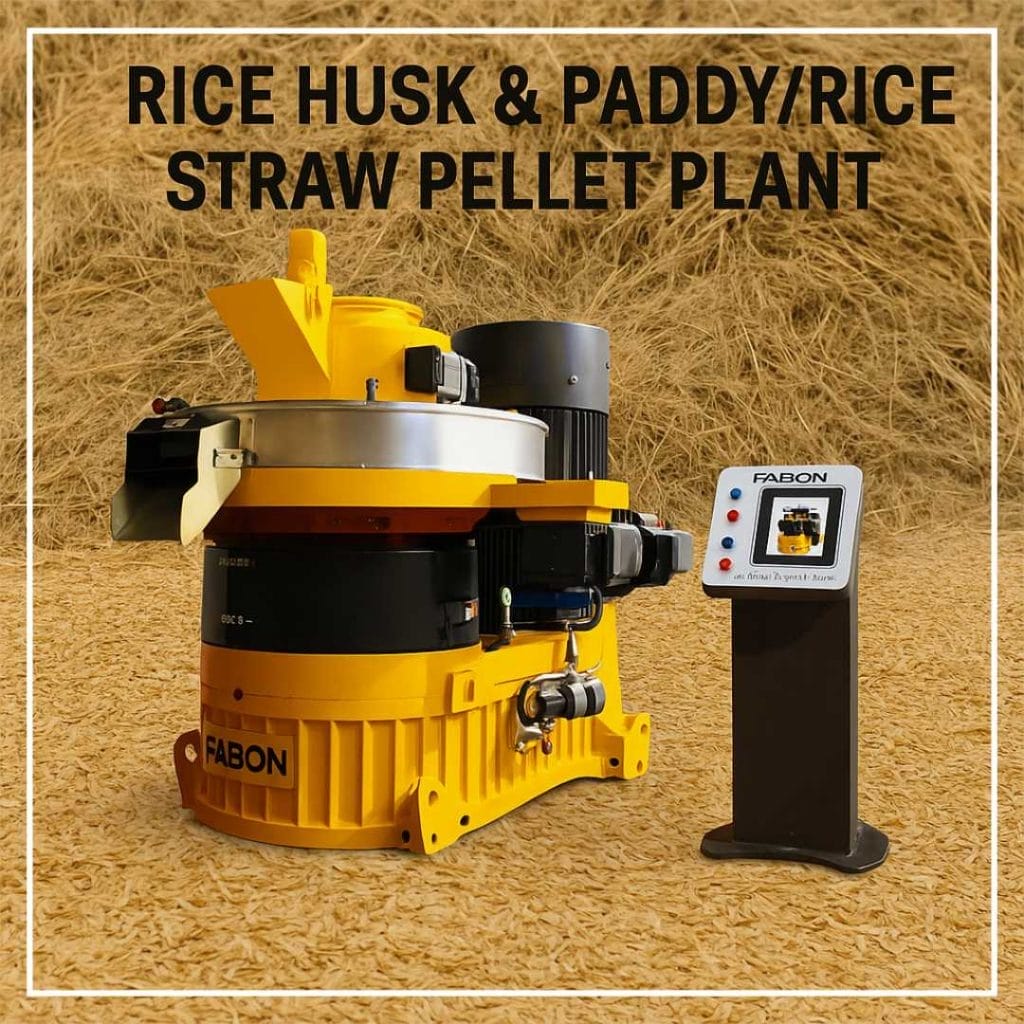
2 TPH Rice Husk & Paddy Straw Pellet Plant – Complete Guide (2025)
Introduction
India produces over 120 million tonnes of rice annually, which generates a huge amount of rice husk and paddy straw residue. Traditionally, this by-product has been underutilized or burned in fields, causing severe air pollution. Today, biomass pellet plants provide a sustainable and profitable solution.
In this blog, we explain how to set up a 2 TPH Rice Husk & Paddy Straw Pellet Plant in India, covering plant layout, quotation, machinery, subsidies, process flow, production capacity, sales opportunities, applications, and pellet quality parameters.
Shed Size Requirement for 2 TPH Plant
For a 2 Ton per Hour (TPH) Pellet Plant, a well-designed shed is essential for smooth operations:
- Shed Area: 15,000 – 18,000 sq. ft.
- Height: 28 – 32 feet (suitable for cyclones, conveyors, dryers)
- Division:
- Raw material storage (paddy straw, husk) – 6,000 sq. ft.
- Processing & machinery – 7,000 sq. ft.
- Finished pellets storage – 3,000–5,000 sq. ft.
Quotation (Indicative Cost in Indian Rupees)
| Sr. No | Machinery / Section | Qty | Approx. Cost (INR Lakhs) |
|---|---|---|---|
| 1 | Rice Straw Shredder / Cutter (50 HP) | 1 | 18.00 |
| 2 | Hammer Mill (75 HP) | 1 | 20.00 |
| 3 | Flash Dryer / Rotary Dryer (as per moisture) | 1 | 35.00 – 45.00 |
| 4 | Screw Conveyors, Belt Conveyors, Cyclones | — | 15.00 |
| 5 | Rice Husk & Straw Pellet Machine 2TPH (125HP) | 2 | 60.00 – 70.00 |
| 6 | Pellet Cooler + Vibrating Screener | 1 | 18.00 |
| 7 | Storage Silos, Packing Machine | 1 | 12.00 |
| 8 | Control Panel, Electricals, Installation | — | 20.00 |
| — | Total Project Cost (Approx.) | — | 2.2 – 2.5 Cr. INR |
👉 Note: Cost may vary based on raw material handling system, automation level, and dryer type.
Machinery Requirement
- Chopper / Shredder – to cut paddy straw into 20–30 mm.
- Hammer Mill – to grind husk/straw into 3–5 mm powder.
- Dryer (Flash/Rotary) – to reduce moisture to 10–12%.
- Pellet Mill (Ring Die Type) – 2 machines of 1TPH each.
- Conveyors & Cyclones – for dust-free transfer.
- Pellet Cooler & Screener – to maintain pellet hardness.
- Packing Machine – 15–50 kg bags or jumbo bag system.
- Control Panel with PLC – for automation & monitoring.
Process Flow
- Raw Material Feeding (Rice husk/straw from storage)
- Cutting & Grinding (via shredder & hammer mill)
- Drying (to reduce moisture content)
- Pelletizing (pressing through pellet mill die at high temp/pressure)
- Cooling & Screening
- Bagging & Storage
Output & Required Moisture
- Plant Capacity: 2 TPH → ~1,400–1,500 tons/month (20 hrs/day, 26 days/month).
- Input Moisture: 15–20% for husk, 25–35% for straw.
- Required Pelletizing Moisture: 10–12%.
- Output: 8 mm / 10 mm biomass pellets with bulk density of 600–700 kg/m³.
Subsidies & Government Support (India – 2025)
- MNRE (Ministry of New & Renewable Energy):
- 30–40% Capital Subsidy for Biomass Projects.
- State NRE Departments:
- Additional 15–25% subsidy depending on state.
- PM-KUSUM Yojana & SATAT Scheme:
- Support for biomass pellet use in power plants & CBG units.
- Bank Financing (MSME/CGTMSE):
- Up to 70% loan, collateral-free for SMEs.
👉 Effectively, your 2.5 Cr project cost may reduce to 1.5–1.7 Cr after subsidies.
Sales After Production
A 2 TPH plant produces ~1,500 tons/month, which can be sold as:
- Power Plants (NTPC, State Gencos): High demand under biomass co-firing policy.
- Industrial Boilers & Furnaces: Replacement for coal, oil, diesel.
- Agro-industries: Rice mills, dal mills, textile units.
- Export Market: EU & Middle East buyers prefer rice husk pellets.
- Local Retail: Small packs for cooking stoves, bakery, poultry farms.
Application of Rice Husk & Paddy Straw Pellets
- Thermal Power Plants (Coal substitution up to 20%)
- Steam Boilers in Textile, Food, Pharma, Paper Industries
- Commercial Heating (Hotels, Canteens, Fryers, Bakeries)
- Metal Industries (Aluminium melting furnace, foundries)
- Gasification for CBG / Bio-CNG Plants
Pellet Quality – GCV & Ash Content
- Gross Calorific Value (GCV):
- Rice Husk Pellets → 3,200 – 3,600 kcal/kg
- Paddy Straw Pellets → 3,200 – 3,500 kcal/kg
- Ash Content:
- Rice Husk → 15–18%
- Paddy Straw → 8–12%
Conclusion
A 2 TPH Rice Husk & Paddy Straw Pellet Plant is a profitable venture in 2025, supported by government subsidies, strong industrial demand, and renewable energy policies. With rising coal prices and stricter pollution norms, biomass pellets are becoming the future of green fuel.
Investing in this sector not only ensures high ROI (2–3 years) but also contributes to sustainable rural employment and environmental protection.
IM interested to setup biomass pillet plant. Will you undertake construction and documentation procedure from first to St stage of opening.
Kindly Contact +91 9370999191 / 9226339191 / 9226719191/ 9545359191…..Also Contact on : [email protected]