

“WHAT IS A PRESS BREAK MACHINE AND HOW DOES IT WORK?”
Introduction
In the world of precision sheet-metal fabrication, one machine stands as a cornerstone of modern manufacturing — the Press Brake Machine. From stainless-steel enclosures to industrial cabinets and biomass machinery panels, press brakes shape the metal backbone of every engineering structure.
At FABON Engineering Pvt. Ltd., we combine innovation, precision, and reliability to manufacture high-performance Press Brake Machines designed for heavy-duty bending, forming, and folding of sheet metals. Whether you are in biomass equipment fabrication, pharma machinery, or general engineering, a press brake ensures accuracy, consistency, and repeatability in every bend.
🧩 1. Understanding the Press Brake Machine
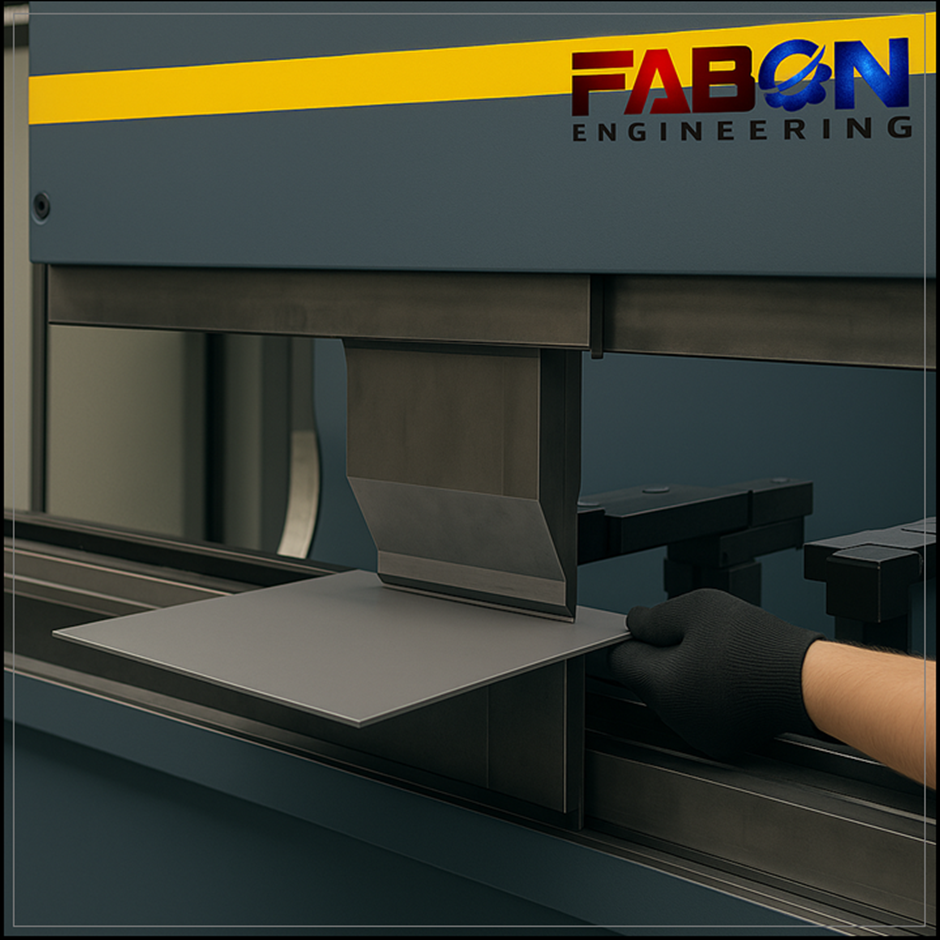
A Press Brake Machine is a mechanical or hydraulic machine tool used to bend sheet or plate material, typically sheet metal. The machine forms precise angles and shapes using a combination of a punch (male die) and a die (female die).
These machines are essential in producing metal components for industries like:
- Renewable energy (e.g., biomass pellet machines, burners, dryers)
- Pharmaceutical equipment
- Automotive and aerospace structures
- Furniture, cabinets, and construction materials
At FABON, our press brakes are engineered for high accuracy, robust performance, and energy efficiency, ensuring every bend meets your production standard.
⚙️ 2. Components of a Press Brake Machine
A press brake consists of several major components that work together to achieve precise bends:
| Component | Description |
| Frame | The solid backbone that supports the entire system and ensures vibration-free operation. |
| Ram or Slide | The upper moving part holding the punch that presses the metal sheet into the die. |
| Bed | The lower fixed part that holds the die and withstands bending force. |
| Back Gauge | A positioning device that controls the bending length and accuracy. |
| Hydraulic System | Powers the ram in hydraulic or servo-hydraulic press brakes. |
| Control Panel / CNC Unit | Allows the operator to program bend angles, force, and sequence. |
| Safety Guards & Light Curtains | Protect the operator during machine operation. |
FABON integrates CNC-based precision back gauges, energy-saving hydraulics, and programmable logic controls (PLC) for intelligent bending operations.
🔩 3. Types of Press Brake Machines
There are various types of press brakes, each suited for specific applications and production requirements.
3.1 Mechanical Press Brake
Operates through a flywheel and clutch mechanism, suitable for repetitive, high-speed bending of thin sheets.
Advantages: High production speed and consistent performance.
Limitations: Less flexible and difficult to control angle precision.
3.2 Hydraulic Press Brake
Uses hydraulic cylinders to control the ram movement. It is the most popular design in modern industries.
Advantages:
- High bending force
- Better angle control
- Safe and quiet operation
- Suitable for thick plates
FABON Hydraulic Press Brakes are designed with pressure-balanced cylinders and energy-efficient motors, ensuring optimal bending with minimal maintenance.
3.3 CNC Press Brake
Controlled by a Computer Numerical Control (CNC) system, it automates bending sequences, back gauge positioning, and angle corrections.
Advantages:
- Extreme accuracy and repeatability
- Multi-axis control (X, R, Z axes)
- Automatic spring-back compensation
- Real-time diagnostics
FABON offers CNC press brakes for industries requiring high customization and precision bending, ideal for biomass machinery frames, electrical panels, and stainless-steel housings.
🧠 4. How Does a Press Brake Machine Work?
Let’s explore the step-by-step working principle of a hydraulic or CNC press brake:
Step 1: Material Placement
The sheet metal is placed on the die bed, aligned with reference stops or the back gauge.
Step 2: Program Input (for CNC models)
The operator enters parameters such as bend angle, sheet thickness, and bend length into the CNC control unit.
Step 3: Ram Movement
The hydraulic cylinders or mechanical clutch drives the ram downward, pushing the punch into the metal.
Step 4: Bending Action
The metal bends around the V-groove of the die, forming the desired angle.
Step 5: Return Stroke
Once bending is complete, the ram returns to its upper position, ready for the next operation.
Step 6: Quality Inspection
The formed piece is checked for dimensional accuracy and angle precision.
FABON’s precision back-gauge system, servo valves, and real-time feedback sensors ensure micron-level repeatability in each stroke.
🧮 5. Bending Methods Used in Press Brakes
Different methods determine the bend radius, accuracy, and spring-back characteristics:
| Method | Description | Applications |
| Air Bending | Punch does not fully contact the die; angle depends on depth of stroke. | General-purpose bending |
| Bottoming (Coining) | Metal fully pressed into the die for sharper angles. | High precision parts |
| Wipe Bending | Sheet slides along the die edge while the punch forces the bend. | Complex shapes and channels |
At FABON, our CNC control system automatically selects bending method based on material type and desired geometry — minimizing setup time and material stress.
🏭 6. Applications of Press Brake Machines
Press brakes are indispensable in industrial fabrication. FABON machines are used in:
🔹 Biomass Machinery
- Pellet Machine body frames
- Hammer Mill casings
- Dryer ducts and enclosures
- Screw conveyor covers
🔹 Pharma and Food Industry
- SS 316L enclosures, hoppers, and bins
- Machine guards, electrical panels
🔹 Automotive and Transport
- Chassis, panels, brackets, and housings
🔹 Agricultural Equipment
- Feed pellet machine frames
- Napier grass cutter enclosures
🔹 General Fabrication
- Electrical panels
- Storage racks
- Furniture parts
Each FABON press brake is built for multi-industry flexibility, capable of bending mild steel, stainless steel, and aluminum with exceptional consistency.
🧰 7. Key Features of FABON Press Brake Machines
| Feature | Description |
| CNC/NC Controller | User-friendly interface for automatic bending sequence programming. |
| Hydraulic Synchronization | Twin-cylinder balance ensures uniform bending pressure. |
| Rigid Frame | Welded and stress-relieved structure for long life and accuracy. |
| Safety Interlocks | Light curtains and foot-switch controls for safe operation. |
| Energy-Saving System | Low-noise, variable-speed hydraulic pump. |
| Quick Tool Change System | Reduces setup time for die/punch changes. |
| High Bending Accuracy | ±0.1 mm precision on every bend. |
🧱 8. Advantages of FABON Press Brake Machines
- Made in India design ensuring world-class quality.
- ISO 9001:2015 certified manufacturing standards.
- Customizable tonnage and bed length as per client requirement.
- Low maintenance with energy-efficient hydraulic systems.
- High repeatability, ideal for mass production.
- Operator-friendly design with ergonomic controls.
- Comprehensive after-sales service and spare-parts support.
FABON’s engineering philosophy ensures durability, reliability, and precision, making it the first choice for Indian and international manufacturers.
🧮 9. Technical Specifications (Example Range)
| Model | Tonnage (kN) | Bending Length (mm) | Stroke (mm) | Speed (mm/s) | Motor Power (HP) |
| FPB-40 | 400 | 1250 | 100 | 12 | 5 |
| FPB-80 | 800 | 2500 | 120 | 10 | 7.5 |
| FPB-160 | 1600 | 3200 | 150 | 8 | 10 |
| FPB-250 | 2500 | 4000 | 180 | 7 | 15 |
Specifications can be customized based on customer requirements for different industrial applications.
🧩 10. Material Considerations in Bending
The type and thickness of material influence bending force, spring-back, and tooling selection.
| Material | Tensile Strength (MPa) | Recommended Die Opening (V) | Spring-back Tendency |
| Mild Steel | 400 | 8 × Thickness | Medium |
| Stainless Steel | 600 | 10 × Thickness | High |
| Aluminum | 250 | 6 × Thickness | Low |
FABON’s CNC controller compensates automatically for spring-back correction, ensuring dimensional accuracy even in high-strength materials.
🧰 11. Tooling in Press Brakes
Tooling selection is critical to bending performance.
- Punch Types: Acute, Gooseneck, Hemming, Radius
- Die Types: V-dies, U-dies, Offset dies, Multi-V dies
- Tool Material: Hardened tool steel or carbide inserts
FABON supplies precision-ground tooling with all machines, ensuring compatibility with international tool standards (Amada, Wila, Promecam).
🔒 12. Safety Features and Best Practices
Press brakes operate under high forces — safety is paramount.
- Foot Switch Control prevents accidental engagement.
- Light Curtains & Emergency Stop Buttons protect operators.
- Guarded Ram Area ensures safe hand distance.
- Training & Maintenance by FABON service engineers guarantee long-term safety and reliability.
⚡ 13. Maintenance of a Press Brake Machine
Routine maintenance ensures longevity and performance:
- Daily Checks: Hydraulic oil level, back-gauge alignment, tool cleanliness.
- Weekly: Check cylinder seals and pressure calibration.
- Monthly: Clean filters, check electrical panels, and lubricate moving parts.
- Annually: Replace hydraulic oil and inspect control calibration.
FABON provides a Preventive Maintenance Manual with every press brake, helping customers maximize uptime and extend machine life.
🌍 14. FABON Press Brakes in Biomass and Renewable Energy Sector
FABON Engineering is a pioneer in biomass equipment fabrication — including pellet plants, dryers, and burners. The press brake plays a vital role in shaping heavy structural components and sheet-metal housings.
By integrating FABON press brakes into fabrication lines, manufacturers can:
- Reduce manual welding through accurate bending.
- Achieve leak-proof and dust-tight enclosures for biomass dryers.
- Cut production time by over 40 %.
This synergy between metal-forming and bioenergy manufacturing reflects FABON’s mission — “Redefining Excellence in Engineering and Sustainability.”
🌱 15. Why Choose FABON Press Brake Machines
✅ ISO 9001:2015 Certified Quality
✅ Robust Hydraulic Design for 20-hour operation cycles
✅ CNC/NC Options with servo-drive control
✅ Custom Designs for biomass, pharma, and general fabrication sectors
✅ Comprehensive After-Sales Support with spare-parts availability
✅ Made-in-India Excellence — engineered and built in Nashik
When you buy a FABON Press Brake, you invest in precision, performance, and peace of mind.
💡 16. Future of Press Brake Technology
The future of metal forming lies in automation, AI-driven CNC control, and energy-efficient systems.
FABON is already developing:
- IoT-enabled press brakes for remote diagnostics
- Energy-saving servo-hydraulic drives
- Smart bending algorithms that reduce setup time by 60 %
- Eco-friendly manufacturing aligned with India’s “Make Green” initiative
🖥️ 17. SEO-Focused Keywords
Primary Keyphrase:
✅ Press Brake Machine in India
Supporting Keywords:
- Hydraulic Press Brake Machine
- CNC Press Brake Manufacturer
- Sheet Metal Bending Machine
- FABON Press Brake Price India
- Metal Forming Machine Manufacturer
- Made in India Press Brake
- FABON Engineering Pvt Ltd
- Best Press Brake for Biomass Industry
- CNC Hydraulic Bending Machine
- Precision Sheet Metal Forming
📞 18. FABON — Your Partner in Precision Engineering
With decades of experience in biomass, pharma, and industrial machinery, FABON Engineering delivers integrated fabrication solutions — from cutting to bending, welding, and finishing.
Contact FABON Engineering Pvt Ltd
📍 Plot No. XX, MIDC Area, Nashik, Maharashtra, India
🌐 www.fabon.in
📧 [email protected] | 📞 +91 9370999191
📚 19. Conclusion
The Press Brake Machine is not just a bending tool — it’s the heart of modern fabrication. It enables precision, efficiency, and consistency in every project, from small enclosures to large biomass machinery.
At FABON Engineering Pvt Ltd, our advanced hydraulic and CNC press brakes deliver unmatched accuracy, performance, and reliability — empowering industries to bend the future with precision.
Whether you are a startup or a large-scale manufacturer, FABON stands ready to be your trusted engineering partner.