
“HOW TO CREATE POLLUTION FREE TOMORROW WITH BIOMASS ENERGY”
1. Introduction: Why a Pollution-Free Tomorrow Matters
Air pollution has become one of the biggest threats to human health, industrial growth, and climate stability. From rising CO₂ levels to increasing particulate emissions, industries worldwide are under pressure to adopt cleaner fuel sources.
A pollution-free tomorrow is not a dream—it is a necessity.
And one of the most powerful solutions available today is biomass energy.
Biomass is renewable, carbon-neutral, and abundant. When converted into pellets, briquettes, or gas, it becomes a high-efficiency fuel for homes and industries.
FABON Engineering, India’s fastest-growing biomass machinery manufacturer, is leading the movement to empower industries with clean, sustainable energy solutions.
2. Understanding Biomass Energy
Biomass energy is produced from organic waste such as:
- Wood chips
- Sawdust
- Rice husk
- Coconut shells
- Corn cobs
- Sugarcane bagasse
- Agricultural residues
- Forest waste
- Napier grass
These materials are processed into high-density biomass pellets using advanced pelletization machines.
Biomass is considered carbon-neutral because the CO₂ released during burning is equal to the CO₂ absorbed by the plants during growth.
3. India’s Current Pollution Crisis
India ranks among the most polluted countries in the world. Key reasons include:
- Fossil fuel burning (coal, diesel, furnace oil)
- Industrial emissions
- Pollution from brick kilns, boilers, furnaces
- Open burning of agricultural waste
- Lack of clean industrial energy alternatives
Industries consuming coal and furnace oil are under pressure from:
- CPCB regulations
- State Pollution Control Board guidelines
- Carbon credit policies
- Renewable energy mandates
This is where biomass energy offers a large-scale, practical, economical solution.
4. How Biomass Energy Reduces Pollution
Biomass energy directly supports a pollution-free tomorrow through:
✔ Low Emissions
Biomass pellets emit:
- 80% less CO₂ than coal
- Nearly zero SO₂
- Minimal NOₓ
- No toxic fumes
✔ Prevents Open Burning of Waste
Farm residues that were previously burnt in open fields can now be pelletized.
✔ Reduces Coal Dependency
Industries can replace up to 100% of coal with biomass pellets.
✔ Cleaner Industrial Operations
Boilers, hot air generators, fryers, and furnaces run smoother and cleaner on biomass energy.
✔ Supports Carbon Neutrality & Net-Zero Targets
Biomass energy is recognized globally as a renewable and sustainable energy source.
5. FABON Engineering’s Role in Building a Pollution-Free Tomorrow
FABON Engineering (Nashik, Maharashtra) is a leading manufacturer of:
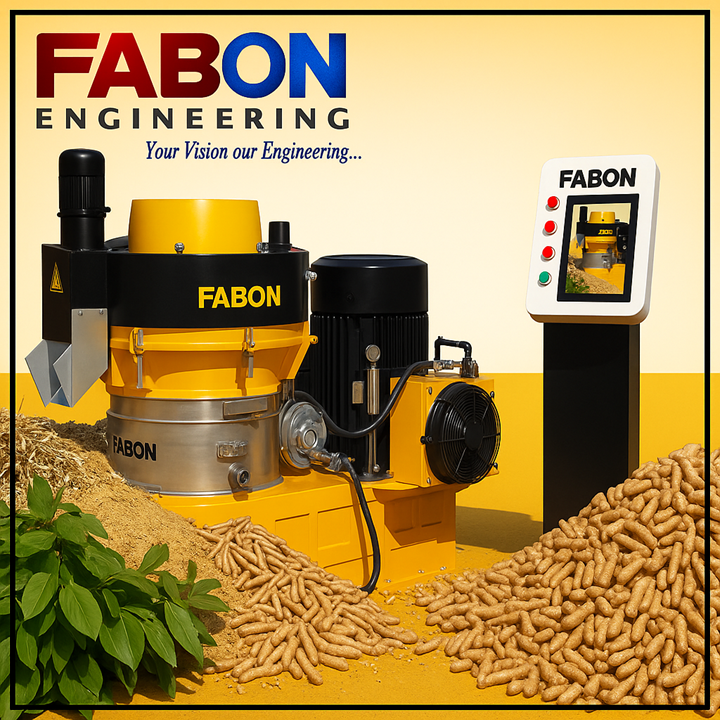
- Biomass Pellet Making Machines
- Biomass Pellet Burners
- Rotary Dryers
- Flash Dryers
- Hammer Mills
- Sawdust Making Machines
- Wood Chippers
- Screw Conveyors & Feeding Systems
FABON machines are designed for 20-hour continuous operation with high output, low energy consumption, and long service life.
FABON promotes pollution-free energy by helping industries switch to clean biomass fuel.
6. FABON Biomass Machines & Their Key Features
A. FABON Biomass Pellet Making Machine
✔ 1 TPH to 5 TPH capacity
✔ High-precision ring die
✔ 1-year warranty
✔ Heavy-duty gearbox
✔ Energy-efficient motor
✔ European-grade pellet density
B. FABON Pellet Burner (Front-Fire, Vertical & Horizontal)
✔ Smoke collector system
✔ Ideal for hotels, industries, food processing
✔ Up to 70% fuel savings
✔ Zero black smoke
✔ Fully automatic feeding
C. FABON Flash Dryer
✔ Dries sawdust and biomass from 35% to 10% moisture
✔ 500 kg/hr to 2 TPH
✔ Low fuel consumption
✔ Best for pellet plants
D. FABON Rotary Dryer
✔ For large-scale biomass handling
✔ Heavy-duty drum
✔ Suitable for rice husk & industrial residues
E. FABON Hammer Mill
✔ Crushes raw biomass into fine powder
✔ High output
✔ Replaceable screens
F. FABON Sawdust Making Machine
✔ Converts wood logs into sawdust
✔ No waste generation
✔ Robust build for long life
FABON’s machines are installed in several states including Maharashtra, Rajasthan, West Bengal, Tamil Nadu, Gujarat, and Telangana.
7. Step-By-Step: How Biomass Pellets Are Produced
1. Collection of Raw Material
Wood waste, crop residues, and forestry waste are collected.
2. Size Reduction Using Hammer Mill
Raw material is crushed into fine powder (2–6 mm).
3. Drying in Flash/Rotary Dryer
Moisture is reduced to 8–12%.
4. Pelletizing in FABON Pellet Mill
High pressure converts biomass into dense, cylindrical pellets.
5. Cooling & Packing
Pellets are cooled, screened, and packed for supply.
8. Applications of Biomass Energy Across Industries
Biomass pellets and FABON burners are widely used in:
- Food industries
- Namkeen & snack frying industries
- Pharma industries (hot water, hot air generation)
- Hotels & restaurants
- Dyeing units
- Poultry farms
- Textile factories
- Chemicals & dyes
- Steel reheating
- Cement & brick industries
- Boilers and furnaces
Even large power plants like NTPC have started biomass co-firing programs.
9. Economic Benefits of Biomass Energy
✔ Fuel Cost Reduction (40–60%)
Pellets are cheaper than diesel, LPG, and furnace oil.
✔ Stable Fuel Supply
Agricultural waste is available across India.
✔ Low Maintenance of Burners/Boilers
✔ Carbon Credits & Green Certification
Industries switching to biomass can earn sustainability credits.
✔ Low Ash Content (1–3%)
Ash can be used as fertilizer.
10. Environmental Impact: A Sustainable Tomorrow
Biomass energy supports:
- Reduced greenhouse gas emissions
- Lower global warming potential
- Conservation of forests
- Circular economy through waste utilization
- Reduction of landfill waste
It is one of the strongest contributors to India’s carbon-neutral future.
11. Government Policies & Subsidies (2025 Update)
MNRE Biomass Program 2025
Subsidies available for:
✔ Biomass gasifiers
✔ Briquette/pellet manufacturing plants
✔ Boilers & industrial retrofits
NTPC Biomass Co-Firing Policy
NTPC buys biomass pellets for thermal power plants.
State Government Schemes
Several states offer capital subsidies for biomass projects:
- Maharashtra
- Uttar Pradesh
- Rajasthan
- Tamil Nadu
- Karnataka
Banks also offer term loans under:
- MSME schemes
- Mudra loan
- CGTMSE
FABON provides complete guidance for subsidy documentation, DPR and plant setup.
12. Why FABON Is India’s Most Trusted Biomass Machinery Brand
✔ 100% Made in India
✔ Heavy-duty industrial build
✔ 1-year warranty
✔ After-sales support across India
✔ Best performance in 20-hour operations
✔ Complete turnkey solutions
✔ Thousands of satisfied industrial clients
FABON machines are designed to last 15–20 years with minimal maintenance.
13. FABON Projects & Case Studies
Case Study 1: Food Industry – Gujarat
Switched from LPG to FABON biomass burner
➡ Saved 55% fuel cost
➡ Zero smoke frying
➡ Cleaner production
Case Study 2: 2 TPH Pellet Plant – Rajasthan
Raw material: Napier grass
➡ High-density pellets
➡ 18 hours/day operation
➡ Export quality pellets
Case Study 3: Pharma Industry – Maharashtra
Hot water system using FABON burner
➡ Reduced carbon emissions
➡ Cleaner working environment
14. Future of Biomass Energy in India
By 2030, biomass could contribute:
- 15% of India’s total energy
- 30 million tonnes of pellet demand
- 50,000 new biomass plants
- 4 lakh rural jobs
With strong government support and environmental needs, biomass energy will be one of India’s fastest-growing renewable sectors.
FAQ – Biomass Energy & Pollution-Free Tomorrow (FABON Engineering)
1. What is biomass energy?
Biomass energy is a renewable form of energy generated from organic materials like wood chips, sawdust, agricultural waste, rice husk, and crop residues. These materials are processed into pellets or briquettes and used as clean fuel.
2. How does biomass energy help reduce pollution?
Biomass energy reduces pollution by:
✔ Emitting 80% less CO₂ than coal
✔ Producing near-zero sulfur and nitrogen emissions
✔ Preventing open burning of agricultural waste
✔ Reducing industrial black smoke
✔ Supporting carbon-neutral operations
3. Why is biomass energy considered carbon-neutral?
Biomass is carbon-neutral because the CO₂ released during burning equals the CO₂ absorbed by the plant during growth. This natural balance makes biomass a sustainable and eco-friendly fuel.
4. What industries can use biomass pellets?
Biomass pellets are widely used in:
- Food & snack frying industries
- Pharma companies
- Hotels and commercial kitchens
- Boilers, furnaces, and hot air generators
- Textiles & dyeing units
- Chemical industries
- Poultry & livestock farms
- Power plants (co-firing)
5. What are the benefits of using biomass fuel over coal or LPG?
✔ 40–60% fuel cost savings
✔ Lower emissions
✔ Stable fuel supply
✔ Higher combustion efficiency
✔ Low ash content (1–3%)
✔ Suitable for automation and continuous operations
✔ Applicable in all types of industrial heating
6. What are biomass pellets made of?
Biomass pellets are made from:
- Sawdust
- Wood chips
- Rice husk
- Bagasse
- Coconut shells
- Corn cobs
- Groundnut shells
- Napier grass
- Other agricultural residues
FABON pellet machines convert these raw materials into high-density pellets.
7. How do FABON biomass pellet machines work?
FABON’s pellet machines follow a structured process:
- Raw material crushing
- Drying to optimum moisture
- Pelletization using a ring die
- Cooling and screening
These machines offer high output, low energy consumption, and 1-year warranty.
8. Can biomass completely replace coal in industries?
Yes. Many industries already run 100% on biomass pellets using FABON pellet burners and boilers. Biomass provides similar calorific value with cleaner combustion.
9. Are there government subsidies for biomass projects in India?
Yes. Under the MNRE Biomass Program 2025, subsidies are available for:
- Pellet plants
- Briquette units
- Biomass gasifiers
- Industrial burner retrofits
Many states like Maharashtra, UP, Rajasthan, and Karnataka also offer additional incentives.
FABON provides assistance for DPR, subsidy documentation, and plant setup.
10. What makes FABON Engineering different from other biomass machinery brands?
FABON stands out because of:
✔ 100% Made in India machinery
✔ Heavy-duty industrial build
✔ 1-year warranty
✔ Best after-sales service
✔ Low maintenance
✔ 20-hour/day running capability
✔ Complete turnkey biomass plant solutions
11. Can FABON provide a complete biomass pellet plant setup?
Yes. FABON Engineering offers turnkey solutions, including:
- Hammer mill
- Dryer (flash/rotary)
- Pellet mill
- Cooler
- Conveyor system
- Packing machine
- Burner for plant heating
12. What is the price of a FABON biomass pellet machine?
The price depends on the capacity (1 TPH to 5 TPH), raw material type, and automation level.
FABON provides cost-effective solutions with high ROI and long-lasting performance.
13. Are biomass pellets safe to use for food industries?
Yes. Biomass pellets are clean-burning, smokeless, and suitable for all food frying and roasting operations when used with FABON pellet burners equipped with smoke collectors.
14. Do biomass pellets produce ash?
Yes, but very little—typically 1–3%. The ash is non-toxic and can be used as organic fertilizer.
15. Can FABON machines run continuously for long hours?
Absolutely. FABON machines are designed for 20-hour daily operation, ensuring high productivity and reliability.
16. How much space do I need to install a biomass pellet plant?
A 1 TPH pellet plant usually requires 15,000–20,000 sq. ft depending on layout. FABON provides complete plant design and space planning.
17. What raw material is best for biomass pellets?
Commonly used raw materials include sawdust, rice husk, wood chips, and Napier grass.
FABON machines can process almost all raw materials with ease.
18. Can I get after-sales support from FABON anywhere in India?
Yes. FABON has service support across multiple states and provides installation, training, maintenance, and online assistance.
19. How long does a biomass pellet machine last?
With proper maintenance, FABON pellet machines last 15 to 20 years.
20. How can FABON help me reduce pollution in my industry?
FABON offers:
- Clean biomass burners
- High-density pellet machines
- Zero-smoke combustion systems
- Dust-free material handling
- Energy-saving drying systems
All helping you transition to a pollution-free, sustainable operation.