

Napier Grass Dewatering & Pellet Making Process : Complete Guide (India, 2025)
1) Raw material fundamentals (what you’re working with)
- Botanical: Napier/Elephant grass (Pennisetum purpureum). Extremely high-yield tropical grass; 20–80 t dry matter/ha/yr under good inputs (i.e., ≈100–400 t fresh/ha/yr depending on region/variety).
- Moisture at harvest: commonly ~70–80% (fresh). High moisture is the main processing challenge and is why dewatering+drying are essential.
- Energy potential: Napier pellets measured in trials show GCV ~16–17.9 MJ/kg (≈3820–4275 kcal/kg), once dried and densified properly.
Where to source in India (2025):
- Contract farming with dairies/fodder growers; typical green fodder spot rates ~₹2/kg (state/season dependent).
- Super Napier planting material is widely available (seeds/cuttings; indicative seed prices ₹200–₹1200/kg depending on hybrid/vendor).
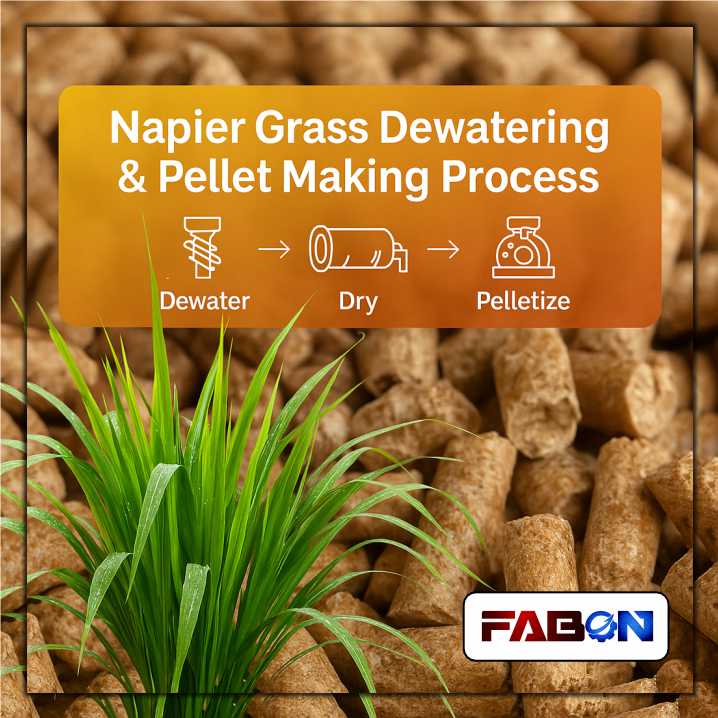
2) Process flow (from grass to pellets)
A. Size reduction & mechanical dewatering
- Chop (30–50 mm).
- Screw-press / twin-roll press to push out free water; typical target after press: ~55–65% MC (varies by press & cultivar).
- Press filtrate can be treated/used as process water.
Why it matters: Every kilogram of water mechanically removed saves thermal energy later. With fresh Napier at ~75–80% MC, dewatering is non-negotiable. (High-MC grasses are widely documented; see above.)
B. Thermal drying to pellet spec
- Pellet mills prefer ≤10% moisture.
- Industrial dryers for biomass typically require ~3.2–3.6 MJ of heat per kg of water evaporated (indirect/convective systems; real plants vary by insulation, heat recovery, airflow, etc.).
- Published reviews put biomass dryer energy intensity in the ~1.5–3+ MJ/kg (technology-dependent); practical plants commonly land near the 3 MJ/kg class for wet herbaceous feedstocks.
C. Pelletizing (ring-die)
- Condition to ~70–90 °C, feed 6–10 mm dies (for energy pellets).
- Expect bulk density 600–700 kg/m³, durability index ≥95% when properly dried and bound by native lignin.
3) Worked example (mass & energy balance)
Goal: Start with 1,000 kg fresh Napier at 75% MC → make pellets at 10% MC.
- Dry solids = 25% of 1,000 = 250 kg.
- Final pellets at 10% MC contain 90% solids ⇒ final mass = 250 / 0.90 ≈ 278 kg.
- Water to remove thermally (assume press brings it only slightly down before dryer; here we model net evaporation demand to reach 10%):
- Initial water = 750 kg; final water in pellets = 28 kg ⇒ ~722 kg water evaporated in the dryer.
- Drying heat (use 3.4 MJ/kg as mid-range): 722 × 3.4 = ~2,455 MJ.
- If firing a biomass burner on 4,000 kcal/kg (~16.7 MJ/kg) fuel at ₹10/kg, fuel cost per MJ ≈ ₹10 / 16.7 ≈ ₹0.60/MJ.
- Fuel cost for drying ≈ 2,455 × 0.60 = ₹1,473. (Engineering estimate grounded in dryer SEC literature.
Electricity (typical, indicative):
- Fans/feeding/press/handling ~ 30 kWh for this batch; ring-die pelleting ~ 60 kWh/ton of pellets ⇒ 0.278 t ≈ 17 kWh.
- Total ~ 47 kWh; at ₹8/kWh ⇒ ₹376.
Labor, maintenance & consumables (knife wear, die-roll, grease, bags): assume ₹800 for this batch (conservative placeholder for small/medium plant).
Raw Napier cost (two scenarios):
- Scenario A (contract farming / near-field): ₹2/kg fresh ⇒ ₹2,000 for 1,000 kg.
- Scenario B (procured + transport): ₹4/kg fresh ⇒ ₹4,000.
Total production cost per batch (278 kg pellets)
- A: 2,000 (raw) + 1,473 (drying fuel) + 376 (power) + 800 (O&M) = ₹4,649 ⇒ ₹16.7/kg.
- B: 4,000 + 1,473 + 376 + 800 = ₹6,649 ⇒ ₹23.9/kg.
Takeaway: Unit cost is ultra-sensitive to fresh Napier price and dryer SEC. Pushing more water out in the press and securing farm-gate Napier at ≤₹2/kg are the two biggest levers.
4) GCV expectations & quality
- Measured Napier pellet GCVs: ~16–17.9 MJ/kg (≈ 3,820–4,275 kcal/kg) depending on cultivar and processing. Aim for ash ≤8%, moisture ≤10–12%, fines ≤5% to meet most utility/industrial specs.
- For context, many wood pellets are ~4,300–4,600 kcal/kg; agri-residue pellets trend lower due to higher ash. (Reference values for various pellets.)
5) Market prices (India, 2025)
- Utility/NTPC tender-linked pricing often benchmarks around ₹2.27–₹2.32 per 1,000 kcal (region-specific); base rates and adjustment formulas are common in 2024–2025 tenders. That maps to ₹7,200–₹10,500/ton depending on GCV.
- Open market ranges advertised for industrial pellets: ~₹5,000–₹16,000/ton depending on type/quality/logistics. Expect the bulk of transactions ~₹7,500–₹11,000/ton for non-torrefied agri/wood blends in 2025.
- Policy tailwind: India’s biomass cofiring mandate (5% now, 7% by FY 2025–26) sustains demand into 2026.
Reality check vs our cost model:
- With contract-farmed Napier at ~₹2/kg and efficient dewatering/drying, ex-works cost ≈ ₹16–18/kg is achievable only at very small batch in the example above; at scale, heat recovery (recirculation, economizers), higher press dryness, cheaper agri-fuel, and optimized manpower can compress to the ₹9–12/kg band. Plants targeting NTPC price formulas must run tight on moisture and logistics to be viable.
6) Practical specs & kit list (FABON-style)
- Chopper/Crusher: 30–50 mm cut, 5–10 TPH.
- Screw Dewatering Press: twin-screw, food-grade SS contact, VFD-driven; aim >35–45% TS after press (feed-dependent).
- Dryer: indirect rotary/flash with recirculating hot air from a biomass burner; SEC target ≤3.2 MJ/kg H₂O; bag filter/cyclone + spark arrestor.
- Pellet Mill: ring-die 560–760 mm, 6–10 mm die; conditioner + feeder + magnet; cooler + screener; fines recycle.
- QA Lab: moisture, ash, bulk density, sieve for fines, proximate tests.
7) Quick FAQs
Q1. What GCV can I commit for Napier pellets?
Plan 3,800–4,200 kcal/kg, moisture ≤10–12%, ash controlled by field dirt removal & clean chopping. Validate with third-party tests before contracts.
Q2. How do I cut drying costs?
Max out mechanical dewatering, insulate ducts, recover heat, keep inlet MC consistent, and maintain burners. Literature SECs near 3.2–3.6 MJ/kg H₂O are reachable with tuned indirect systems.
Q3. Who buys in India?
Thermal power (NTPC, DVC, state gencos) via tenders and industrial boilers/ovens on open market. Tenders specify price vs GCV, fines, ash, moisture.
8) SEO add-ons (use on your page)
Title tag (≤60 chars): Napier Grass Dewatering & Pellets: Process, Cost, GCV (India 2025)
H1: Napier Grass Dewatering Process & Pellet Making in India
H2s: Raw Material & Moisture | Dewatering & Drying | Pellet Specs & GCV | Cost & Market Price (2025) | FAQs
Internal links idea:
- FABON Biomass Pellet Burners (cost savings vs LPG/Diesel)
- FABON Rotary/Flash Dryers (SEC benchmarks)
- FABON Ring-Die Pellet Mills (6–10 mm dies)
Target keywords: Napier grass pellets, Super Napier biomass, elephant grass dewatering, biomass dryer SEC India, pellet GCV India, NTPC biomass pellet price, pellet plant cost India, FABON pellet machine.
9) One-page costing summary (copy for your brochure/quote)
- Input: 1,000 kg fresh Napier @ 75% MC
- Pellets out: ~278 kg @ 10% MC
- Drying fuel: ~2,455 MJ → ₹1,473 (if fuel ₹10/kg @ 16.7 MJ/kg)
- Electricity: ~47 kWh → ₹376 (₹8/kWh)
- O&M/Labour/Consumables: ₹800
- Raw material: ₹2–4/kg fresh ⇒ ₹2,000–₹4,000
- Ex-works cost: ₹16.7–₹23.9/kg (small batch example; scale/optimizations can lower this).
- Typical sale price band (2025): ₹7,000–₹11,000/ton (₹7–11/kg) utility/industrial depending on GCV/logistics; some listings broader.
Citations & sources
- Moisture/yield fundamentals & biomass context: Feedipedia, MDPI/Elsevier, and recent reviews.
- Dryer specific energy consumption (SEC): 3.2–3.6 MJ/kg H₂O (indirect dryers); overview ranges for biomass dryers.
- Napier pellet GCV measurements: 16–17.9 MJ/kg in controlled trials.
- Indian fodder price signal: ~₹2/kg reference (Haryana).
- India market/tender pricing: NTPC/DVC tender docs & price benchmarks ₹2.27–₹2.32 per 1,000 kcal; open-market ranges.
- Biomass co-firing policy driver (5%→7%): Bioenergy International.
COMPLETE INFORMATION REGARDING BIOMASS PELLETS BY NAPIER GRASS PLANT AND MACHINERY
Kindly Contact +91 9226339191 / 9370999191 / 9226719191/ 9545359191…..Also Contact on : [email protected]
I need more information for Napier grass economics
Kindly Contact +91 9370999191 / 9226339191 / 9226719191/ 9545359191…..Also Contact on : [email protected]