
Hydraulic CNC Press Brake vs Servo-Electric Press Brake – Which Is Better for Indian Manufacturers?

Hydraulic CNC Press Brake vs Servo-Electric Press Brake – Which Is Better for Indian Manufacturers?
FABON Engineering Pvt. Ltd. and many Indian machine builders and sheet-metal fabricators are facing a common strategic question today:
Should we continue with proven hydraulic CNC press brakes—or invest in the new generation of servo-electric press brakes?
This is not only a technology decision.
For Indian manufacturers, it directly impacts:
- production cost per part
- electricity bills
- operator availability
- maintenance dependency
- machine uptime
- financing and ROI
- export competitiveness
This detailed, plagiarism-free technical guide explains both technologies from a practical Indian factory perspective.
1. Introduction – Why This Comparison Is Important in India
India’s sheet-metal industry is changing rapidly.
Automotive, EV components, solar structures, electrical panels, enclosures, elevators, pharma equipment, food machinery, defence fabrication and export-oriented OEMs are all demanding:
- tighter tolerances
- faster cycle time
- lower energy consumption
- repeatable quality
- digital production control
At the same time, Indian factories still face:
- unstable power supply in many regions
- shortage of highly skilled operators
- pressure to reduce production cost
- high expectations on machine life (15–25 years is common)
So, the real question is not:
“Which press brake is technologically superior?”
The real question is:
Which press brake is commercially and operationally better for Indian manufacturers?
To answer that, we must first clearly understand how both technologies actually work.
2. What Is a Hydraulic CNC Press Brake?
A hydraulic CNC press brake uses hydraulic cylinders to move the ram (upper beam).
Basic operating principle
- An electric motor drives a hydraulic pump.
- Hydraulic oil is pressurised.
- Oil flows into the left and right cylinders.
- The cylinders push the ram downward.
- CNC controller synchronises both sides.
Modern hydraulic press brakes use:
- closed-loop synchronisation
- linear scales or encoders
- proportional or servo valves
Typical main elements
- hydraulic power pack
- oil tank
- hydraulic cylinders
- proportional / servo valves
- linear scale feedback
- CNC controller
- back gauge system
Why hydraulic press brakes became dominant in India
Hydraulic press brakes entered India strongly because:
- they handle high tonnage easily
- they are mechanically forgiving
- they tolerate rough production environments
- maintenance skill is widely available
- spare parts are locally sourced
Even today, more than 85–90% of press brakes running in India are hydraulic.
3. What Is a Servo-Electric Press Brake?
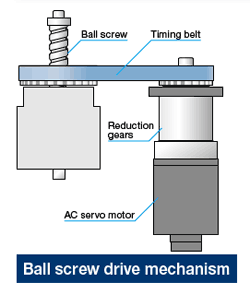
A servo-electric press brake eliminates hydraulic oil completely.
Basic operating principle
- high-torque servo motors rotate
- rotation drives ball screws or roller screws
- mechanical transmission converts rotation into linear ram movement
- CNC controller controls motor position and torque
No hydraulic pump.
No oil.
No pressure valves.
Typical main elements
- servo motors
- planetary gearboxes
- ball screw / roller screw assemblies
- encoder feedback
- CNC controller
- back gauge system
Why servo-electric technology is growing globally
- energy efficiency
- clean operation
- high positioning accuracy
- lower noise
- faster approach speeds
However, adoption in India is still very limited.
4. Technology Architecture Comparison
| Parameter | Hydraulic CNC Press Brake | Servo-Electric Press Brake |
|---|---|---|
| Power transmission | Oil pressure | Mechanical ball/roller screw |
| Energy storage | Hydraulic oil | Motor torque |
| Ram control | Proportional valves + feedback | Servo motor + encoder |
| Lubrication | Hydraulic oil system | Mechanical lubrication only |
| Heat generation | Oil heating | Motor and drive heating |
| Control response | Medium-fast | Very fast |
5. Tonnage Capability – A Major Decision Factor
This is one of the most critical differences.
Hydraulic press brake
Hydraulics can easily scale to:
- 100 ton
- 200 ton
- 300 ton
- 600 ton
- 1200 ton
- and above
This is one reason heavy-fabrication sectors in India depend on hydraulics.
Servo-electric press brake
Servo-electric systems are limited in tonnage.
In most commercial models:
- practical range is up to ~80–120 tons
- higher tonnage becomes extremely expensive
- screw life and mechanical stress become limiting factors
Indian reality
Most Indian fabrication shops:
- regularly bend 3 mm to 10 mm plates
- often require long bed lengths
- sometimes bend thick brackets, channels and frames
Hydraulics handle such mixed workloads easily.
Servo-electric systems are far more suitable for:
- thin sheet
- light gauge
- precision parts
- short stroke cycles
6. Machine Size and Structural Design
Hydraulic machines
- heavier frames
- massive side frames
- large oil tank and power pack
- higher overall weight
But heavy structure means:
- better vibration damping
- better long-term geometry stability
Servo-electric machines
- more compact drive architecture
- lighter overall weight
- smaller foundation load
However:
- frame rigidity becomes even more critical
- mechanical drive alignment is extremely sensitive
In Indian industrial conditions where:
- floors may not be perfectly level
- machine relocation is common
hydraulic structures are more forgiving.
7. Accuracy and Repeatability
This topic is often misunderstood.
Hydraulic CNC press brake accuracy
Modern hydraulic CNC press brakes using:
- linear scales
- closed loop control
- proper crowning systems
can achieve:
- ±0.01 mm ram positioning repeatability
Angle accuracy depends mainly on:
- material variation
- tooling condition
- operator compensation
Servo-electric press brake accuracy
Servo-electric drives can offer:
- extremely fine positioning resolution
- very fast correction loops
However, in bending:
material springback dominates accuracy, not drive technology.
So real-world difference in finished bend angle is usually:
- much smaller than marketing claims
Important truth for Indian manufacturers
Unless your production is:
- very thin gauge
- very high repetition
- very high precision (electronics or micro-enclosures)
both machines can meet industrial tolerance requirements.
8. Energy Consumption – One of the Biggest Talking Points
Hydraulic press brake energy use
- motor runs frequently
- oil is continuously circulated
- heat is generated in oil
- cooling fans and pumps consume power
Typical energy behaviour:
- power consumption even during idle time
Servo-electric press brake energy use
- motors run only when motion is needed
- no idling oil pump
- regenerative braking possible
Power is consumed mainly during:
- ram movement
- holding force generation
Indian electricity cost impact
In India, industrial electricity cost is continuously increasing.
For factories running:
- 2 shifts
- 3 shifts
- or 24×7 operations
servo-electric press brakes can reduce:
- energy cost per part significantly
However, this saving must be compared against:
- higher machine purchase cost
9. Speed and Productivity
Hydraulic press brake
- approach speed limited by oil flow
- return speed limited by valve capacity
- acceleration and deceleration are smoother but slower
Servo-electric press brake
- extremely fast approach
- high acceleration
- short cycle times for small parts
Production impact
Servo-electric press brakes show clear productivity advantages when:
- parts are small
- stroke is short
- batch sizes are large
- bending depth is shallow
In Indian job-shop environments where:
- parts change frequently
- large parts and deep bends are common
speed advantage becomes less significant.
10. Noise and Working Environment
Hydraulic press brake
- pump noise
- oil flow noise
- cooling fan noise
Servo-electric press brake
- almost silent during idle
- only servo motor sound during motion
For factories targeting:
- clean room type production
- electronics and medical enclosures
- international compliance standards
servo-electric machines provide better working conditions.
11. Maintenance Requirements
This is a decisive factor for Indian manufacturers.
Hydraulic press brake maintenance
- oil replacement
- oil filtration
- seal replacement
- valve calibration
- hose and pipe maintenance
- pump maintenance
But:
- hydraulic technicians are easily available
- local service ecosystem is very strong in India
Servo-electric press brake maintenance
- ball screw wear monitoring
- servo motor diagnostics
- encoder calibration
- drive electronics troubleshooting
- high-precision alignment
The biggest challenge:
servo-electric press brakes require higher technical skill.
Indian service reality
In metro cities, servo expertise is growing.
But in many industrial clusters:
- hydraulic technicians are easily available
- servo-electric specialists are still limited
This directly affects downtime risk.
12. Spare Parts and Availability
Hydraulic machines
- seals
- valves
- pumps
- hoses
- filters
Most are:
- available locally
- multiple vendors exist
- price competition is strong
Servo-electric machines
- proprietary motors
- drives
- encoders
- ball screws
- couplings
Often:
- OEM-specific
- imported
- longer lead times
This can be risky in breakdown situations.
13. Long-Term Reliability in Indian Conditions
Hydraulic press brake durability
Hydraulics tolerate:
- dust
- temperature variation
- voltage fluctuation
- rough daily use
That is one reason many hydraulic machines in India still run:
- after 15–20 years
Servo-electric press brake durability
Servo-electric machines are sensitive to:
- power quality
- electrical grounding
- temperature
- dust ingress
With proper installation and maintenance, they perform very well.
But they demand:
- stricter environment control
14. Operator Skill Level
Hydraulic press brake operators
- widely available in India
- training is easier
- troubleshooting is simpler
Servo-electric press brake operators
- need understanding of:
- CNC diagnostics
- servo alarms
- parameter tuning
Training requirement is higher.
15. Tooling Compatibility
Both machines use:
- standard press brake tooling
- segmented punches and dies
- crowning systems
However:
servo-electric machines generally prefer:
- lighter tooling
- optimised forming forces
Heavy forming tools are better suited to hydraulic platforms.
16. Integration with Industry 4.0 and Smart Manufacturing
Hydraulic CNC press brake
Modern hydraulic CNC press brakes now offer:
- offline programming
- production data monitoring
- remote diagnostics
- automatic crowning
- adaptive bending systems
Servo-electric press brake
Because of digital drives:
- data integration is naturally easier
- energy monitoring is more precise
- predictive maintenance features are more advanced
For export-oriented OEMs:
servo-electric machines integrate more easily into digital factories.
17. Initial Investment (CAPEX)
Hydraulic CNC press brake
- lower machine price
- simpler infrastructure
- no special power conditioning normally required
Servo-electric press brake
- significantly higher machine price
- sometimes requires:
- better electrical infrastructure
- stabilised power
- harmonic filters
For Indian MSMEs, financing and cash flow are major concerns.
18. Operating Cost (OPEX)
Hydraulic press brake OPEX
- electricity
- oil
- filters
- periodic seal replacement
- pump servicing
Servo-electric press brake OPEX
- lower electricity
- no oil cost
- fewer consumables
But:
- higher spare part cost when failure occurs
19. ROI Comparison – Indian Factory Perspective
Hydraulic machine ROI is strong when:
- mix of heavy and light parts
- variable production
- multiple thickness jobs
- limited technical manpower
- low risk tolerance
Servo-electric machine ROI becomes attractive when:
- production is stable
- part mix is standardised
- thin gauge dominates
- production volume is high
- energy cost is a major concern
20. Safety and Environmental Aspects
Hydraulic machines
- risk of oil leakage
- environmental disposal of oil
- slip hazards if leakage occurs
Servo-electric machines
- no oil
- cleaner shop floor
- better compliance with environmental norms
For export-oriented suppliers supplying to European customers, this is becoming increasingly important.
21. Typical Indian Application Suitability
Hydraulic CNC press brake is best suited for:
- general fabrication shops
- heavy electrical panels
- transformer tanks
- elevators and lifts
- structural components
- agricultural equipment
- automotive sub-assemblies
- job shops
Servo-electric press brake is best suited for:
- electronics enclosures
- control panels (thin sheet)
- medical equipment cabinets
- data-center racks
- precision stainless steel enclosures
- high-volume production lines
22. Scalability and Future Expansion
Indian manufacturers usually expand capacity gradually.
Hydraulic press brake ranges allow:
- easy addition of larger tonnage machines later
- similar maintenance philosophy
- operator skill transfer
Servo-electric adoption often requires:
- separate training
- different maintenance approach
- higher dependency on OEM support
23. Financing and Government Schemes
Indian MSMEs often use:
- bank term loans
- MSME schemes
- state subsidies
- technology up-gradation programs
Hydraulic machines:
- are easier to evaluate by banks
- have established resale value
- lower perceived financial risk
Servo-electric machines:
- still face hesitation in financing in some regions due to unfamiliar technology.
24. Risk Management Perspective
From a risk management viewpoint:
| Risk | Hydraulic | Servo-Electric |
|---|---|---|
| Service availability | Very strong | Limited in some regions |
| Spare lead time | Short | Sometimes long |
| Operator dependency | Moderate | High |
| Electrical sensitivity | Low | Higher |
| Long-term unknowns | Low | Medium |
25. Final Verdict – Which Is Better for Indian Manufacturers?
The honest engineering answer:
For most Indian manufacturers today, hydraulic CNC press brakes remain the safer and more versatile choice.
They provide:
- higher tonnage capability
- better tolerance to varied jobs
- easier service support
- lower operational risk
- proven long-term reliability
However…
Servo-electric press brakes are not a marketing gimmick.
They are technically superior in:
- energy efficiency
- noise levels
- cycle speed for light parts
- digital integration
- environmental cleanliness
26. Clear Recommendation for Indian Buyers
Choose a hydraulic CNC press brake if:
- your job mix includes medium to heavy thickness
- you run job-shop type production
- you want maximum flexibility
- you need assured service support
- your operators are traditionally trained
- you expect long machine life with minimum complexity
Choose a servo-electric press brake if:
- your production is thin-sheet dominated
- your parts are standardised
- you run long production batches
- you want low energy cost per part
- you have strong electrical and CNC support
- you are targeting export-grade manufacturing environments
27. Strategic Advice for Indian Fabricators
A very practical strategy being adopted by progressive Indian manufacturers is:
- retain hydraulic press brakes for heavy and mixed work
- introduce one servo-electric press brake for:
- high-volume thin-sheet lines
- premium precision work
- pilot digital manufacturing
This hybrid approach delivers:
- production flexibility
- controlled investment
- technology readiness
28. Conclusion
The future of press brake technology in India will not be “hydraulic versus servo-electric”.
It will be:
hydraulic and servo-electric working together – each in the role where it delivers maximum value.
For Indian manufacturing conditions, hydraulic CNC press brakes will continue to dominate for many years, while servo-electric press brakes will grow steadily in specialised, high-precision and high-volume segments.