

“HOW TO SET UP A COMPLETE BIOMASS PELLET PLANT WITH FABON”
Your turnkey guide for a profitable bio-fuel business
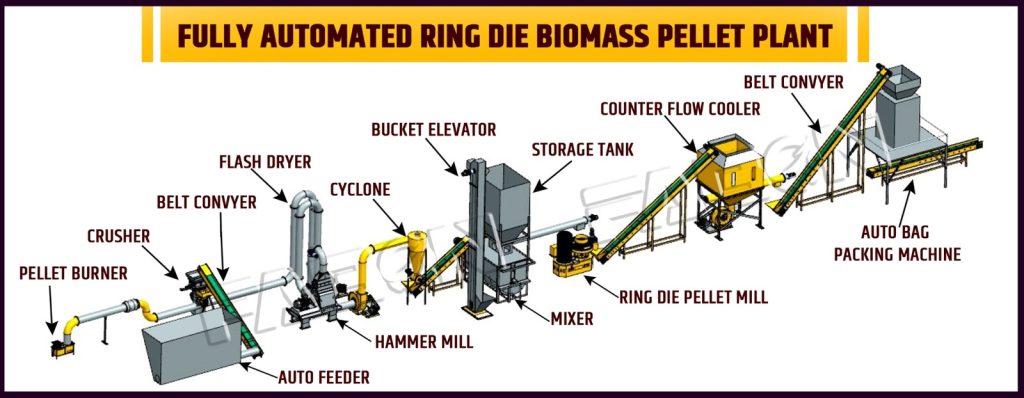
1. Introduction
In the context of increasing global demand for renewable energy and circular economy solutions, biomass pellets have emerged as a viable fuel alternative. By converting agricultural and forestry residues into compact, high-energy fuel pellets, you address waste management, reduce carbon footprint, and tap into industrial fuel markets. This guide by FABON Engineering Pvt. Ltd. lays out the comprehensive roadmap to plan, design, build, and operate a biomass pellet plant—covering raw material sourcing, equipment selection, plant layout, cost & finance, operations, marketing, quality & standards, and long-term maintenance.
Whether you are targeting a 1 ton/hour (TPH) or 2 TPH (or higher) capacity plant, this guide will walk you step by step through everything you need.
2. Business Case & Market Opportunity
2.1 Why biomass pellets?
- Industries using boilers and furnaces are under pressure to reduce fossil fuel use. Biomass pellets offer a more carbon-neutral alternative.
- Many countries (including India) have mandates for co-firing biomass in thermal power plants, increasing demand.
- Agro-residues (rice husk, bagasse, cotton stalks, corn cobs) and forestry waste (sawdust, wood chips) are abundantly available and under-utilised.
- Higher energy density and easier transportability of pellets compared to loose biomass.
2.2 Demand & customers
Your customers may include:
- Industrial boilers (brick kilns, cement plants, fertiliser plants)
- Power plants / co-firing units
- Commercial kitchens, hotels, large-scale heating systems
- Export markets (Europe, Korea, Japan) looking for renewable fuel pellets
2.3 Raw-material supply & cost drivers
Key factors: raw-material availability, moisture content, particle size, transport logistics, and cost. For example:
- Sawdust: low moisture, high GCV (~3,500-4,000 kcal/kg) – excellent material. fabon.in+2macreat.com+2
- Sugarcane bagasse: abundant but higher moisture (30-50 %) and lower GCV (~2,300-2,700 kcal/kg) – requires more drying. fabon.in+1
- The shorter the transport distance for both raw-material and finished-goods, the better your margins.
2.4 Profitability & ROI
Using typical numbers (for example a 1 TPH plant):
- If you produce ~8 tons/day, and sell at ₹8,000-10,000/ton, revenue ~₹64,000-80,000/day. fabon.in
- Raw material cost, labour, electricity must be accounted; typical ROI ~12-18 months if operations and market are stable. fabon.in
- For larger capacity plants, scale gives better economies.
3. Feasibility & Pre-Planning
3.1 Raw material audit
- Identify all local agro/forestry residues: sawdust, wood chips, groundnut shells, maize cobs, cotton stalks.
- Assess annual volume: how many tons available, seasonal variations.
- Check moisture content, GCV (gross calorific value) for each feedstock. fabon.in+1
- Map out supply chain: within 50-100 km radius is optimal to minimise transport cost.
3.2 Market & off-take assessment
- Contact prospective buyers: industrial users, power plants, export buyers.
- Secure letter of intent (LOI) if possible, to ensure demand before build-up.
- Check pellet quality standards required by buyers (density, moisture, ash content, size).
- Study competition: existing pellet plants, price trends for coal and biomass fuel.
3.3 Location & site selection
Key factors:
- Good road connectivity for inbound biomass trucks and outbound pallets.
- Availability of sufficient land: raw material yard; processing shed; finished goods storage; parking for trucks. fabon.in+1
- Proximity to power supply (industrial grade), water availability, and good labour access.
- Must comply with environmental regulation: dust, emissions, waste water, fire safety. fabon.in+1
- Decide plant capacity (1 TPH, 2 TPH, 3-5 TPH) based on raw-material and market.
3.4 Plant capacity & layout estimate
Example data from FABON:
- For 1 TPH: land ~0.75-1 acre. fabon.in
- For 2 TPH: land ~1.5-2 acres; connected load 350 kW; workforce ~20-25. fabon.in
- Layout must include raw material yard, processing shed, dryer area, pelletising line, cooling & screening, packing/storage and dispatch.
3.5 Regulatory & subsidy check
- Under Ministry of New and Renewable Energy (MNRE) programmes, you can register your pellet plant for capital subsidy.
- Prepare Detailed Project Report (DPR), apply via BioUrja portal.
- Understand state-level subsidies, policies (MSME, banks, renewable energy boards).
- Environmental & pollution clearances: state pollution control board (SPCB) consents; fire safety certificate, building clearance.
4. Plant Process Flow & Machine Selection
4.1 Overview of the process
The typical process flow for biomass pellet production is:
Raw material → Size reduction → Drying → Fine grinding → Pelletising → Cooling & screening → Packing & storage → Dispatch.
FABON’s guide provides detailed steps. fabon.in
4.2 Pre-processing / Size reduction
- Large logs, stalks must be chipped/ shredded to manageable size (3-5 cm). fabon.in+1
- Use of wood chipper/shredder/crusher.
- Further fine grinding via hammer mill or rotor beater to 2-5 mm particles ensures uniform pelletising. fabon.in+1
- Magnetic separator may be used to remove metals/iron to protect the pellet press.
4.3 Drying & moisture control
- Moisture content is extremely critical: ideal incoming moisture ~10-15%.
- If raw biomass has higher moisture (>30 %), a rotary dryer or flash dryer is required.
- Use biomass burner or waste heat source to fuel dryer for better energy efficiency.
- Design proper airflow, residence time for drying; avoid over-drying or under-drying as both impact pellet quality.
4.4 Pelletising / Pressing
- The heart of the plant: pellet mill (either flat-die or ring-die). For industrial scale, ring-die is preferred. fabon.in+1
- Feedstock is fed under high pressure through holes in the die; friction and pressure generate heat, lignin becomes binder and forms pellets. fabon.in
- Die size and pellet diameter: commonly 6-10 mm diameter, length 10-30 mm. fabon.in
- Critical parameters: die speed, roller pressure, feeding rate, temperature, moisture content.
- Cooling: Immediately after pelletising, pellets exit hot (70-90 °C). Use pellet cooler to bring down to ambient and harden.
4.5 Cooling, screening & dust removal
- Hot pellets must be cooled and hardened; else breakage increases.
- Vibratory screens separate fines and broken pieces; fines can be recycled. fabon.in
- Dust collection (cyclones, bag filters) is necessary both for product quality and environment compliance. fabon.in
4.6 Packing, storage & logistics
- Packaging options: 10–25 kg bags for retail; jumbo bags or bulk conveyors for industrial users/exports. fabon.in
- Storage: Use dry, well-ventilated sheds to avoid moisture ingress; FIFO principle to maintain quality.
- Outbound logistics: weighbridge, truck loading bay, containerisation if exporting.
4.7 Auxiliary systems & automation
- Material handling: conveyors, elevators, screw conveyors, belt conveyors.
- Control systems: PLC-based panels for monitoring load, power, fault detection.
- Utilities: Power distribution, backup DG set, water system for cooling and dust suppression.
5. Infrastructure, Utilities & Human Resources
5.1 Land & civil works
- E.g., for a 1 TPH plant: 8,000-10,000 sq ft built-up plant area + raw material yard + storage area. fabon.in
- For a 2 TPH plant: site area 1.5-2 acres minimum. fabon.in
- Shed height (20-25 ft) to accommodate dryers & conveyors. fabon.in
- Design flow layout: raw material entry → processing → pelletising → packing → dispatch. fabon.in
5.2 Power, water & utilities
- Power: Example for 2 TPH plant: connected load ~350 kW (incl. pelletising line, motors, conveyors). fabon.in
- Water: For cooling and dust suppression; e.g., 5,000-8,000 litres/day for 2 TPH plant. fabon.in
- Backup: DG set + UPS for critical controls.
- Dust / emissions control: Bag filters, cyclones, ventilation, fire safety sprinklers. fabon.in
5.3 Human resources & staffing
- Example: for 2 TPH plant workforce 20-25 persons: 6-8 skilled operators; 12-15 semi-skilled; 3-4 supervisory. fabon.in
- Training: Safe operation of pellet mill; handling dryers; dust safety; maintenance protocols.
- Safety: Fire prevention, no smoking zones, protective equipment for workers.
5.4 Raw-material yard & logistics
- Covered and open storage: dry season open yard; monsoon/inventory in covered sheds.
- Movement: Trucks for bulk supply, forklifts/mini-loaders for internal handling. fabon.in
- Weighbridge for tracking raw input and finished pellet output; quantification helps quality + cost management.
6. Cost of Project & Financials
6.1 Capital expenditure (CapEx)
Based on data and industry averages:
- For 1 TPH plant: total investment ~₹1.1-1.5 crore (land & civil work ₹25-30 lakh; machinery ₹45-60 lakh; dryer ₹10-15 lakh; electrical/installation ₹5-8 lakh; dust & conveyors ₹5-7 lakh; packing system ₹2-4 lakh; working capital ₹10-15 lakh). fabon.in
- For larger capacities (3-5 TPH or more) costs scale up; according to other sources, medium size plants ~USD 150k-300k (~₹1.2-2.5 crore) for 3-5 TPH.
6.2 Operating expenditure (OpEx)
Major cost components:
- Raw material cost (procurement+transport)
- Electricity and fuel (dryer, pellet machine, auxiliaries)
- Labour cost, maintenance, spare parts
- Logistics of finished product dispatch
- Utilities (water, dust control, etc)
Cost can vary widely depending on local power tariff, raw material cost, labour rates.
6.3 Revenue & returns
- Example for 1 TPH: 8 tons/day × ₹8,000-10,000/ton → ₹64,000-80,000/day revenue. fabon.in
- If cost (raw + labour + electricity) ~₹20,000/day and other costs ~₹10,000/day → net ~₹30,000-40,000/day → ROI ~12-18 months in good case. fabon.in
- For larger plants, production and revenue scale up; however need to secure market and raw-material for continuity.
6.4 Subsidy and support
- Under MNRE biomass programme: eligible units can apply via BioUrja portal for capital subsidy.
- Example: up to ₹40 lakhs per TPH capacity (varies). fabon.in
- Additional state-level incentives: soft loans via NABARD, state renewable energy boards. fabon.in
- Ensure inclusion of subsidy in your financial models.
6.5 Risk & sensitivity analysis
Elements to watch:
- Raw-material supply risk (seasonality, competition for waste)
- Power/fuel cost fluctuations
- Market price drop (if coal price drops, pellet price may get pressure)
- Machine downtime / maintenance costs
- Export market risks (currency, logistics)
Include scenario for lower utilisation (e.g., 70 % capacity) in your DPR.
7. Plant Layout, Workflow & Quality Control
7.1 Workflow diagram & layout considerations
- Raw material yard → Pre-crusher/shredder → Hammer mill → Dryer → Pellet Mill → Cooler → Screen → Bagging/packing → Storage & dispatch. fabon.in+1
- Ensure smooth material flow, minimise cross-traffic, dust containment.
- The layout should allow easy maintenance access, forklift/truck movement, storage segregation.
- FIFO and stock rotation to maintain pellet quality.
7.2 Quality control & standards
- Pellet size, diameter, length, density, moisture (<10-12 %), ash content, calorific value. fabon.in
- For exports: meet standards such as ENPlus, ISO 17225-2 (common in Europe) though India may have own standards.
- Test every batch: hardness, dust content, fines, moisture after cooling.
- Use dust‐extraction to ensure finished product has minimal dust (improves safety and quality).
- Store in dry environment; moisture ingress reduces pellet durability and calorific value.
7.3 Maintenance & uptime
- Scheduled maintenance for pellet mill (rolls, die) – monitor wear and replace timely.
- Spare parts inventory (critical rollers, bearings) to avoid downtime.
- Dryer maintenance – ensure burner, fan, conveyor are functioning.
- Training of operators in shift hand-over, machine start/stop protocol. For example: “Idling machine for 3 minutes before loading”.
7.4 Safety, environment & regulatory compliance
- Dust suppression, bag filters, cyclones – dust ignitions are fire risk.
- Fire safety: extinguishers, sprinklers, no smoking zones.
- Pollution control board compliance: emissions, waste water, ash disposal.
- Proper storage of raw biomass (avoid spontaneous combustion).
- Environmental clearances if required for larger capacities.
8. Marketing, Sales & Logistics
8.1 Positioning your product
- Highlight “renewable”, “carbon-neutral”, “industrial grade fuel pellets”, “export quality”.
- Provide technical sheet: pellet size, density, GCV, ash content, moisture, recommended burner/boiler.
- Offer bulk packaging + logistic support.
8.2 Customer segments
- Industrial boilers/furnaces: highlight cost-savings vs coal or oil, regulatory compliance.
- Power plants: co-firing mandates, long-term contracts.
- Export buyers: assure quality + logistics + certificates.
- Distributors: retail (for smaller heating systems) – perhaps different pellet size.
8.3 Price & contract strategy
- Determine price based on local coal/fuel prices + pellet production cost + logistics margin.
- Consider off-take contracts for stability; e.g., supply to power plant for 12-24 months at fixed rate.
- Provide incentives for long-term contracts (discounts, priority supply).
- Packaging: smaller bags (20-25 kg) for retail; jumbo bags/bulk shipments for industrial/export.
8.4 Logistics & distribution
- Finished goods transport: truck loading bay, weighbridge, efficient dispatch.
- Explore export logistics: containerisation, ports, overseas buyer compliance.
- Storage logistics: maintain finished pellet yard, avoid moisture exposure.
- Raw-material inbound: ensure steady supply chain, trucks, loading, unloading.
- Track inbound/outbound volumes via weighbridge for cost control.
8.5 Branding & online presence
- Create dedicated website/landing page for pellet product.
- Use SEO keywords: “biomass pellet plant India”, “industrial biomass pellets”, “renewable pellets supplier”, etc.
- Publish case-studies, videos of plant operation (FABON plant references).
- Use marketplaces/portals, trade shows, export directories.
9. Turnkey Solution by FABON
9.1 Why choose FABON
- FABON Engineering provides turnkey pellet plant solutions including design, manufacturing, installation, commissioning. fabon.in+1
- They offer machines (sawdust making, hammer mill, pellet mill, dryer) with after-sales support. fabon.in
- FABON has experience in Indian conditions: raw-material variability, monsoon challenges, power supply issues.
9.2 Steps with FABON
- Feasibility study & site survey
- Detailed project report (DPR) preparation: capacity, cost, cash flows
- Machinery selection & supply: crushers, dryers, pellet mill, packing
- Civil & electrical works coordination
- Installation & commissioning; training of staff
- After-sales support, maintenance & spare parts supply
9.3 Sample capacity & costing (for reference)
- 1 TPH plant: land ~0.75-1 acre, investment ~₹1.1-1.5 crore. fabon.in
- 2 TPH plant: land ~1.5-2 acres; connected load ~350 kW; workforce ~20-25. fabon.in
- Use FABON’s pre-designed modules for faster roll-out, minimising risk.
10. Risk Mitigation & Best Practices
10.1 Raw-material management
- Secure multiple suppliers to avoid seasonality gaps.
- Stockpile material during surplus seasons (dry open yard + covered shed).
- Maintain dry, clean feedstock; high moisture causes pellet quality issues and higher energy consumption.
10.2 Quality monitoring
- Regular testing of pellet properties; reject sub-standard batches.
- Monitor production parameters: die pressure, machine throughput, electricity/fuel consumption.
- Maintain feedback loop with buyers for quality improvement.
10.3 Maintenance schedule
- Create preventive maintenance chart: daily checks, weekly, monthly.
- Monitor consumables (die, rollers, belts). Maintain spares inventory.
- Train operators properly; ensure shift hand-over logs, safe operations.
10.4 Financial tracking
- Track actual vs budgeted costs for raw-material, fuel, power, labour.
- Monitor utilisation rate (plant downtime impacts ROI).
- Keep contingency fund (machine breakdowns, logistic delays).
- Review pricing in line with fuel/coal market to maintain competitiveness.
10.5 Environmental & safety compliance
- Keep dust control systems running; inspect regularly.
- Fire hazard management: biomass piles and pellet storage are combustible.
- Comply with emission norms; maintain documentation for subsidies/regulatory audits.
- Maintain insurance cover for plant and inventory.
11. Implementation Timeline & Checklist
11.1 Month-by-month plan (example – for 6-9 months build)
| Month | Key Activities |
| Month 1 | Site finalisation, land lease/purchase, raw-material audit, market commitments |
| Month 2 | DPR preparation, financing & subsidy application, selection of machinery & vendor (FABON) |
| Month 3 | Civil & shed construction begins, power/water connection application |
| Month 4 | Machinery fabrication/shipment, foundation work, utilities installation |
| Month 5 | Drying system & pellet mill installation, conveyors & ancillary systems installation |
| Month 6 | Electrical wiring, automation setup, test runs of individual machines |
| Month 7 | Full line commissioning, trial runs using actual biomass, quality testing |
| Month 8 | Packing & storage setup, logistics arrangements, first batch production, dispatch |
| Month 9 | Ramp-up to full production, operations manual, maintenance schedule, QA system, first revenue |
11.2 Pre-commissioning checklist
- Power supply (transformer, industrial connection, backup DG).
- Raw material yard, storage shed ready.
- Ensure machine installation meets vendor specs (leveling, alignment, lubrication).
- Safety systems in place (fire extinguishers, safety signage, PPE).
- Dust collection system operational.
- Control panel & automation tested.
- Quality lab or testing kit ready for pellet parameters.
- Trucks/logistics contracted for raw and finished materials.
11.3 Go-live checklist
- First full production run: monitor throughput, power/fuel consumption, pellet quality.
- Packaging & storage ready.
- Marketing/dispatch ready: first buyers lined up, delivery route planning.
- Maintenance / downtime plan in place.
- Financial tracking begins (daily production, cost, revenue).
12. Sustainability, Scaling & Future Growth
12.1 Sustainability aspects
- Use of waste biomass makes this a circular economy product.
- If you have excess heat or boilers, integrate dryer with waste heat recovery.
- Explore energy certification (carbon credits) if eligible.
- Use solar or wind power to reduce electricity cost and carbon footprint.
12.2 Scaling up & diversification
- Start with 1-2 TPH; once stable, expand to 3-5 TPH or more.
- Add value-added products: branded fuel pellets for residential heating, export to high-end markets.
- Explore co-production: pellet + briquettes + pellet-burner system.
- Expand raw-material base: non-traditional biomass (napier grass, miscanthus) as feedstock.
- Vertical integration: owning raw-material supply (agro-waste collection centres) to secure input and reduce cost.
12.3 Innovation & quality improvement
- Invest in automation and monitoring: PLC, sensors for temperature, die pressure, moisture.
- R&D: improve pellet density, reduce ash content, tailsor pellet size for specific burner types.
- Certifications: ISO, ENPlus for export markets.
- Branding: Position as “premium renewable fuel pellet” in industrial and export segments.
13. Concluding Summary
Setting up a biomass pellet plant with FABON is a compelling business opportunity in the renewable energy sector. With the right raw-material supply, plant layout, machinery selection, operational discipline and market strategy, you can achieve a robust return on investment and build a sustainable business.
Key takeaways:
- Secure feedstock and market before heavy investment.
- Focus on process precision: moisture control, pelletising parameters, cooling & screening—to ensure high-quality pellets.
- Choose the right capacity aligned with local raw material/market; don’t over-invest prematurely.
- Use experienced turnkey provider (like FABON) to reduce risk of mis-engineering or delays.
- Monitor costs, maintain uptime, ensure quality, and market effectively.
We at FABON Engineering Pvt. Ltd. are ready to support you at every step — from feasibility to commissioning and beyond. If you’re planning a 1 TPH, 2 TPH, or higher capacity biomass pellet plant, we are your partner for a complete solution.
I am interested for establishing a biomass pellet manufacturing unit in Jeypore koraput Orissa can you please share me the details. I have only 1.25 acres only . will it be possible? Is it coming under agriculture products ? What will be the subsidy of centre and state. Can I get a loan amount from bank .
Kindly Contact +91 9226339191 / 9370999191 / 9226719191/ 9545359191…..Also Contact on : [email protected]