

“HOW TO IMPROVE FEED CONVERSION EFFICIENCY WITH PELLETED FEED”
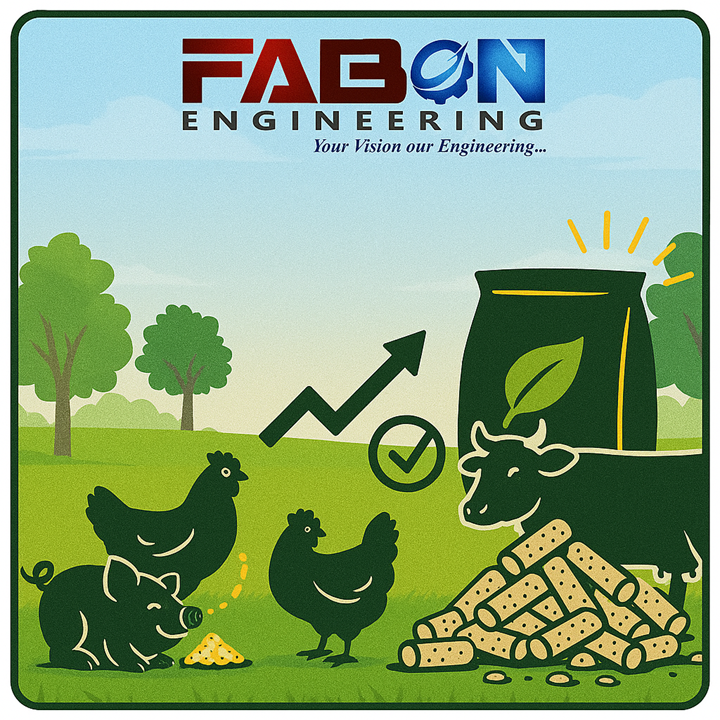
1. Introduction: The Science Behind Efficient Feeding
Feed is the single largest expense in livestock farming—often representing 60–70% of total production cost. Improving Feed Conversion Efficiency (FCE)—the ability of animals to convert feed into body weight—is therefore a crucial performance factor.
Traditional loose feed or mash forms often result in high wastage, uneven nutrition, and poor digestibility. The modern solution lies in pelleted feed — compact, uniform, and energy-efficient.
At FABON Engineering, we specialize in advanced Feed Pellet Machines that help livestock farmers and commercial feed producers achieve higher FCR (Feed Conversion Ratio), lower feed cost, and consistent growth results across cattle, poultry, pigs, and fish.
2. What Is Feed Conversion Efficiency (FCE)?
Feed Conversion Efficiency measures how efficiently animals convert feed nutrients into weight gain or production (milk, eggs, meat).
FCR = Feed Intake (kg) By Weight Gain (kg)
A lower FCR indicates better efficiency. For example:
- Broiler chickens: 1.5–1.8 FCR
- Cattle: 6–8 FCR
- Fish: 1.2–1.5 FCR
By optimizing feed form, composition, and digestibility through pelleting, FABON Feed Pellet Machines can help achieve up to 10–20% improvement in FCR across livestock categories.
3. Why Pelleted Feed Outperforms Traditional Feed
3.1 Uniform Nutrition Distribution
Pelleting ensures every pellet contains the same proportion of nutrients — vitamins, proteins, fats, and minerals — eliminating sorting or selective feeding behavior in animals.
3.2 Improved Digestibility
The heat and pressure during pelleting gelatinize starch, soften fibers, and denature anti-nutritional factors — making feed easier to digest and absorb.
3.3 Reduced Wastage
Pellets are less dusty, non-segregating, and easy to handle. Studies show 5–10% less feed wastage compared to mash feed.
3.4 Enhanced Palatability
Pelleted feed tastes and smells better. Livestock and fish consume it readily, resulting in higher feed intake and faster growth.
3.5 Better Feed Hygiene
High-temperature processing kills pathogens and mold spores, ensuring a safer and longer-lasting feed.
4. FABON’s Role in Feed Pellet Innovation
FABON Engineering, a trusted name in biomass and feed machinery, designs and manufactures high-performance Feed Pellet Machines suitable for:
- Poultry feed
- Cattle feed
- Pig feed
- Fish feed
- Goat and sheep feed
Our FABON Feed Pellet Line integrates precision engineering with efficient design — built for continuous 20-hour operation, minimal downtime, and long-term reliability.
5. FABON Feed Pellet Machine – Key Features
| Feature | Description |
| Model Range | 100 kg/hr to 5 TPH |
| Pellet Die Type | Flat Die / Ring Die |
| Motor Power | 5 HP – 100 HP |
| Material of Construction | Heavy-duty MS/SS |
| Pellet Size Options | 2 mm – 10 mm |
| Warranty | 1 Year |
| After-Sales Service | Pan-India network |
| Operation | Continuous duty, low vibration |
| Control | Automatic temperature and feed rate |
| Applications | Cattle, poultry, fish, pig feed & biomass pellets |
6. How Pelleted Feed Improves Feed Conversion Ratio (FCR)
6.1 Higher Feed Intake and Lower Feed Loss
Pellets are dense and uniform, preventing animals from wasting feed. This directly improves daily feed utilization.
6.2 Nutrient Preservation
FABON machines use precise temperature control to prevent nutrient degradation while maintaining pellet strength and durability.
6.3 Optimal Feed Texture
Each pellet maintains consistent hardness (7–9 kg/cm²) ensuring it doesn’t break during transport or feeding.
6.4 Energy Savings
Pelleted feed requires less chewing and rumination, so animals spend less energy on digestion — improving FCR.
7. Real-World Results – Case Studies
Case 1: Poultry Farm in Maharashtra
- Before FABON Pellet System: FCR 1.8
- After Installation: FCR improved to 1.55
- Feed cost reduced by 9%
- Bird weight uniformity increased by 15%
Case 2: Cattle Feed Mill, Gujarat
- Old mash feed line → replaced with FABON 2 TPH pellet line
- Result: 18% increase in milk yield & better feed efficiency
Case 3: Fish Feed in Andhra Pradesh
- Switched to 4mm FABON aqua pellets
- Reduced feed wastage by 12%
- Achieved higher growth rate and cleaner ponds
8. Advantages of FABON Feed Pellet Machines
- Strong, Rugged Construction — Built for Indian conditions.
- Energy Efficient Motors — Consumes 15–20% less electricity.
- Precision Die and Rollers — Ensures uniform pellet size.
- Easy Maintenance — Modular parts, quick die-change system.
- Customizable Output — Tailored for livestock species.
- Made in India — Engineered and assembled at FABON Nashik facility.
- High ROI — Payback within 8–12 months based on feed cost savings.
9. Integration with Complete Feed Plant
FABON doesn’t just build pellet machines — we provide end-to-end feed plant solutions, including:
- Hammer Mill for grinding
- Ribbon Blender / Mixer
- Conditioner
- Pellet Mill
- Cooler
- Crumbler
- Vibratory Sieve
- Bagging System
Each component is engineered to deliver maximum throughput with minimal power consumption.
10. Feed Conversion Efficiency Improvement Tips
| Technique | Effect on FCR |
| Maintain proper pellet size for animal age | Improves intake efficiency |
| Add binders and steam conditioning | Enhances pellet strength |
| Ensure uniform feed mixing | Improves nutrient distribution |
| Control moisture at 10–12% | Prevents mold growth |
| Use FABON Pellet Mill die clearance adjustment | Optimizes compaction |
| Regular maintenance and cleaning | Prevents contamination and blockages |
11. Cost Savings and ROI Calculation Example
For a 1 TPH FABON Feed Pellet Machine, running 20 hours/day:
| Parameter | Mash Feed | Pelleted Feed |
| Feed Wastage | 8% | 2% |
| Power Cost/ton | ₹350 | ₹280 |
| Feed Conversion Ratio | 1.8 | 1.55 |
| Average Cost Savings | ₹700–₹1000 per ton | |
| ROI Period | 8–10 months |
12. Environmental & Operational Benefits
- Reduced Dust Emissions – Cleaner working environment.
- Less Feed Storage Space – Compact and easy to store.
- Uniform Feed Handling – Compatible with automatic feeders.
- Sustainable Manufacturing – FABON machines are energy-efficient, supporting India’s green mission.
13. FABON’s Vision for Future Farming
As India transitions towards precision livestock nutrition, FABON Engineering continues to innovate with:
- IoT-based feed plant automation
- Energy-efficient pellet lines
- Eco-friendly designs
- Integration of biomass energy systems for feed drying
FABON aims to make Indian farms more productive, sustainable, and globally competitive through smart engineering and sustainable feed technology.
14. Why Choose FABON Engineering
✅ ISO 9001:2015 Certified Company
✅ In-house R&D and Design Team
✅ After-Sales Support Across India
✅ Customized Feed Plant Solutions (500 kg/hr to 10 TPH)
✅ Proven Performance in Feed, Biomass, and Agro Machinery
Visit: 🌐 www.fabon.in
📞 Contact: +91-9370999191
📧 Email: [email protected]
15. Conclusion
Improving Feed Conversion Efficiency isn’t just about better feed — it’s about better technology.
Pelleted feed produced by FABON Feed Pellet Machines ensures every bite counts — increasing growth rate, reducing waste, and maximizing profits for farmers.
With FABON’s engineering excellence, you don’t just feed your animals — you feed your success.