

How to Calculate Press Brake Tonnage for Different Materials (MS, SS, Aluminium)

🔧 Introduction
In sheet metal fabrication, selecting the correct press brake tonnage is critical for achieving accurate bends, avoiding machine overload, and ensuring tool life. Whether you are bending Mild Steel (MS), Stainless Steel (SS), or Aluminium, the required tonnage varies significantly based on material strength, thickness, and tooling.
Many fabrication units face issues like:
- Under-bending or over-bending
- Tool damage
- Machine breakdown
- Inconsistent product quality
All of these often come down to incorrect tonnage calculation.
This comprehensive guide will help you understand:
- The tonnage calculation formula
- Differences between MS, SS, and Aluminium
- Step-by-step calculation methods
- Practical examples
- Tool selection impact
- Real-world industrial insights
⚙️ What is Press Brake Tonnage?
Press brake tonnage refers to the force required to bend sheet metal into a desired angle using a press brake machine.
👉 It is typically measured in:
- Tons (T)
- kN (kilonewtons)
The tonnage required depends on:
- Material type
- Thickness
- Bend length
- Die opening (V-width)
📐 Standard Press Brake Tonnage Formula
T=V1.42×L×t2
Where:
- T = Required tonnage (tons)
- L = Bend length (mm)
- t = Material thickness (mm)
- V = Die opening (mm)
- 1.42 = Constant for mild steel
🧠 Understanding the Formula
🔹 Key Insights:
- Tonnage increases with square of thickness → very important
- Larger die opening reduces tonnage
- Longer bend length increases force
👉 Example:
- Doubling thickness → 4x tonnage required
🏗️ Material Strength Comparison
Different materials require different tonnage due to yield strength differences.
| Material | Relative Factor | Strength |
|---|---|---|
| Mild Steel (MS) | 1.0 | Standard |
| Stainless Steel (SS) | 1.5–2.0 | High |
| Aluminium | 0.5–0.7 | Low |
🧱 Mild Steel (MS) Tonnage Calculation
Mild Steel is the baseline material for tonnage calculation.
✅ Example Calculation:
- Thickness (t) = 5 mm
- Bend Length (L) = 1000 mm
- Die Opening (V) = 40 mm
👉 Formula:
T = (1.42 × 1000 × 5²) / 40
T = (1.42 × 1000 × 25) / 40
T = 35,500 / 40
T = 88.75 tons
🛡️ Stainless Steel (SS) Tonnage Calculation

Stainless Steel requires higher tonnage due to:
- Higher tensile strength
- Lower ductility
- More springback
🔹 Correction Factor:
👉 Multiply MS tonnage by 1.5 to 2
✅ Example:
From MS calculation:
- 88.75 tons × 1.5 = 133 tons
👉 Required tonnage for SS ≈ 130–180 tons
🪶 Aluminium Tonnage Calculation
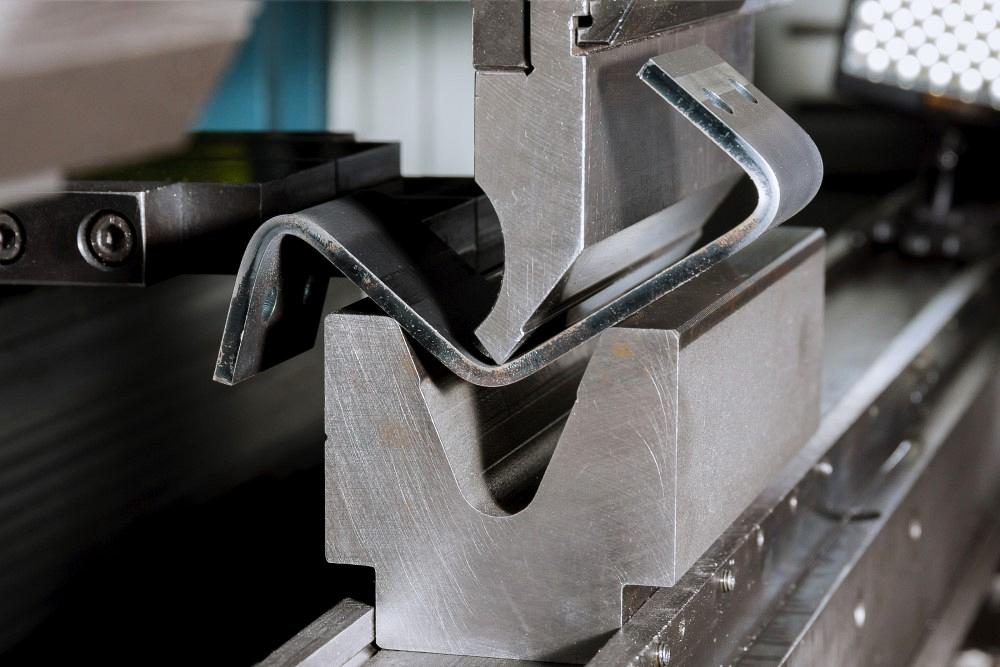
Aluminium is softer and requires less force.
🔹 Correction Factor:
👉 Multiply MS tonnage by 0.5 to 0.7
✅ Example:
- 88.75 × 0.6 = 53 tons
👉 Required tonnage for Aluminium ≈ 50–60 tons
📊 Quick Tonnage Comparison Chart
| Material | 5mm Thickness (1000mm Length) |
|---|---|
| Mild Steel | ~90 tons |
| Stainless Steel | ~130–180 tons |
| Aluminium | ~50–60 tons |
⚙️ Effect of Die Opening (V-Width)
Rule of Thumb:
👉 V = 6 × Thickness (for air bending)
| Thickness | Recommended V |
|---|---|
| 2 mm | 12 mm |
| 5 mm | 30–40 mm |
| 10 mm | 60–80 mm |
🔥 Important:
- Smaller V → Higher tonnage
- Larger V → Lower tonnage
📉 Real Impact of Die Selection
| Die Opening | Tonnage |
|---|---|
| Small V | High force |
| Large V | Low force |
👉 Choosing wrong die can:
- Overload machine
- Damage tooling
- Affect bend quality
📏 Bending Method Impact
1. Air Bending (Most Common)
- Lowest tonnage
- Flexible angles
2. Bottoming
- Higher tonnage
- More accuracy
3. Coining
- Very high tonnage (3–5x air bending)
- No springback
🧪 Springback Consideration
Different materials behave differently after bending:
| Material | Springback |
|---|---|
| MS | Low |
| SS | High |
| Aluminium | Medium |
👉 SS requires:
- More tonnage
- Angle correction
🏭 Machine Selection Based on Tonnage
| Application | Recommended Machine |
|---|---|
| Light work | 40–80 Ton |
| Medium fabrication | 100–200 Ton |
| Heavy fabrication | 300–400 Ton |
⚠️ Common Mistakes in Tonnage Calculation
- Ignoring material type
- Using wrong die opening
- Not considering bend length
- Overloading machine
- Ignoring safety factor
🔧 Practical Industrial Example
Case: Fabrication Unit
- Material: MS
- Thickness: 8 mm
- Length: 2500 mm
- V: 64 mm
👉 Calculation:
T = (1.42 × 2500 × 64) / 64
T = (1.42 × 2500 × 64) / 64
T = 1.42 × 2500
T = 355 tons
👉 Machine Required: 400 Ton CNC Press Brake
📈 How Tonnage Affects Production
Correct tonnage ensures:
- Accurate bending
- Less rejection
- Higher productivity
- Longer machine life
Incorrect tonnage leads to:
- Scrap material
- Machine damage
- Poor quality
🚀 Advanced Tips for Fabricators
- Always keep 20–30% safety margin
- Use CNC system for automatic calculation
- Maintain proper tooling
- Monitor material quality
🔮 Future Trends (2026)
- Smart CNC press brakes with auto tonnage calculation
- AI-based bending correction
- Industry 4.0 integration
- Energy-efficient hydraulic systems
🧠 Expert Recommendation
For fabrication businesses:
- Use MS formula as base
- Apply correction factors
- Choose proper die opening
- Invest in CNC press brake for accuracy
🏁 Final Conclusion
Calculating press brake tonnage is not just a formula—it is a critical engineering decision that directly affects:
- Product quality
- Machine safety
- Business profitability
✔ Key Takeaways:
- MS is baseline material
- SS requires highest tonnage
- Aluminium requires lowest
- Thickness impacts tonnage exponentially
- Die selection is crucial
👉 Final Verdict:
Accurate tonnage calculation is the backbone of efficient sheet metal fabrication.