

“HOW SAWDUST MAKING MACHINE WORKS IN BIOMASS PELLET INDUSTRIES AND IT’S INPUT AND OUTPUT”
INTRODUCTION
Biomass pellet production is one of the fastest-growing clean-energy industries in India, driven by the rising demand for sustainable fuel in industries, power plants, boilers, ovens, and commercial heating systems. But the quality of biomass pellets depends on one crucial element:
👉 Consistent, fine, uniform sawdust or biomass powder.
This is where the sawdust making machine becomes the backbone of the pellet industry.
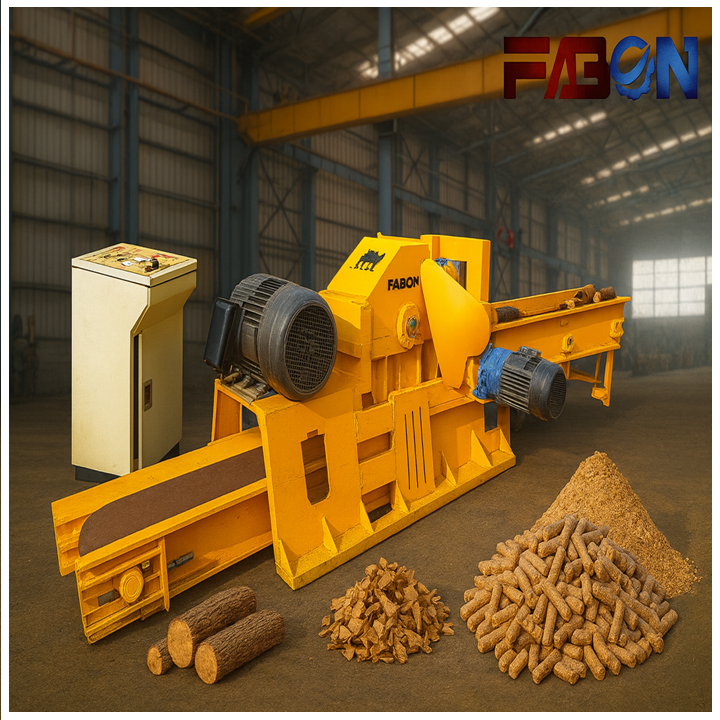
A sawdust making machine converts wood logs, slabs, chips, coconut shells, bamboo, pallets, and agro-waste into fine sawdust that is ideal for pelletizing. Without high-quality sawdust, pellet production efficiency drops, energy consumption increases, and pellet durability suffers.
FABON Engineering—India’s leading biomass machinery manufacturer—produces high-performance sawdust machines designed for continuous 20-hour operations, low maintenance, and maximum output, making them one of the top choices for pellet manufacturers across India and abroad.
This 5000-word technical blog explains:
✔ How sawdust making machines work
✔ Complete internal working mechanism
✔ Input materials and preparation
✔ Output size, quality & final applications
✔ Role of sawdust in pellet production
✔ Technical specifications
✔ Industrial benefits
✔ Why FABON machines outperform Chinese & local competitors
WHAT IS A SAWDUST MAKING MACHINE?
A sawdust making machine—also called wood crusher, wood powder machine, or biomass pulverizer—is an industrial machine used to convert raw wood and biomass waste into fine sawdust suitable for biomass pellet manufacturing.
It is used in:
- Biomass pellet plants
- Feed pellet plants
- Furniture & timber industries
- Mushroom farming
- Paper pulping units
- Animal bedding plants
- Incense stick manufacturing
- Bio-coal briquette plants
1.1 Why Sawdust Is Important in Biomass Pellet Production
Pellet machines require powder particle size of 2–8 mm. Larger particles reduce:
- Pellet density
- Pellet durability
- Die life
- Production rate
A sawdust machine ensures:
- Uniform fine powder
- High binder absorption
- Better compaction inside die
- Smooth feeding
- Reduced wear & tear
FABON machines provide consistent powder that helps pellet plants increase productivity by 20–35%.
RAW MATERIALS USED IN SAWDUST MAKING
The flexibility of input raw materials decides the machine’s versatility. FABON sawdust machines accept:
2.1 Wood-Based Materials
- Hardwood logs
- Softwood logs
- Waste timber
- Wooden pallets
- Plywood waste
- Veneer waste
- Sawmill residues
- Tree branches
- Bamboo
2.2 Agricultural Biomass
- Coconut shells
- Groundnut shells
- Mustard stalk
- Cotton stalk
- Sugarcane trash
- Rice husk (coarse)
- Corn cobs
- Paddy straw bundles
2.3 Recycled Waste
- Wooden packaging material
- Waste crates
- Old furniture scrap
- Demolition wood
FABON machines are engineered with heavy-duty motors (20 HP to 200 HP) and hardened blades, allowing them to process even high-density hardwoods like teak and acacia.
STEP-BY-STEP WORKING OF A SAWDUST MAKING MACHINE
This is the core section that explains how sawdust making machine works in biomass pellet industry.
The working can be divided into 7 stages:
3.1 STAGE 1: RAW MATERIAL FEEDING
Raw material is fed manually or using a belt conveyor/log conveyor.
✔ The feed size depends on the machine model
✔ Larger logs require pre-cutting (8–10 inches)
✔ FABON provides feeding conveyors for automatic systems
3.2 STAGE 2: PRIMARY CUTTING VIA ROTOR BLADES
Inside the machine, a high-speed rotor—fitted with alloy steel cutting blades—grabs the material.
Speed range: 1500–2800 RPM
The blades perform:
🔹 Shearing
🔹 Chipping
🔹 Splitting
This reduces raw material to intermediate chips.
3.3 STAGE 3: SECONDARY IMPACT MILLING
The intermediate chips hit the impact hammers mounted inside the chamber.
This reduces material further to 2–10 mm sawdust.
FABON machines use balanced rotors to minimize vibration and improve output quality.
3.4 STAGE 4: SCREENING & SIZE CONTROL
The crushed material passes through a perforated screen.
✔ Only fine sawdust passes out
✔ Coarse particles return for re-crushing
Screen sieve sizes available:
- 4 mm
- 6 mm
- 8 mm
- 10 mm
3.5 STAGE 5: BLOWER DISCHARGE & CYCLONE COLLECTION
A powerful blower fan sends the sawdust out through the outlet pipe to a cyclone.
Cyclone performs:
✔ Separation of air & powder
✔ Settles fine sawdust
✔ Ensures dust-free collection
FABON provides:
- Single cyclone
- Double cyclone
- High-capacity twin cyclones (for 5–10 TPH plants)
3.6 STAGE 6: STORAGE OR FEEDING TO PELLET MACHINE
Collected sawdust is:
➡ Directly sent to pellet machine feeder
➡ Stored in a hopper or silo
➡ Sent to a dryer (if moisture > 15%)
3.7 STAGE 7: DUST FILTERING
An optional bag filter system captures micro dust, making the process pollution-free.
OUTPUT QUALITY – WHAT THE MACHINE PRODUCES?
4.1 Final Output
- Fine sawdust
- Particle size: 2–8 mm
- Moisture: depends on input (not changed by machine)
- Shape: fibrous, uniform
4.2 Output Capacity
FABON makes machines from:
| Model | Motor HP | Output Capacity |
| Fabon SM-300 | 20 HP | 300–500 kg/hr |
| Fabon SM-500 | 40 HP | 500–800 kg/hr |
| Fabon SM-1000 | 75 HP | 1–1.5 TPH |
| Fabon SM-1500 | 100 HP | 1.5–2 TPH |
| Fabon SM-2000 | 150 HP | 2–3 TPH |
| Fabon SM-3000 | 200 HP | 3–5 TPH |
FABON is among the few companies in India manufacturing 2–5 TPH sawdust plant systems with cyclones, conveyors, blowers, and silos.
ROLE OF SAWDUST IN BIOMASS PELLET INDUSTRY
Premium pellet quality requires:
✔ Fine powder
✔ Stable moisture
✔ Good binding properties
✔ Uniform density
FABON sawdust making machines help pellet plants achieve:
5.1 Higher Pellet Strength
Fine powder improves compacting inside pellet die → pellets do not break.
5.2 Higher Output
Uniform sawdust allows smoother die movement → increases output by 20–40%.
5.3 Lower Energy Consumption
Smaller particles require less power to press.
5.4 Better Heat Value
Sawdust maintains GCV 3800–4200 kcal/kg, ideal for:
- Boilers
- Hot air generators
- Furnaces
- Industrial heating
COMPLETE PROCESS FLOW IN A SAWDUST-TO-PELLET PLANT
6.1 Input Stage
✔ Wood logs
✔ Agro waste
✔ Wooden pallets
✔ Sawmill waste
6.2 Processing Stage
- Pre-cutting (if required)
- Sawdust making machine operation
- Screening
- Drying in FABON Flash Dryer or Rotary Dryer
- Pelletizing in Ring-Die Pellet Machine
- Cooling
- Bagging
6.3 Output
✔ High-density biomass pellets
✔ GCV 3800–4500 kcal/kg
✔ Moisture 8–12%
ADVANTAGES OF FABON SAWDUST MAKING MACHINES
FABON Engineering machines outperform Chinese models and local manufacturers due to:
7.1 Heavy-Duty Construction
- Thick MS plates
- Heavy structural base
- Shock-proof design
- Anti-vibration mounts
7.2 Hardened Alloy Steel Blades
- Long life
- High cutting efficiency
- Easy to replace
7.3 High Output with Low Electricity
- 20–30% lower power consumption
- Optimized rotor design
7.4 Continuous 20-Hour Operation
Machines designed for pellet manufacturers running long shifts.
7.5 Easy Maintenance
- Simple bearing access
- Quick screen change
- Supports Indian standard spare parts
7.6 Customizable
- Multiple screen sizes
- Cyclone options
- Blower capacities
- Input chute design
SAFETY FEATURES IN FABON MACHINES
- Emergency stop
- Overload protection
- Bearing temperature monitoring
- Rotor balancing
- Enclosed design for safe operation
COSTING & ROI ANALYSIS
9.1 Operating Cost
- Electricity
- Blade replacement
- Labor
- Maintenance
9.2 ROI
Most FABON clients achieve return on investment in:
👉 4–6 months (for 1–2 TPH plants)
FABON also provides turnkey pellet plants from 500 kg/hr to 10 TPH.
WHY BIOMASS PELLET PLANTS PREFER FABON?
✔ 1-Year Warranty
✔ On-Site Installation & Training
✔ 20+ Years Engineering Expertise
✔ Genuine Spare Supply
✔ After-Sales Support
✔ Pan-India Service Team
CONCLUSION
A sawdust making machine is crucial for any biomass pellet manufacturing plant. Its job is to convert raw wood and agro waste into fine, uniform sawdust that ensures:
✔ Higher pellet output
✔ Better fuel quality
✔ Lower production cost
✔ Long life of pellet die & rollers
FABON Engineering provides the strongest, most reliable, and energy-efficient sawdust machines specifically designed for Indian raw materials and harsh industrial conditions.
If you want to set up a sawdust or pellet plant, FABON is the most trusted partner in India.
FABON SAWDUST MAKING MACHINE
High-output | Heavy-duty | Precision engineered for biomass pellet industries
1️ What is a FABON Sawdust Making Machine?
A FABON Sawdust Making Machine is a heavy-duty industrial crusher designed to convert wood logs, slabs, pallets, branches, coconut shells, and agro-waste into fine sawdust suitable for biomass pellet production.
2️ How does the sawdust machine work?
The machine works through a 3-stage operation:
- Feeding via conveyor/log tray
- Primary cutting using alloy steel blades
- Secondary crushing & screening for fine uniform sawdust
FABON’s optimized rotor and blade design ensures high output with low electricity consumption.
3️ What input materials can the machine handle?
✔ Hardwood logs
✔ Softwood logs
✔ Wooden pallets & waste
✔ Sawmill residues
✔ Bamboo, coconut shells
✔ Agro residues like cotton stalk, mustard stalk, corn cobs
4️ What is the output size of sawdust?
FABON machines produce 2–8 mm uniform sawdust, ideal for pellet machines, briquettes, furnaces, and biomass boilers.
5️ What capacities does FABON offer?
FABON models range from 500 kg/hr to 5 TPH, depending on raw material type and motor size (20 HP to 200 HP).
6️ Is this machine suitable for biomass pellet plants?
Yes. It is specifically designed for continuous operation in pellet factories, ensuring:
✔ Uniform powder
✔ Higher pellet density
✔ 20–40% increase in pellet output
7️ What are the major advantages of FABON sawdust machines?
- Heavy-duty steel body
- Hardened alloy blades
- Low power consumption
- 20-hour continuous operation
- Easy maintenance
- Integrated safety features
- High accuracy control panel
- Indian raw-material–friendly design
8️ Does the machine require pre-cutting of wood logs?
Large logs may require pre-cutting into 8–10 inch lengths for smooth feeding. FABON provides optional log conveyors for fully automated feeding.
9️ Does FABON provide a cyclone and blower system?
Yes. FABON offers:
- Single cyclone
- Dual cyclone
- Custom cyclone collectors
for dust-free separation and fine-powder collection.
10 What safety features are included?
- Emergency stop
- Overload protection
- Enclosed cutting chamber
- Anti-vibration design
- Electrical safety control panel
- Proper guarding around belts and motors
11 What is the maintenance requirement?
Minimal maintenance due to:
✔ Quick-change cutting blades
✔ Easy access bearings
✔ Robust build quality
✔ Standard Indian parts
12 Do you provide installation & service?
Yes—FABON offers Pan-India installation, commissioning, operator training, and lifetime service support.
13 What industries use this sawdust machine?
- Biomass pellet plants
- Briquette plants
- Wood processing units
- Mushroom farms
- Paper pulping plants
- Animal bedding manufacturers
- Incense stick industries
14 What is the power consumption?
Depends on the model:
- 20 HP to 200 HP motors
- Optimized design ensures 20–30% lower electricity usage than competitors.
15 How does FABON’s machine compare to Chinese machines?
FABON machines are:
✔ Stronger
✔ More durable
✔ Higher output
✔ Easier to maintain
✔ Made for Indian wood hardness
✔ Backed by local service & spares
16 Can it run continuously for long hours?
Yes, FABON machines are engineered for 20-hour industrial operation, with low heat generation and stable vibration.
17 What is the ROI for pellet plant owners?
ROI is typically 4–6 months, depending on plant capacity and raw material cost.
18 Can the machine be integrated in a fully automatic line?
Yes. FABON provides:
✔ Conveyors
✔ Cyclones
✔ Dust collectors
✔ Silos
✔ Pellet machines
✔ Complete 1–10 TPH turnkey pellet plants
19 What warranty does FABON provide?
Every FABON machine comes with a 1 Year Warranty, plus lifetime service and spare support.
20 Do you offer customization?
Yes. FABON machines can be customized for:
- Output capacity
- Raw material type
- Motor configuration
- Blade type
- Screen size
- Discharge height
- Color & branding