

“HOW BIOMASS PELLETS ARE POWERING A GREENER FUTURE”
Introduction
In a world striving for sustainable energy and reduced carbon emissions, biomass pellets have emerged as a powerful, practical solution. These compact fuel cylinders made from organic residues are rapidly transforming the way we generate heat, power industry and support circular economies. Companies like FABON are at the forefront of delivering high-quality biomass pellet solutions that enable industries, utilities and communities to switch away from fossil fuels.
In this article we’ll explore:
- What biomass pellets are and how they are produced
- The environmental, economic and social benefits of pellet fuel
- The global market and outlook, especially in India
- Use-cases: industry, power generation, co-firing, domestic heating
- How FABON’s offering fits in and why choosing the right supplier matters
- Challenges, sustainability pitfalls and how to mitigate them
- What the future holds for biomass pellets and how you can get involved
Let’s begin our journey into how biomass pellets are powering a greener future.
What are biomass pellets?
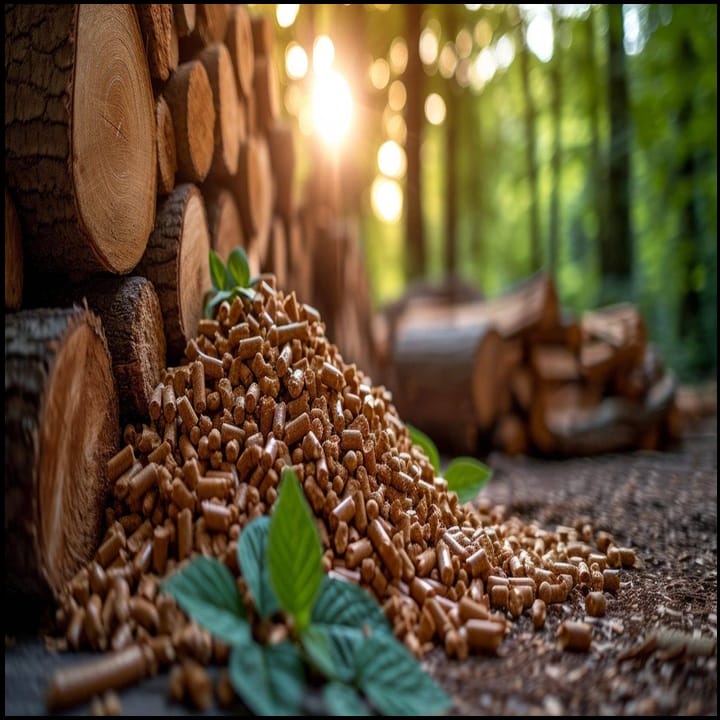
At its core, a biomass pellet is a densified form of biomass: organic materials like wood chips, sawdust, agricultural residues, energy crops, are processed, dried, ground, compressed under high pressure into uniform cylinders that can be efficiently stored, transported and combusted. FABON+2Nature+2
Characteristics of biomass pellets
Some of the key characteristics:
- Uniform shape, size (commonly 6-8 mm diameter for wood-based pellets) makes them easy to handle and feed into automatic systems. FABON+1
- Low moisture content (typically <10%) which boosts energy density and combustion efficiency. FABON+1
- High bulk density compared to loose biomass (e.g., wood chips) meaning less volume for same energy. greenvinci.com+1
- Low ash content (for high quality wood pellets) – this enables cleaner combustion. FABON+1
- Ability to use a wide range of feedstocks (wood, agricultural residues, etc). FABON+1
How are they produced?
The production process generally follows these steps:
- Raw material collection: wood residues, sawdust, agricultural residues, energy crops. FABON+1
- Drying: bringing moisture down to ~6-10% to ensure efficient pelletizing and burning. FABON+1
- Grinding/Milling: producing fine powder or uniform particles. FABON
- Pelletizing/Compression: using a pellet mill/die, high pressure and often heat cause lignin (in wood) or binders to bind the material into dense pellets. FABON+1
- Cooling and hardening: to stabilise shape and avoid breakage. FABON
- Screening & Packaging: removing fines, dust; then packaging for storage, transport or bulk use. FABON
Types of biomass pellets
There are a few broad types:
- Wood pellets: from forestry residues, sawdust, wood chips. High calorific value, low ash. FABON+1
- Agricultural residue pellets (agro-pellets): made from straw, husks, stalks, shells etc. Generally lower energy value, higher ash content. FABON+1
- Advanced pellets (torrefied, black pellets): biomass is pre-treated (e.g., torrefied) to improve energy density, hydrophobicity, storage, etc. FABON+1
Why biomass pellets matter for a greener future
Let’s explore the key benefits — environmental, economic, social — that make biomass pellets a vital piece of the clean energy transition.
Environmental benefits
- Carbon-cycle advantage / low net CO₂: When biomass is sourced sustainably (i.e., residues or from regrowth), the CO₂ emitted when it is burned is roughly equal to the CO₂ absorbed while the plant grew. That gives a “carbon neutral” or – at least significantly lower carbon-intensity – fuel compared to fossil fuels. FABON+1
- Waste-utilisation & circular economy: Many pellets are made from residues (sawdust, agriculture waste) which otherwise might decompose and emit methane, or be burned openly causing pollution. Using those residues for fuel is a win for resource efficiency. FABON+1
- Lower pollutant emissions than coal/fossil fuels: Because pellets generally have very low sulfur, chlorine, and often lower heavy metals (provided feedstock is clean), they result in fewer harmful emissions like SO₂, HCl, and heavy‐metal contaminants. FABON+1
- Improved combustion & efficiency: The uniform size, dryness and density mean combustion is more complete and efficient, which reduces waste, unburnt material and emissions. greenvinci.com
- Reduced pressure on landfills / open burning: By diverting biomass residues into pellet production, less material goes to landfill or is burned openly—a positive for air quality and land use.
Economic & energy security benefits
- Reduced dependence on fossil fuel imports: For countries that import coal, oil or gas, local biomass pellet production offers a way to rely more on domestic feedstocks.
- Job creation, rural economy boost: Pellet manufacturing plants, feedstock collection, transport and logistics create local employment especially in rural/agricultural regions.
- Cost-effectiveness: In many industrial heating applications, pellets can compete effectively with coal or other fossil fuels—especially when future carbon pricing or regulation is factored in. PelletIndia.com
- Compatibility with existing infrastructure: Many power plants or boilers can adapt to co-firing pellets with coal, meaning less radical capital investment required to switch. FABON
Social & sustainability impact
- Cleaner air and healthier communities: Use of pellets in place of open biomass burning, low-quality coal or diesel for heating can cut particulate matter, SOx/NOx and other pollutants—improving air quality.
- Managing agricultural residues & stubble: In regions with crop-residue burning (a major air pollution source), converting that residue into pellets offers a dual benefit: energy production + pollution reduction.
- Supporting circular resource use: Encouraging residual streams to become value streams fosters sustainable land management and resource efficiency.
Global market outlook & opportunity
The market for biomass pellets is growing rapidly worldwide—and the opportunity is particularly significant in India and similar emerging economies.
Global scale
- According to one study, the global biomass pellets market was valued at USD 10.14 billion in 2024 and is projected to reach USD 16.41 billion by 2033 (CAGR ~4.8%). Imarc Group
- Another source projects the market to grow from USD 12.3 billion in 2025 to USD 23.5 billion by 2035 (CAGR 6.7%) for heating and industrial applications. Future Market Insights
- The global production of biomass pellets has also seen strong growth: e.g., one estimate puts 2022 production at ~44 million tonnes, up nearly 150% since 2012. FABON
India-specific relevance
- India is focusing on biomass pellets through initiatives such as the national biomass mission (SAMARTH) and co-firing mandates in coal power plants. For example, the government mandates coal plants to use ~5% blend of biomass pellets by energy from FY 2024-25, rising further. FABON
- Agricultural waste in India is abundant (~230 million tons surplus) which offers huge feedstock potential for pellet production and co-firing. FABON
Market drivers
Some of the key drivers behind this growth:
- Stronger regulatory pressure on carbon emissions, fossil fuel substitution.
- Advances in pelletizing technology and logistics, reducing cost.
- Policies favouring renewable energy and bioenergy incentives.
- Need for rural employment and utilization of residue streams.
Why now is the time
With carbon pricing, global energy transition momentum, rising cost of fossil fuels, and increasing concern around energy security (especially for import-dependent nations) the timing is ripe. Entrepreneurs and industries shifting early to pellets stand to gain strategic advantage.
Application scenarios: Where biomass pellets shine
Here we explore how biomass pellets are used in real-world settings, and how companies like FABON deliver value.
Industrial boilers & process heat
Many manufacturing plants require large amounts of thermal energy for drying, heating, steam generation (cement, textiles, food processing, chemicals, etc.). Switching from coal or heavy oil to high-quality biomass pellets offers:
- reduced fossil fuel cost and carbon footprint
- lower particulate and sulphur/metal emissions
- a renewable, domestically-sourced fuel option
FABON offers biomass pellets that meet consistent quality criteria (low moisture, controlled ash, high calorific value) making them suitable for industrial boilers and furnaces.
Power generation & co-firing
Large-scale power plants, especially coal-fired ones, can co-fire biomass pellets (blend biomass with coal) or convert parts of the facility to pellet-only combustion. Benefits:
- leveraging existing boiler infrastructure
- immediate emission reductions (CO₂, SO₂, NOx) when biomass replaces a portion of coal.
- In many jurisdictions, biomass can qualify for renewable credits or incentives.
For instance, countries in Europe have led conversion of coal plants to pellet-fuelled. India’s co-firing targets also open opportunity. FABON can supply bulk pellet volumes and support logistics for power utilities considering biomass substitution.
Domestic heating, pellet stoves and small systems
On a smaller scale, biomass pellets are used for residential heating (pellet stoves), commercial buildings and community heating systems. The benefits include cleaner combustion compared to raw wood or coal and higher efficiency. PelletIndia.com While this is a smaller segment in India right now, it holds growth potential.
Agricultural residue & regional valorisation
In agricultural regions, residues such as rice husk, wheat straw, corn stalks, coconut shells can be pelletised. This not only provides fuel, but helps tackle residue-burning, air pollution and creates new income streams for farmers. FABON’s expertise in utilising such feedstocks (depending on region) helps integrate local supply chains.
Export & global supply chains
High quality biomass pellets are also exported (especially wood pellets) to meet global demand in Europe, Japan, Korea etc. While bonding to export is more common for wood pellets, India’s agro-pellet potential offers a window. Companies like FABON are well-placed to scale up pellet production and supply both domestic & export markets.
Why choose FABON? (and what sets them apart)
Here we shift to promoting FABON’s strengths and show how they offer value in the pellet ecosystem.
Trusted quality & process
FABON emphasises strict quality control in their pellet manufacturing: consistent diameter & length, low moisture content, low ash, high calorific value. According to their website, pellets produced by FABON are derived from sustainable sources and processed via advanced pellet mills. FABON This gives customers confidence in combustion performance and predictable outcomes.
Customised feedstock & local sourcing
FABON is adept at utilising a range of feedstocks (wood residues, agro-residues) and tailoring the pellet spec to suit the end-use (industrial boiler, co-firing, small-scale). This versatility is crucial in the Indian context where feedstock availability, seasonality and residue type vary.
Sustainability and circular economy-thinking
The brand emphasises the environmental benefits of pellet use: transforming residual biomass that would otherwise be waste, reducing landfill or open burning, supporting lower carbon energy. FABON By working with FABON, customers join a transition to renewable, local fuel and contribute to sustainability goals.
Logistics & supply chain support
Switching to biomass fuel requires more than just fuel supply — logistics (transport, storage, handling), consistent delivery, quality assurance and technical support are vital. FABON’s experience means fewer surprises and more reliable fuel supply.
Competitive economics
While fossil fuel costs are volatile and subject to carbon regulation risk, high-quality biomass pellets provide a stable and often lower-cost alternative. In many industrial heating scenarios, pellets offer comparable cost with added green credentials. FABON helps evaluate the fuel economics and ROI for clients.
One-stop solution & end-use support
FABON doesn’t just supply pellets — they help clients evaluate feedstock, design pellet fuel switch-over, and optimise pellet utilisation. This end-to-end approach is a differentiator compared to basic fuel suppliers.
How to evaluate and select biomass pellets — what to look for
If you’re considering switching to biomass pellets (or looking for a supplier), here are key criteria and questions to ask:
- Feedstock origin and sustainability
- Where is the raw material sourced? Are they residues or dedicated crops?
- Are forests managed sustainably (if wood is used)?
- Is there any deforestation or indirect land-use change risk?
- Quality specifications
- Moisture content (ideally <10 %)
- Ash content (lower is better, especially for industrial boilers)
- Calorific value (kcal/kg or MJ/kg)
- Bulk density, hardness / durability (to avoid breakage in transport or combustion)
- Size uniformity (diameter, length) to ensure smooth feeding into systems
For example, wood pellets may have a GCV (gross calorific value) of ~4,200-4,800 kcal/kg. FABON
- Certification & standards
- Are the pellets certified (e.g., ENplus, ISO) or tested in lab?
- Supplier transparency on testing and third-party verification helps.
- Logistics & supply reliability
- Does the supplier have consistent feedstock availability?
- What is the transport chain, packaging, storage conditions? Moisture during transport/storage can degrade quality.
- Bulk vs bagged supply: what is your requirement?
- Compatibility with your system
- Will your boiler/furnace accept pellets? Do you need adaptation or retrofitting?
- If co-firing with coal, what blend %, what modifications?
- What are ash handling, residue implications? Some agro-pellets may have high ash or silica.
- Economic evaluation & ROI
- Fuel cost per unit energy – compare pellets vs current fuel
- Maintenance cost, ash disposal cost, boiler efficiency
- Carbon/ESG value: are there incentives, credits for switching?
- After-sales support & technical service
- Does the supplier assist with installation, training, monitoring?
- Are there warranties or performance guarantees?
By asking the right questions and choosing a reputable supplier like FABON, you mitigate risk and maximise the benefits of biomass pellet fuel.
Challenges and how to overcome them
While biomass pellets offer enormous promise, it’s important to recognise and address potential challenges.
Feedstock supply & variability
- One of the biggest risks is inconsistent feedstock (in volume, moisture, composition) which can disrupt pellet manufacturing quality.
- Solution: Establish secure feedstock agreements, diversify feedstock sources, monitor seasonal variation. A supplier like FABON, with experience in multiple feedstocks, helps buffer this risk.
Quality control & ash issues
- Some agricultural-residue pellets have higher ash and silica content, which may cause slagging/fouling in boilers. FABON
- Solution: Choose feedstocks carefully, test sample pellets for ash/silica, ensure boiler compatibility, have ash management plan.
Storage, transportation, and logistics
- Moisture ingress during transport or storage can degrade pellets (reduce energy, increase fines, mould). greenvinci.com
- Solution: Ensure sealed packaging, covered storage, monitor humidity, choose logistics partners equipped for bulk pellet handling.
Sustainability & certification concerns
- Not all pellets are equally “green”. If sourced from deforested land, or if land-use change is not managed, the carbon benefit may be lower or negative. There have been recent critiques of large-scale biomass use. The Guardian+1
- Solution: Ensure feedstock is residue-based or from sustainably managed sources, verify chain of custody, transparency in supplier’s sourcing.
Cost competitiveness & hidden costs
- While pellet fuel can be competitive, if boiler conversion, ash disposal, or supply chain costs are high, the economics may suffer.
- Solution: Conduct a full lifecycle cost assessment, pilot the fuel, monitor actual results.
Policy & regulatory risk
- Biomass policies, subsidies, incentives can change. Also emissions regulation may require additional control systems.
- Solution: Stay updated on policy changes, maintain flexibility in fuel options, work with suppliers who track regulatory landscape (like FABON).
Market maturity
- In some regions (especially in developing countries) biomass pellet market may still be nascent — logistics, standards, user awareness may lag.
- Solution: Choose an experienced supplier who can guide through implementation, provide training and support, and has track record.
Case studies & success stories
Co-firing in power plants
Many coal-fired thermal plants globally have started blending biomass pellets with coal, achieving emission reductions with minimal boiler modification. For example, the global production and use of wood pellets for power has scaled rapidly. FABON
Industrial switch-over
Manufacturing plants in India and elsewhere have replaced part of their coal or heavy-fuel oil consumption with biomass pellets, achieving savings and reducing carbon footprint. Suppliers highlight savings of 60-70 % compared to diesel/heavy fuel oil. PelletIndia.com
Agricultural-residue utilisation
In India, the challenge of stubble burning (especially in states like Punjab, Haryana) has been partly addressed via converting agricultural residues into pellet fuel rather than open burning. This not only improves air quality but also creates new business models for farmers. According to one study, the global technical potential of agricultural residue pellets is huge—on the order of over 1.4 billion tonnes globally, enabling displacement of fossil fuels and significant CO₂ reduction. arXiv
FABON’s role
FABON’s website emphasises the benefits of biomass pellets: carbon-neutrality, waste reduction, efficient heating and power generation, support for local economies and fuel affordability. FABON Through their manufacturing, quality control and supply infrastructure, they are enabling industries and utilities to make the shift.
How your organisation can adopt biomass pellets
If your company, utility or organisation is exploring biomass pellets, here’s a step-by-step roadmap:
- Define your fuel switch or renewable target
- Are you replacing fossil fuel (coal, oil, diesel) with biomass pellets?
- Are you co-firing (blending biomass with existing fuel) or fully converting?
- What target emission reduction or renewable energy share do you aim for?
- Assess current system & technical compatibility
- What fuel do you currently use? What are its cost, calorific value, emissions?
- Does your boiler/furnace support pellets? What modifications are required (fuel feed system, ash handling, storage, burner)?
- What are operational aspects: feedstock logistics, storage space, pellet delivery, handling?
- Select the right pellet specification
- Work with a supplier (e.g., FABON) to define pellet specs: diameter, length, moisture (<10 %), ash content, calorific value, size uniformity.
- Perform lab tests with sample pellets to ensure compatibility.
- Secure supply chain & logistics
- Identify and contract with a pellet supplier with track record and capacity (like FABON).
- Plan storage, handling, transport (bags, bulk trucks, silos).
- Ensure feedstock and pellet consistency over time (seasonal variability, supply chain risks).
- Cost & financial modelling
- Compare current fuel cost vs pellet fuel cost (including transport, handling, ash disposal).
- Factor any conversion/modification costs, maintenance, potential subsidies or carbon credits.
- Estimate payback period, ROI, emissions reduction benefit.
- Implementation & commissioning
- Modify equipment as needed (fuel feed, burner, storage).
- Install monitoring and control to ensure pellet combustion performance (efficiency, emissions, ash).
- Train operations staff on pellet handling, feed system, ash removal.
- Performance monitoring & continuous improvement
- Track fuel consumption, calorific output, emissions, maintenance intervals.
- Feedback to supplier (e.g., FABON) on pellet performance, ash behaviour, any quality issues.
- Optimize operations and ensure long-term supply reliability.
- Communicate the sustainability impact
- Document and report carbon savings, waste utilisation, local benefit to stakeholders (investors, regulators, CSR).
- Use the switch to biomass pellets as part of your sustainability/ESG strategy.
By following these steps and partnering with a trusted supplier like FABON you can ensure a smooth transition to pellet fuel and maximise the green benefits.
The future of biomass pellets & what to expect
Technological evolution
- Torrefied/black pellets: these are upgraded biomass pellets with higher energy density, improved hydrophobicity and better handling/storage properties. These will expand for industrial and power use. FABON+1
- Integration with bio-energy value chains: pellet production may increasingly link to biorefineries, combined heat & power (CHP), carbon capture, etc.
- Hybrid systems: Combining biomass pellets with solar, wind or waste heat for flexible and resilient energy systems.
Policy & market drivers
- Carbon pricing, emission regulations and renewable mandates will push more industries and utilities toward pellet fuel.
- Government incentives/fiscal support will accelerate pellet adoption in new sectors (industrial process heat, district heating, co-firing).
- Standardisation and certifications will strengthen, raising quality and trust in pellet fuel.
Scaling in emerging markets
- In Asia, Africa and Latin America, vast agricultural residue streams exist. Scaling pellet production and use in these markets offers big potential — for energy access, rural jobs and emission reduction.
- India, with its large agricultural output and residue potential, is one of the key markets. FABON is well placed in this market.
Sustainability focus
- Greater emphasis on feedstock traceability, land-use change impact, water use, biodiversity and supply chain transparency.
- Circular economy models: using residues, returning ash to soil as fertiliser, coupling with bio-char production etc.
Business models & innovation
- Pellet-to-energy companies may adopt new models: fuel supply contracts, energy-as-a-service, off-taker arrangements, partnerships with agriculture producers for feedstock supply.
- Export opportunities will grow, but so will competition, quality standards and sustainability demands.
Why now is the moment to act
- The cost of delay can be high: fossil fuel price volatility, potential carbon regulation, reputational risk for carbon-intensive operations.
- Early movers in biomass pellet fuel gain competitive advantage: lower fuel cost, improved sustainability credentials, improved regulatory readiness.
- The technical risks are lower than many other renewables: pellet fuel can be integrated into existing boiler/furnace systems with modest retrofit.
- With reputable suppliers like FABON offering quality pellets and support, the transition becomes less risky.
Summary & key take-aways
- Biomass pellets are a technically mature, commercially viable renewable fuel made by densifying organic residues.
- They deliver significant environmental benefits (carbon reduction, waste utilisation, lower pollutants) and economic advantages (domestic fuel use, cost competitiveness, job creation).
- The global market is booming and countries like India offer huge opportunity.
- Application scenarios span industrial heating, power generation/co-firing, domestic heating, and exporting.
- Choosing the right pellet supplier is critical: factors include feedstock quality, pellet specification, logistics, and sustainability credentials. FABON sets a strong example.
- Challenges (feedstock supply, logistics, quality control, sustainability) exist but can be managed with due diligence.
- The future offers upgraded pellets, stronger policy support, and new business models — the time to act is now.
Call to Action
If your organisation is exploring a switch to renewable fuel, or wants to reduce its carbon footprint while improving fuel security and cost-effectiveness, now is the perfect time to engage. Reach out to FABON (visit fabon.in or contact their team) to evaluate how high-quality biomass pellets can fit your operation: from feedstock sourcing to pellet supply to technical support for switching. Make the move to a greener future — power your operations with biomass pellets today.
FAQ (Frequently Asked Questions)
Q1: Are biomass pellets truly carbon-neutral?
A: They can be very close to carbon-neutral if the feedstock is sustainably sourced and the growth-harvest-combustion cycle is managed. Emissions from pellet production, transport and combustion still exist, so lifecycle analysis is important. FABON+1
Q2: Can my existing coal/biomass boiler handle pellets?
A: In many cases yes — especially for co-firing a portion of pellets with coal. Some retrofit may be required (fuel feed system, ash handling, burner calibration). Work with a specialist (like FABON) to evaluate.
Q3: What are typical pellet fuel specifications?
A: For premium wood pellets: moisture <10%, ash content <1–2%, calorific value ~4,200-4,800 kcal/kg. For agro-pellets, specs vary (ash may be higher). FABON+1
Q4: Are pellets more expensive than coal or diesel?
A: It depends on region, transport, fuel cost, carbon regulation. In many cases pellets offer competitive cost when factoring in emissions, sustainability credentials, and potential incentives.
Q5: How large is the market in India for pellets?
A: India has significant opportunity. With large agricultural residues, governmental co-firing mandates and industrial heat needs, the market is poised for growth. FABON+1