
Horizontal Biomass Pellet Burner: The Smart, Automated and Cost-Effective Replacement for LPG, Diesel, Furnace Oil and Traditional Wood-Fired Heating
Industries worldwide are under increasing pressure to reduce fuel expenses, improve energy efficiency and adopt cleaner heating technologies. Conventional fuels such as LPG, diesel, furnace oil, natural gas, coal and firewood are becoming expensive and unpredictable. At the same time, businesses must meet stricter environmental expectations while maintaining consistent production quality.
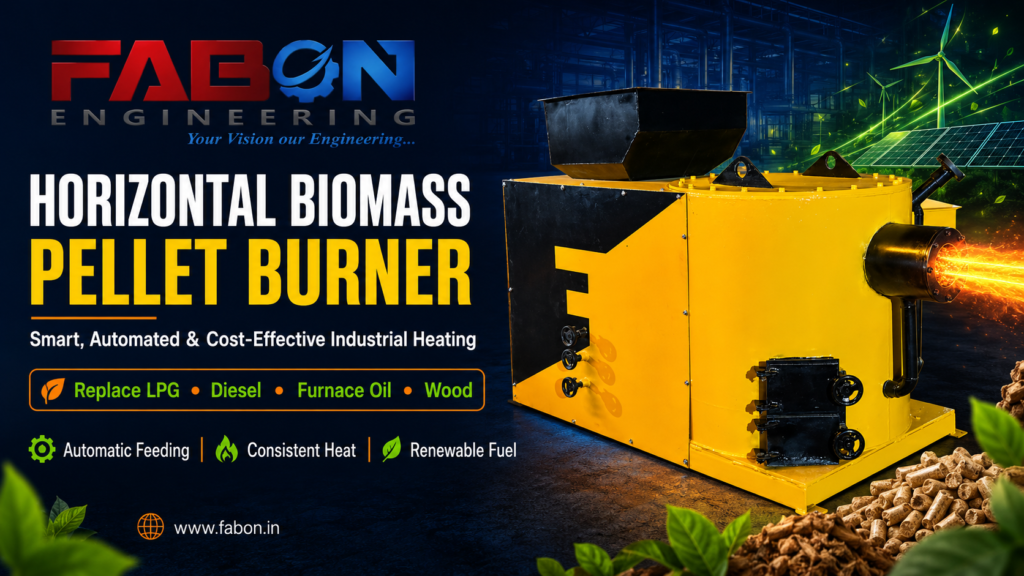
A horizontal biomass pellet burner offers a practical solution to these challenges. It converts biomass pellets into controlled thermal energy and directs the flame horizontally into a boiler, furnace, oven, dryer, thermic-fluid heater, roasting machine or other industrial heating equipment.
Unlike traditional wood- or coal-fired systems, a modern horizontal biomass pellet burner can provide automatic fuel feeding, adjustable airflow, controlled combustion and stable heat output. It can often be integrated with existing heating equipment, allowing industries to shift towards renewable solid fuel without replacing their complete production system.
For hotels, restaurants, food-processing units, dairy plants, bakeries, namkeen manufacturers, chemical plants, textile factories, powder-coating units, biomass pellet plants and many other industries, this technology offers an opportunity to reduce dependence on fossil fuels and improve control over heating operations.
This detailed guide explains how a horizontal biomass pellet burner works, its components, benefits, applications, fuel requirements, selection criteria, operating procedure, maintenance needs and financial potential.
What Is a Horizontal Biomass Pellet Burner?
A horizontal biomass pellet burner is an industrial combustion system designed to burn compressed biomass pellets and generate a high-temperature flame in a horizontal direction.
The system generally consists of:
- A biomass pellet storage hopper
- A screw-type fuel-feeding mechanism
- A combustion chamber
- A primary and secondary air supply system
- One or more blowers
- A motor and gearbox
- An electrical control panel
- Temperature sensors
- A flame outlet or burner mouth
- An ash-removal arrangement
- Safety interlocks
- Optional automatic ignition
- Optional PLC and HMI controls
The burner receives biomass pellets from the hopper. A screw feeder transfers a controlled quantity of pellets into the combustion chamber. Air supplied by the blower supports combustion. The resulting flame and hot gases are discharged through the front outlet in a horizontal direction.
Because the flame is projected forward, the burner can be connected to the side or front of many existing heating systems. This makes it especially useful for retrofit applications.
The burner can replace or supplement conventional burners that use:
- LPG
- PNG
- CNG
- Diesel
- Furnace oil
- Light diesel oil
- Coal
- Firewood
- Wood chips
- Agricultural residue
- Other solid fuels
The actual feasibility of fuel replacement depends on the required process temperature, heating chamber design, available space, operating pattern and quality of biomass pellets.
Why Horizontal Biomass Pellet Burners Are Becoming Popular
The popularity of biomass pellet burners is being driven by a combination of economic, environmental and operational factors.
Rising fossil-fuel prices
Fuel represents a major recurring expense in any heat-intensive industry. LPG, diesel and furnace-oil prices can fluctuate significantly. Even a small increase in fuel price can affect the cost of every kilogram of finished product.
Biomass pellets are produced from renewable residues such as sawdust, wood waste and agricultural biomass. In areas with an established pellet supply network, pellets can offer a more economical thermal-energy source.
The actual saving varies according to:
- Local pellet price
- Conventional fuel price
- Pellet calorific value
- Pellet moisture
- Burner efficiency
- Heat-transfer efficiency
- Operating temperature
- Daily operating hours
- Production load
- Quality of insulation
Many industries evaluate biomass conversion because even a modest percentage reduction in hourly fuel expenditure can create substantial annual savings.
Demand for renewable energy
Biomass is considered a renewable energy source when the feedstock is responsibly sourced. Using residues for energy can reduce reliance on fossil fuels and create value from material that might otherwise be discarded or openly burned.
A horizontal biomass pellet burner gives industries a practical route towards incorporating renewable thermal energy into their operations.
Automation of solid-fuel combustion
Traditional firewood and coal systems require frequent manual feeding. Their temperature can fluctuate because fuel is loaded in batches. The operator may also struggle to maintain the correct fuel-to-air ratio.
A biomass pellet burner automates much of this process. The feeder introduces pellets at a controlled rate, while the blower supplies regulated combustion air. This produces more consistent heating than manual fuel loading.
Easy integration with existing equipment
Replacing an entire boiler, dryer or oven can require considerable investment. In many cases, a horizontal burner can be connected to existing equipment after suitable technical modifications.
This retrofit potential makes the horizontal configuration attractive to small, medium and large industries.
Better fuel handling
Loose agricultural residue and firewood are difficult to transport, store and feed automatically. Biomass pellets have a relatively uniform shape, size and bulk density. These characteristics simplify storage, feeding and combustion.
Increasing availability of pellets
The biomass-pellet industry is expanding in India and many other countries. Pellets are now being produced from sawdust, wood waste, groundnut shells, rice husk blends and other suitable residues.
However, users should confirm reliable fuel availability before purchasing a burner. A technically good burner cannot deliver expected performance if pellet quality or supply is inconsistent.
Understanding the Horizontal Flame Design
The direction of flame is an important feature of any industrial burner.
In a vertical burner, heat rises upward and is suitable for cooking vessels, kettles and certain bottom-heating applications. A horizontal burner projects the flame forward and is suitable when heat must enter equipment through a side opening.
Horizontal flame systems are commonly connected to:
- Boiler combustion chambers
- Rotary dryers
- Hot-air generators
- Industrial ovens
- Roasting drums
- Frying systems
- Furnaces
- Thermic-fluid heaters
- Powder-coating ovens
- Baking chambers
- Milk-processing kettles
- Chemical reactors
- Food dryers
- Biomass dryers
The burner mouth is aligned with the receiving chamber so that the flame and hot gases enter the equipment correctly. The design of the receiving chamber must provide sufficient space for complete combustion.
If the chamber is too small or the flame directly hits a sensitive surface, it can cause overheating, incomplete combustion or equipment damage. The burner and heating chamber must therefore be matched by a qualified manufacturer or engineer.
How a Horizontal Biomass Pellet Burner Works
Although designs vary, most automatic horizontal pellet burners follow a similar sequence.
1. Pellet storage
Biomass pellets are loaded into a hopper. The hopper may be mounted directly above or behind the fuel feeder.
Its capacity is selected according to the burner size and desired operating duration. Small systems may need manual hopper filling several times per day, while larger installations can use a storage silo and automated fuel-transfer conveyor.
Pellets must remain dry. Exposure to rain or excessive humidity can cause them to absorb moisture, swell and break into powder.
2. Controlled fuel feeding
A screw conveyor or auger transfers pellets from the hopper into the combustion chamber. Its speed determines how much fuel enters the burner.
The feeding rate may be controlled through:
- A timer
- A variable-frequency drive
- A temperature controller
- A PLC
- A proportional control system
- A manual potentiometer
A properly adjusted feeder delivers enough fuel to meet the heat demand without overloading the combustion chamber.
3. Ignition
Depending on the model, ignition can be manual, semi-automatic or automatic.
For manual ignition, a small quantity of pellets is placed in the combustion area and ignited using an approved fire starter. After the pellets establish a stable flame, the blower and feeder are gradually started.
Automatic burners may use an electric hot-air igniter, heating element or other ignition system. The controller monitors the start-up sequence and begins normal operation after detecting stable combustion.
4. Primary air supply
Primary air enters near or below the pellet bed. It supports the initial combustion of solid fuel and helps release combustible gases from the biomass.
Too little air can cause smoke, carbon formation and incomplete combustion. Too much primary air may cool the combustion zone or carry unburned particles away.
5. Secondary air supply
Secondary air is introduced above or around the primary combustion area. It helps burn the combustible gases released from the pellets.
Correct secondary-air distribution is essential for:
- A cleaner flame
- Higher combustion efficiency
- Reduced smoke
- Lower unburned carbon
- More complete heat release
- Better flame shape
Advanced burner designs use carefully positioned air holes or air passages to create turbulence and improve mixing.
6. Horizontal flame generation
The blower pressure and combustion-chamber geometry direct the flame towards the front outlet. The flame then enters the connected boiler, furnace, oven or dryer.
The flame length and intensity depend on:
- Burner capacity
- Pellet-feeding rate
- Blower speed
- Pellet calorific value
- Combustion-air setting
- Burner-mouth dimensions
- Back pressure from the heating chamber
- Chimney draught
7. Heat transfer
The receiving equipment absorbs energy from the flame or hot gases. For example:
- A boiler transfers heat to water and produces steam.
- A dryer uses hot air to remove moisture.
- An oven transfers heat to products.
- A thermic-fluid heater raises the temperature of circulating oil.
- A furnace uses the heat for melting or thermal processing.
- A food-processing system heats frying oil, a kettle or a roasting chamber.
8. Temperature control
Temperature sensors continuously or periodically measure the process condition. Based on the temperature setting, the controller adjusts pellet feeding and airflow.
When the process temperature falls, the burner increases heat generation. As it approaches the set value, the controller reduces fuel feeding or shifts to a lower operating mode.
9. Ash discharge
Biomass pellets contain mineral matter that remains as ash after combustion. Ash collects in the combustion chamber or ash tray and must be removed regularly.
The quantity of ash depends strongly on raw material. Premium wood pellets generally produce less ash than pellets made from high-ash agricultural residues.
Major Components of a Horizontal Biomass Pellet Burner
Pellet hopper
The hopper stores fuel before it enters the feeder. It should have:
- Adequate storage capacity
- A steep slope for smooth fuel movement
- A lid or cover
- Protection from rain and moisture
- Easy access for cleaning
- A suitable outlet to prevent bridging
A level sensor can be installed to warn the operator when the hopper is nearly empty.
Screw feeder
The screw feeder is one of the most important parts of the burner. It meters the fuel and transfers it into the combustion chamber.
Its design must prevent:
- Irregular feeding
- Pellet crushing
- Excessive powder formation
- Fuel jamming
- Reverse flame travel
- Motor overload
The screw speed should match the burner’s capacity and the density of the pellets.
Gear motor
The gear motor rotates the feeder screw at a controlled speed. It must provide sufficient torque and withstand continuous operation.
For better control, a variable-frequency drive can regulate motor speed.
Combustion chamber
The combustion chamber is where pellets burn and heat is released. It must withstand high temperature, thermal cycling and abrasion.
Depending on the design, it may include:
- Heat-resistant steel
- Castable refractory
- Fire bricks
- Ceramic insulation
- Replaceable grates
- Air-distribution passages
The chamber must be designed to provide enough residence time for complete combustion.
Blower
The blower supplies combustion air and helps form the horizontal flame. Some burners use a single blower, while others use separate primary- and secondary-air blowers.
A variable-speed blower offers improved control because airflow can be matched with the fuel-feeding rate.
Ignition system
Automatic ignition improves convenience and reduces dependence on operator skill. However, the ignition system must be suitable for the burner capacity and pellet characteristics.
Industrial systems may also retain a manual ignition option for emergency operation.
Electrical control panel
The control panel manages the feeder, blower, ignition, alarms and safety devices. It may include:
- Main isolator
- MCB or MCCB
- Contactors
- Overload relays
- Temperature controller
- VFD
- Timers
- Emergency stop
- Indicator lamps
- Buzzer
- PLC
- HMI touchscreen
Temperature sensors
Thermocouples, RTDs or other sensors measure the burner or process temperature. Sensor location is critical. An incorrectly positioned sensor can give misleading readings and cause unstable operation.
Refractory lining
Refractory material retains heat, protects the metal body and stabilises combustion. It must be properly cured before the burner is operated at full capacity.
Ash-removal system
Small burners may have a manual ash tray. Larger systems may use:
- Screw-type ash discharge
- Mechanical grate
- Moving grate
- Pneumatic cleaning
- Automatic de-ashing
Safety devices
A well-designed system may include:
- Over-temperature protection
- Motor-overload protection
- Flame-failure alarm
- Hopper high-temperature sensor
- Reverse-fire protection
- Emergency stop
- Feeder interlock
- Blower interlock
- Pressure monitoring
- Low-fuel warning
Biomass Pellet Quality Required for Efficient Burning
The burner’s performance depends heavily on pellet quality. Users sometimes focus only on pellet price, but low-quality pellets can increase fuel consumption, ash, smoke, cleaning frequency and downtime.
Pellet diameter
Common pellet diameters include:
- 6 mm
- 8 mm
- 10 mm
- 12 mm
The burner manufacturer should specify the acceptable range. Pellets that are too large may not feed smoothly. Pellets that are too small or broken can create excess powder.
Moisture content
Lower and consistent moisture generally supports easier ignition and more stable combustion. Excess moisture consumes energy during evaporation and can reduce useful heat output.
Pellets should be stored in a covered, dry and ventilated location. Bags should not be placed directly on a damp floor.
Calorific value
Calorific value indicates the amount of heat available from the fuel. It varies according to raw material, moisture and ash.
Wood-based pellets often provide stable combustion and relatively low ash. Agricultural pellets can also perform effectively when the burner is designed for their characteristics.
Ash content
High ash content leads to:
- More frequent cleaning
- Increased ash disposal
- Possible clinker formation
- Blocked air passages
- Reduced heat transfer
- Unstable flame
The acceptable ash level depends on the burner design and the selected application.
Mechanical durability
Good pellets should resist breaking during transportation and handling. Weak pellets create fines and dust, which can cause irregular feeding and sudden combustion.
Bulk density
Consistent bulk density allows the screw feeder to deliver a predictable amount of fuel. If density varies significantly between batches, the burner settings may need adjustment.
Pellet length
Very long pellets may bridge inside the hopper or jam the feeder. Excessively short pellets and powder can feed too quickly. Pellet length should therefore remain within the burner manufacturer’s recommended range.
Raw-material consistency
Frequent changes between wood pellets, rice-husk pellets, groundnut-shell pellets and mixed agricultural pellets can affect flame behaviour. Each fuel may require a different air-to-fuel setting.
Before bulk purchase, it is advisable to test the intended pellet in the burner.
Key Benefits of a Horizontal Biomass Pellet Burner
Potential reduction in fuel cost
The most attractive benefit is the opportunity to reduce thermal-energy cost.
However, savings must be calculated using useful heat, not simply fuel weight. One kilogram of LPG cannot be directly compared with one kilogram of biomass pellets because their calorific values and combustion efficiencies differ.
A proper comparison should consider:
- Delivered fuel price
- Net calorific value
- Burner efficiency
- Heat-transfer efficiency
- Fuel consumption per hour
- Production achieved per hour
- Labour cost
- Electricity consumption
- Maintenance cost
- Ash disposal
- System downtime
Depending on these factors, a pellet burner may offer meaningful operating-cost savings compared with LPG, diesel or furnace oil.
Automatic fuel feeding
Automatic feeding reduces continuous manual intervention. The operator does not need to repeatedly open a furnace door and add firewood or coal.
This improves convenience and can reduce fluctuations in temperature.
Stable and controllable heat
By adjusting feeder and blower speeds, the burner can increase or decrease heat output. This control is useful in processes where product quality depends on temperature stability.
Retrofit compatibility
A horizontal burner can often be connected to existing equipment, reducing the need to purchase a completely new heating system.
Before conversion, the manufacturer should inspect:
- Existing chamber dimensions
- Burner opening
- Chimney size
- Draught
- Heat requirement
- Process temperature
- Back pressure
- Available electrical supply
- Space for the burner and hopper
Cleaner workplace than traditional firing
A properly designed pellet system typically offers more organised fuel handling than loose firewood or coal. It can reduce scattered fuel, manual chopping and repeated furnace-door opening.
It still requires ash management and regular cleaning, so it should not be described as completely maintenance-free.
Renewable-fuel utilisation
Biomass pellets can transform agricultural and wood-processing residues into useful industrial energy. This supports a circular approach to resource use.
Reduced dependence on conventional fuels
Businesses can diversify their energy sources instead of depending entirely on LPG, diesel or other fossil fuels.
Easier storage than loose biomass
Pellets occupy less volume than many loose biomass materials and can be handled in bags, bulk containers or silos.
Suitable for continuous operation
With an adequately sized hopper or storage silo, the system can operate continuously for long production cycles.
Scalable design
Horizontal burners can be manufactured in a wide range of thermal capacities. They can serve small food-processing units as well as larger industrial heating systems.
Industrial Applications
Boilers
A horizontal pellet burner can be connected to suitable steam or hot-water boilers. It supplies flame and hot gases into the boiler’s combustion chamber.
The conversion requires careful matching of:
- Boiler rating
- Steam demand
- Operating pressure
- Furnace volume
- Heat-transfer area
- Chimney capacity
- Feed-water condition
- Existing burner opening
A boiler should never be converted solely on the basis of its tonnage. Actual steam consumption and operating pattern must also be assessed.
Rotary dryers
Drying is essential in biomass pellet plants, food-processing units, mineral-processing plants and agricultural industries.
The burner can supply heat to a hot-air generator or directly to a suitably designed drying system. Indirect heating may be preferred when the product should not contact combustion gases.
Applications include drying:
- Sawdust
- Wood chips
- Agricultural residue
- Biomass powder
- Grains
- Spices
- Food ingredients
- Fertiliser
- Minerals
Biomass pellet plants
A pellet plant often requires substantial energy to dry raw material. Using biomass pellets or production residues for drying can reduce dependence on fossil fuel.
The burner can serve:
- Rotary dryers
- Flash dryers
- Belt dryers
- Hot-air generators
- Preheating systems
Food-processing industries
Food manufacturers require heat for frying, roasting, boiling, baking and drying.
Potential applications include:
- Namkeen production
- Potato-chip and wafer production
- Sweets manufacturing
- Khoya and mawa preparation
- Milk boiling
- Spice roasting
- Grain roasting
- Dal processing
- Commercial frying
- Large-scale cooking
The burner must be integrated so that smoke, ash and combustion gases do not contaminate the food. Depending on the process, an indirect heat exchanger may be necessary.
Hotels, restaurants and catering units
Large kitchens consume significant amounts of LPG. A biomass pellet burner may be used for:
- Bulk cooking
- Large frying pans
- Steam generation
- Water heating
- Dal and rice cooking
- Sweet preparation
- Catering vessels
For cooking applications, the system should be easy to regulate and positioned safely away from food-handling areas.
Bakeries
Bakery ovens require stable and uniform temperatures. A horizontal pellet burner may supply hot gases directly or through an indirect heat exchanger.
The oven design must ensure:
- Uniform heat circulation
- Product safety
- Controlled temperature
- No ash contamination
- Suitable exhaust
- Appropriate start-up and shutdown response
Dairy industry
Dairy plants use heat for milk processing, hot-water generation, cleaning and product preparation.
Potential applications include:
- Milk heating
- Khoya production
- Pasteurisation support
- Steam boilers
- Hot-water systems
- Paneer processing
- Sweet manufacturing
Powder-coating ovens
Powder-coating systems require controlled heating and clean airflow. Pellet burners can be considered, but indirect heating is often advisable to prevent ash or combustion particles from reaching the coated components.
Temperature uniformity is especially important for proper curing.
Textile industry
Textile plants use thermal energy for:
- Drying
- Washing
- Dyeing
- Steam generation
- Heat setting
- Processing chambers
A pellet burner can support suitable boilers, dryers or hot-air systems.
Chemical and pharmaceutical industries
Chemical and pharmaceutical processes may need steam, hot air or thermic-fluid heating.
Fuel conversion must be evaluated carefully because some processes require very precise control, contamination protection or hazardous-area compliance.
Furnaces
Horizontal pellet burners may be used for selected furnace applications, including:
- Preheating
- Heat treatment
- Non-ferrous melting support
- Reheating
- Drying and curing
The maximum required temperature and heat density must be verified. Not every high-temperature process can be served efficiently by a standard biomass burner.
Aluminium melting
Specially designed biomass pellet burners can be integrated with crucible furnaces for aluminium melting. Furnace insulation, burner angle, crucible protection and flame circulation are critical.
The system must provide sufficient heat while preventing the flame from damaging the crucible.
Thermic-fluid heaters
Thermic-fluid systems supply controlled process heat without high-pressure steam. A pellet burner may replace an oil-fired burner where the heater’s combustion chamber and heat-transfer system are suitable for solid-biomass combustion.
Industrial ovens
Applications include:
- Paint-baking ovens
- Curing ovens
- Drying ovens
- Rubber-processing ovens
- Food ovens
- Component-heating chambers
Indirect hot-air systems can provide cleaner process air.
Tea, coffee and spice processing
Pellet burners can generate heat for:
- Tea drying
- Coffee roasting
- Spice drying
- Spice roasting
- Hot-air generation
- Steam production
Product-sensitive processes require accurate temperature control and safe isolation from combustion residue.
Direct Heating and Indirect Heating
A major design decision is whether the combustion gases should directly contact the process air or product.
Direct heating
In direct heating, the hot gases from the burner enter the process equipment.
Advantages include:
- Higher heat-transfer efficiency
- Simpler system design
- Lower initial cost
- Faster heating
It may be suitable for certain dryers and industrial processes where limited contact with combustion gases is acceptable.
Indirect heating
In indirect heating, a heat exchanger separates the combustion gases from the clean process air.
Advantages include:
- Cleaner hot air
- Reduced contamination risk
- Better suitability for sensitive products
- Improved control in food, pharmaceutical and coating applications
Indirect systems may have a slightly higher capital cost and some heat-transfer loss, but they are often necessary for product quality and safety.
Selecting the Correct Burner Capacity
Burner capacity should be selected based on actual heat demand, not only the physical size of the machine being heated.
Determine the existing fuel consumption
Record the hourly consumption of the current fuel under normal production conditions.
For example:
- LPG consumption in kg/hour
- Diesel consumption in litres/hour
- Furnace oil consumption in litres/hour
- Coal consumption in kg/hour
- Firewood consumption in kg/hour
Also record production output during the same period.
Calculate useful thermal demand
The approximate heat input can be estimated from fuel consumption and calorific value. The existing burner and equipment efficiency should then be considered to estimate useful heat.
A qualified engineer should perform the final calculation.
Consider peak demand
The burner must handle the maximum practical load, including:
- Cold start
- Full production
- High-moisture material
- Winter operating conditions
- Recovery after loading
- Heat loss through doors or openings
Avoid severe oversizing
An oversized burner may repeatedly start and stop or operate continuously at a very low load. This can cause inefficient combustion, smoke and unnecessary investment.
Avoid undersizing
An undersized burner may run at maximum capacity without reaching the required temperature. This increases fuel consumption, operating stress and production time.
Check chamber size
The receiving chamber must have enough volume for the horizontal flame. If the flame strikes a nearby wall, it may damage refractory or produce incomplete combustion.
Evaluate chimney draught
The chimney must safely remove combustion gases. Insufficient draught can cause smoke leakage or back pressure. Excessive draught can pull heat out of the system too quickly.
Installation Considerations
Correct installation is as important as burner design.
Site survey
A detailed site survey should examine:
- Existing equipment
- Required temperature
- Current fuel consumption
- Production rate
- Burner location
- Fuel-storage area
- Chimney arrangement
- Electrical supply
- Ventilation
- Operator access
- Maintenance clearance
- Fire-safety provisions
Burner alignment
The burner must align properly with the heating chamber. Poor alignment can lead to uneven heating or direct flame impact.
Refractory protection
The burner connection and receiving chamber may need additional refractory lining to withstand high temperature.
Chimney design
The chimney should be sized according to gas volume, temperature and pressure conditions. It should safely discharge fumes away from personnel and neighbouring properties.
Electrical supply
The installation may require power for:
- Feeder motor
- Blower
- Ignition system
- Control panel
- Fuel conveyor
- Ash-handling system
- Pumps or process fans
Voltage stability and earthing must be verified.
Fuel storage
Pellets must be protected from:
- Rain
- Ground moisture
- Water leakage
- Excess humidity
- Open flames
- Welding sparks
- Contamination
Fire safety
Recommended provisions may include:
- Fire extinguishers
- Sand buckets
- Emergency shutdown
- Clear access routes
- Heat-resistant barriers
- Safety signage
- Trained operators
- Proper earthing
- Safe fuel-storage distance
All local fire, electrical, factory and environmental regulations must be followed.
Starting Procedure
The exact procedure depends on the burner model, so the manufacturer’s operating manual must always take priority.
A typical procedure is:
- Inspect the burner, hopper, feeder and combustion chamber.
- Remove excess ash and clinker.
- Confirm that all access doors are closed correctly.
- Check the hopper for dry, suitable pellets.
- Verify the electrical supply and emergency stop.
- Check the process chamber and chimney.
- Start the exhaust or induced-draught fan, if applicable.
- Begin the prescribed ignition sequence.
- Allow the initial pellets to ignite properly.
- Start the blower at a low setting.
- Start pellet feeding at a low rate.
- Observe the flame colour, length and stability.
- Gradually increase fuel and air together.
- Monitor the process temperature.
- Shift to automatic mode after stable combustion is established.
The burner should not be taken suddenly from a cold condition to maximum load unless its design specifically permits it.
Normal Operation
During operation, the operator should observe:
- Flame stability
- Process temperature
- Pellet-feeding consistency
- Blower sound
- Motor condition
- Hopper level
- Smoke condition
- Ash accumulation
- Chimney draught
- Unusual vibration
- Electrical-panel alarms
A bright, stable flame generally indicates good combustion, but visual observation alone is not enough. Temperature readings, fuel consumption and ash condition should also be monitored.
The best setting is not always the highest blower speed. Excess air can reduce efficiency by carrying heat through the chimney.
Shutdown Procedure
A controlled shutdown prevents smoke, overheating and fuel accumulation.
A typical sequence is:
- Stop or reduce pellet feeding.
- Allow the pellets already inside the chamber to burn.
- Keep the blower running at the recommended low setting.
- Confirm that combustion has reduced safely.
- Stop the blower according to the manufacturer’s sequence.
- Switch off the main operating controls.
- Do not open hot access doors immediately.
- Allow the burner to cool naturally.
- Remove ash only when safe to do so.
For an emergency, use the emergency-stop procedure provided by the manufacturer.
Maintenance Requirements
Daily maintenance
- Inspect the combustion chamber.
- Remove ash where required.
- Check the burner air holes.
- Clean spilled pellets and dust.
- Inspect the hopper and screw feeder.
- Check the flame pattern.
- Look for smoke leakage.
- Verify alarms and temperature readings.
Weekly maintenance
- Inspect the feeder screw.
- Check motor and gearbox mounting.
- Clean the blower inlet.
- Inspect electrical connections visually.
- Check refractory surfaces.
- Remove accumulated soot.
- Examine the burner mouth.
Monthly maintenance
- Check motor current.
- Inspect bearings and lubrication points.
- Test safety interlocks.
- Clean temperature sensors.
- Inspect cables and earthing.
- Check chimney condition.
- Inspect all air passages.
- Tighten loose mechanical fasteners.
Periodic maintenance
- Service motors and gearboxes.
- Replace damaged refractory.
- Inspect the screw for wear.
- Balance or service the blower if required.
- Calibrate temperature controls.
- Inspect the heat exchanger.
- Conduct flue-gas or combustion analysis.
- Check structural supports.
- Replace worn seals and gaskets.
The frequency should be increased when using high-ash pellets or operating continuously.
Common Problems and Solutions
Excess smoke
Possible causes include:
- Wet pellets
- Insufficient combustion air
- Excessive fuel feeding
- Blocked air holes
- Poor chimney draught
- Cold combustion chamber
- Large quantity of pellet powder
- Incorrect burner setting
The solution should begin with checking pellet quality, cleaning air passages and balancing fuel with airflow.
Low temperature
Possible causes include:
- Insufficient feeding
- Low-calorific-value pellets
- Excess moisture
- Excess combustion air
- Heat loss
- Undersized burner
- Poor chamber insulation
- Blocked fuel feeder
- Incorrect sensor reading
Clinker formation
Clinker is a fused ash deposit that can block the combustion area.
It may result from:
- High-ash fuel
- Low ash-fusion temperature
- Excessive combustion temperature
- Poor ash removal
- Inappropriate pellet formulation
Changing pellet quality or adjusting the combustion temperature may be necessary.
Feeder jamming
Possible causes include:
- Long pellets
- Wet or swollen pellets
- Foreign material
- Excess pellet powder
- Worn screw
- Incorrect hopper angle
- Motor or gearbox problem
Fire travelling towards the hopper
Reverse flame is a serious safety condition. It may be caused by:
- Feeder stoppage
- Incorrect pressure balance
- Poor burner design
- Loss of draught
- Blocked chamber
- Improper shutdown
The burner should immediately follow its emergency procedure. Reverse-fire protection and hopper-temperature monitoring are strongly recommended.
Excessive fuel consumption
Possible causes include:
- Low-quality pellets
- Poor insulation
- Excess air
- Incorrect burner size
- Dirty heat-transfer surfaces
- High exhaust temperature
- Process leakage
- Unstable production load
- Improper flame alignment
A complete heat-balance assessment may be required.
Calculating the Financial Benefit
A realistic feasibility study should compare the total cost of operation before and after conversion.
Current fuel cost
Calculate:
Hourly fuel cost = Current fuel consumption per hour × Delivered fuel price
Pellet cost
Calculate:
Hourly pellet cost = Pellet consumption per hour × Delivered pellet price
Electricity cost
Add the power consumption of:
- Blower
- Feeder motor
- Igniter
- Conveyor
- Control system
- Induced-draught fan
Labour cost
Compare labour requirements for:
- Fuel handling
- Hopper filling
- Ash removal
- Cleaning
- Manual fire control
Maintenance cost
Include:
- Gearbox service
- Motor maintenance
- Refractory repair
- Feeder-screw replacement
- Blower maintenance
- Sensor replacement
- Ash handling
Production impact
A more stable burner may improve production consistency, but this should be measured rather than assumed.
Track:
- Output per hour
- Rejection rate
- Heating time
- Batch duration
- Product quality
- Downtime
- Start-up time
Payback period
A simplified calculation is:
Payback period = Total conversion investment ÷ Monthly net operating saving
The final investment may include:
- Burner
- Hopper
- Control panel
- Chimney modifications
- Refractory work
- Transportation
- Installation
- Electrical work
- Heat exchanger
- Fuel-storage system
- Taxes
- Operator training
A trial with actual pellets and production conditions is the most reliable way to estimate savings.
Environmental Advantages
Use of renewable residues
Pellet production can convert sawdust, wood residues and agricultural by-products into useful energy.
Reduced open burning
Creating commercial value for agricultural residue can help discourage open-field burning where pellet production and collection systems are viable.
Lower fossil-fuel dependence
Replacing part or all of the fossil-fuel requirement can reduce exposure to non-renewable energy sources.
Controlled combustion
Pellet uniformity and automated feeding can support more controlled combustion than irregular manual firing.
However, emissions depend on:
- Fuel composition
- Moisture
- Ash
- Burner design
- Air settings
- Operating load
- Maintenance
- Pollution-control equipment
A biomass burner should not automatically be described as zero-emission. Appropriate chimneys, cyclones, filters, scrubbers or other emission-control devices may be required.
Productive ash use
Depending on fuel composition and local regulations, biomass ash may have potential uses. It must first be tested for suitability and should never be applied or disposed of without considering its chemical composition.
Biomass Pellet Burner Versus Traditional Firewood Furnace
A traditional firewood furnace has a lower initial cost, but it commonly requires manual feeding and frequent supervision. Firewood size and moisture may vary, causing temperature fluctuation.
A pellet burner offers:
- More uniform fuel
- Automatic feeding
- Better heat control
- Less frequent furnace opening
- Easier fuel measurement
- More predictable operation
Firewood may still be economical in locations where it is legally and sustainably available at low cost. The choice should be based on total operational performance.
Biomass Pellet Burner Versus LPG Burner
LPG burners are compact, clean at the point of use and responsive. They require minimal ash handling. Their major disadvantage can be high and fluctuating fuel cost.
Pellet burners may provide lower fuel expenditure, but they require:
- More installation space
- Pellet storage
- Ash handling
- Regular cleaning
- A proper chimney
- Fuel-quality management
The decision depends on whether the expected savings justify these additional operational requirements.
Biomass Pellet Burner Versus Diesel or Furnace-Oil Burner
Liquid-fuel burners offer high energy density and quick control, but fuel cost and emissions can be concerns.
Pellet systems can reduce reliance on liquid fossil fuels. However, conversion requires a larger combustion chamber and more extensive fuel-handling equipment.
In some installations, a dual-fuel arrangement is retained so that the conventional burner can provide backup during maintenance or pellet-supply interruptions.
Automation and Smart Controls
Modern industrial burners are increasingly equipped with intelligent controls.
PLC control
A PLC can manage:
- Start-up sequence
- Ignition
- Fuel feeding
- Blower operation
- Temperature control
- Alarm handling
- Shutdown
- Interlocks
HMI touchscreen
An HMI can display:
- Set temperature
- Actual temperature
- Feeder speed
- Blower speed
- Motor status
- Alarm history
- Operating mode
- Maintenance reminders
VFD control
Variable-frequency drives regulate motor and blower speeds. This allows the burner to adjust output according to actual heat demand.
Remote monitoring
Selected systems may support:
- Mobile monitoring
- Production data
- Fuel-consumption trends
- Alarm notification
- Remote technical diagnosis
- Operating-hour records
Remote access should be secured with proper authentication and network protection.
Oxygen-based combustion control
Advanced systems may use flue-gas oxygen measurement to optimise air supply. This helps reduce excess air and improve combustion consistency.
Questions to Ask Before Purchasing
A buyer should ask the manufacturer:
- What is the rated thermal capacity?
- What is the practical operating range?
- Which pellet raw materials are supported?
- What pellet diameter is recommended?
- What ash percentage can the burner handle?
- What is the approximate pellet consumption at different loads?
- Is ignition manual or automatic?
- Are the feeder and blower speed-controlled?
- Does the system include a PLC and HMI?
- What safety protection is provided against reverse fire?
- What refractory material is used?
- How often must ash be removed?
- Can it connect to the existing boiler, furnace or dryer?
- Is a heat exchanger required?
- What chimney modifications are needed?
- What electrical load is required?
- What pollution-control system is recommended?
- Is installation and commissioning included?
- Is operator training provided?
- What warranty and after-sales support are available?
- Which spare parts should be kept in stock?
- Can the proposed pellet be tested before finalisation?
- Are performance claims based on similar applications?
- What site-preparation work is the customer’s responsibility?
- What is the expected delivery and commissioning schedule?
Why Technical Evaluation Is Essential
A biomass burner should not be selected only from a brochure, photograph or price quotation. Every application has different operating conditions.
Two factories using similar machines may require different burners because of differences in:
- Production capacity
- Material moisture
- Required temperature
- Batch time
- Insulation
- Chamber design
- Chimney draught
- Local pellet quality
- Daily operating hours
- Ambient conditions
A responsible manufacturer should collect process data and conduct a site evaluation before recommending the final configuration.
The Future of Horizontal Biomass Pellet Burners
Industrial heating is moving towards a combination of renewable fuel, automation and data-based energy management.
Future horizontal pellet burners are likely to include:
- Better automatic modulation
- Improved ignition technology
- Lower-emission combustion chambers
- Automatic ash removal
- Smart hopper-level control
- Remote monitoring
- Predictive maintenance
- Flue-gas oxygen control
- Multi-fuel capability
- Integration with factory energy-management systems
- Improved refractory materials
- More compact heat exchangers
- Real-time fuel-consumption measurement
Hybrid heating systems may also become common. A facility may use biomass pellets as the primary fuel and retain LPG, diesel or electricity as a backup or peak-load energy source.
This arrangement can improve energy security while allowing industries to maximise the use of economical renewable fuel.
FABON Horizontal Biomass Pellet Burner Solutions
FABON Engineering Private Limited offers biomass pellet burner solutions for a variety of commercial and industrial heating applications.
Depending on the project, a system may include:
- Horizontal front-fire burner
- Pellet storage hopper
- Controlled screw feeder
- Variable-speed blower
- Electrical control panel
- Automatic ignition
- PLC and HMI control
- Refractory-lined combustion chamber
- Temperature-based modulation
- Safety interlocks
- Optional smoke-control arrangement
- Installation and commissioning support
- Operator training
- After-sales technical assistance
FABON burners can be evaluated for applications such as:
- Boilers
- Rotary dryers
- Hot-air generators
- Industrial ovens
- Food-processing equipment
- Namkeen fryers
- Bakery ovens
- Dairy heating
- Khoya machines
- Powder-coating ovens
- Furnaces
- Thermic-fluid heaters
- Biomass pellet plants
- Hotels and commercial kitchens
The final burner capacity and configuration should be selected after studying the customer’s existing fuel consumption, required temperature, production capacity, equipment design and available biomass-pellet quality.
Conclusion
The horizontal biomass pellet burner is emerging as an important industrial heating technology because it combines renewable fuel with automatic feeding and controllable combustion.
Its horizontal flame design makes it suitable for integration with boilers, dryers, ovens, furnaces, hot-air generators, thermic-fluid heaters and many other existing systems. For businesses affected by rising LPG, diesel or furnace-oil costs, it offers the possibility of reducing thermal-energy expenditure while creating a pathway towards renewable energy.
The success of the conversion depends on more than purchasing a burner. It requires:
- Correct capacity selection
- Good-quality biomass pellets
- Suitable chamber design
- Proper chimney draught
- Accurate fuel-to-air control
- Safe installation
- Trained operators
- Regular maintenance
- Reliable pellet supply
- Appropriate pollution-control measures
Businesses should compare fuels based on useful heat and total operating cost rather than fuel price alone. A site survey and production trial provide the most reliable basis for estimating consumption, savings and payback.
When correctly designed and operated, a horizontal biomass pellet burner can provide stable heat, automatic fuel feeding, easier solid-fuel management and meaningful long-term savings. It is not simply an alternative burner; it can become a central part of a company’s cost-reduction and renewable-energy strategy.
For industries looking to replace or reduce the use of LPG, diesel, furnace oil, coal or traditional firewood, a properly engineered horizontal biomass pellet burner deserves serious technical and commercial consideration.