

Hammer Mill for Biomass Pellet Manufacturing – Complete Guide 2026
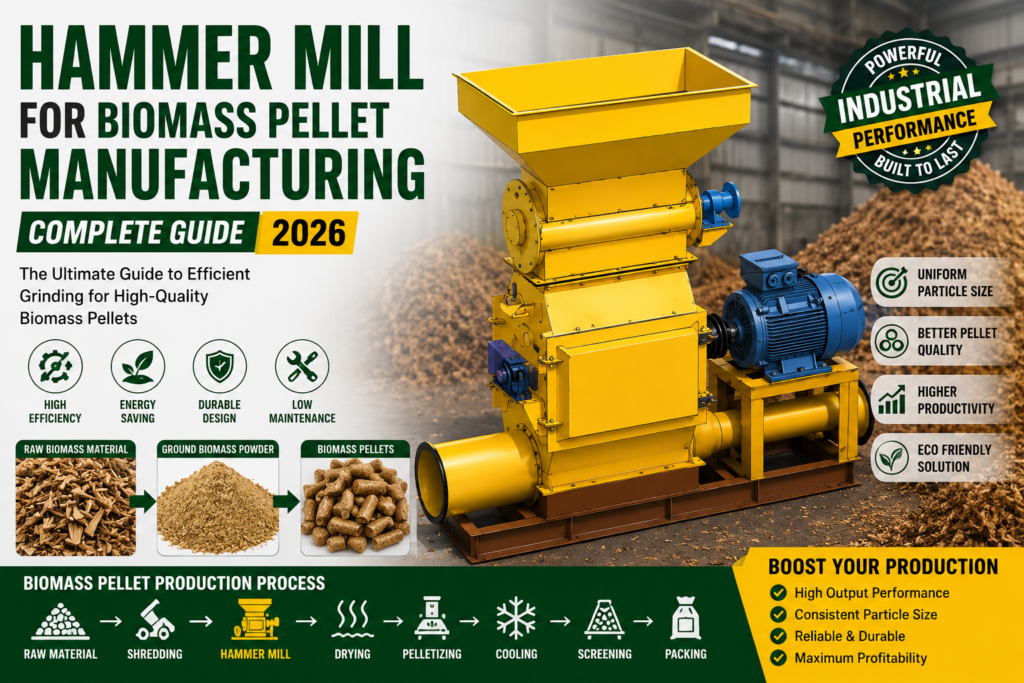
Hammer Mill for Biomass Pellet Manufacturing – Complete Guide 2026
The global demand for renewable energy is increasing rapidly as industries seek sustainable and cost-effective alternatives to fossil fuels. Biomass pellets have emerged as one of the most efficient renewable fuels for industrial heating, boilers, thermal power plants, food industries, textile units, and commercial applications. In the biomass pellet manufacturing process, one of the most important machines is the Hammer Mill Machine.
A hammer mill is responsible for converting coarse biomass material into fine powder suitable for pellet production. The quality, density, durability, and combustion efficiency of biomass pellets depend heavily on the grinding quality achieved by the hammer mill.
Whether you are processing wood chips, sawdust, rice husk, bamboo, bagasse, coconut shell, or agricultural waste, a properly designed hammer mill ensures smooth and efficient pellet manufacturing.
This complete guide explains everything about hammer mills used in biomass pellet manufacturing, including working principles, types, applications, advantages, technical specifications, maintenance, automation, and future trends.
Introduction to Biomass Pellet Manufacturing
Biomass pellets are cylindrical compressed fuel made from agricultural waste, forestry residues, and wood biomass. These pellets are used as an eco-friendly replacement for:
- Coal
- LPG
- Furnace oil
- Diesel
- Firewood
Biomass pellets are widely used in:
- Industrial boilers
- Thermal power plants
- Textile industries
- Hotels and restaurants
- Chemical plants
- Dairy industries
- Food processing industries
- Brick kilns
- Commercial heating systems
The biomass pellet manufacturing process involves several important stages:
- Raw Material Collection
- Wood Shredding or Chipping
- Grinding (Hammer Mill)
- Drying
- Pelletizing
- Cooling
- Screening
- Packing
Among these processes, grinding is one of the most critical stages because pellet machines require fine and uniform raw material for proper compression and pellet quality.
What is a Hammer Mill Machine?
A hammer mill is a high-speed industrial grinding machine used for pulverizing biomass material into fine particles using rotating hammers.
The machine operates by repeatedly striking the biomass material with heavy-duty hammers attached to a rapidly rotating rotor. This impact action breaks down the raw material into fine powder suitable for pellet manufacturing.
Hammer mills are capable of processing:
- Wood chips
- Sawdust
- Bamboo
- Rice husk
- Paddy straw
- Wheat straw
- Coconut shell
- Corn stalks
- Cotton stalks
- Bagasse
- Agricultural waste
- Forestry residue
The final output is a fine and uniform biomass powder that improves pellet quality and machine performance.
Importance of Hammer Mill in Biomass Pellet Manufacturing
The hammer mill plays a major role in ensuring efficient biomass pellet production.
1. Uniform Particle Size
The pellet machine requires consistent particle size for smooth pellet formation. Hammer mills ensure uniform grinding.
2. Improved Pellet Quality
Fine biomass powder improves pellet density, hardness, and durability.
3. Better Combustion Efficiency
Uniform pellets burn more efficiently and produce higher heat output.
4. Reduced Load on Pellet Machine
Proper grinding reduces stress on dies and rollers.
5. Better Moisture Distribution
Finely ground particles dry more evenly inside flash dryers and rotary dryers.
6. Higher Production Efficiency
Consistent feed material improves pellet machine productivity.
Working Principle of Hammer Mill
Hammer mills work on the principle of impact grinding.
Step-by-Step Working Process
Step 1: Feeding
Raw biomass material enters the machine through a hopper.
Step 2: Rotor Rotation
A rotor fitted with hammers rotates at high speed.
Step 3: Impact Grinding
The rotating hammers repeatedly strike the material.
Step 4: Pulverization
The material breaks into smaller particles through repeated impact.
Step 5: Screening
The powder passes through screens with defined hole sizes.
Step 6: Discharge
The fine material exits through the discharge outlet.
The output particle size depends on:
- Rotor speed
- Screen size
- Hammer design
- Material hardness
- Moisture content
Components of Hammer Mill Machine
A hammer mill consists of several important components.
1. Feeding Hopper
The hopper is used for feeding biomass material into the machine.
Features
- Large feeding opening
- Controlled material flow
- Prevents overloading
2. Rotor Assembly
The rotor is the rotating component carrying the hammers.
Features
- High-speed rotation
- Heavy-duty shaft
- Balanced construction
3. Hammers
The hammers perform the grinding action.
Features
- Alloy steel construction
- High impact resistance
- Replaceable design
4. Screens
Screens control the final particle size.
Features
- Different hole sizes
- Wear-resistant material
- Easy replacement
5. Motor
The motor provides power for rotor rotation.
Features
- High efficiency
- Continuous operation
- Industrial-grade design
6. Bearings
Bearings support smooth rotor movement.
Features
- Heavy-duty capacity
- Low vibration
- Long life
7. Grinding Chamber
The chamber contains the hammers and screens.
Features
- Heavy steel body
- Wear-resistant lining
- Easy maintenance access
Types of Hammer Mills Used in Biomass Pellet Plants
Different hammer mill designs are used depending on plant capacity and raw material type.
1. Gravity Discharge Hammer Mill
This type uses gravity for material discharge.
Advantages
- Simple design
- Lower cost
- Easy maintenance
Applications
- Small pellet plants
- Agricultural grinding
2. Pneumatic Discharge Hammer Mill
This design uses airflow for discharge.
Advantages
- Better cooling
- Dust reduction
- Higher efficiency
Applications
- Industrial pellet plants
- Continuous production systems
3. Full Circle Screen Hammer Mill
This machine uses a larger screen area.
Advantages
- Higher throughput
- Uniform grinding
- Improved productivity
Applications
- Large-scale pellet plants
4. Horizontal Hammer Mill
The rotor is mounted horizontally.
Advantages
- Heavy-duty grinding
- Better impact efficiency
Applications
- Industrial biomass processing
Raw Materials Processed in Hammer Mills
Hammer mills are highly versatile machines.
Wood Biomass
- Wood chips
- Sawdust
- Tree bark
- Timber waste
- Bamboo
Agricultural Biomass
- Rice husk
- Paddy straw
- Wheat straw
- Corn stalks
- Cotton stalks
Agro Industrial Waste
- Bagasse
- Coconut shell
- Palm waste
Forestry Waste
- Branches
- Forest residue
- Wood scrap
Ideal Particle Size for Biomass Pellets
The ideal particle size for pellet manufacturing is generally:
- 3–5 mm
Uniform particle size improves:
- Pellet density
- Pellet durability
- Combustion performance
- Production efficiency
Oversized particles reduce pellet quality and increase die wear.
Role of Hammer Mill in Pellet Quality
The grinding quality directly affects pellet quality.
1. Pellet Density
Fine particles compress more efficiently.
2. Pellet Durability
Uniform particles improve Pellet Durability Index (PDI).
3. Reduced Dust Formation
Proper grinding minimizes fines.
4. Better Combustion
Uniform pellets burn consistently.
Capacity Range of Hammer Mills
Hammer mills are available in various capacities.
| Capacity | Suitable Application |
|---|---|
| 500 kg/hr | Small pellet plant |
| 1 TPH | Medium biomass unit |
| 2 TPH | Industrial pellet plant |
| 3 TPH | Commercial production |
| 5 TPH | Large-scale biomass plant |
| 10 TPH+ | Mega industrial project |
Power Requirement of Hammer Mill
Power consumption depends on biomass type and production capacity.
| Capacity | Motor Power |
|---|---|
| 500 kg/hr | 15–20 HP |
| 1 TPH | 30–40 HP |
| 2 TPH | 50–75 HP |
| 5 TPH | 100–150 HP |
Hard materials like coconut shell require higher power.
Advantages of Hammer Mill for Biomass Pellet Manufacturing
1. High Grinding Efficiency
Hammer mills process large quantities quickly.
2. Uniform Output
Produces consistent particle size.
3. Continuous Operation
Suitable for 24-hour industrial use.
4. Lower Operational Cost
Efficient grinding reduces electricity consumption.
5. Versatile Applications
Handles multiple biomass materials.
6. Improved Pellet Quality
Enhances pellet density and durability.
Applications of Hammer Mill
Hammer mills are used in multiple industries.
Biomass Pellet Plants
Primary grinding machine for pellet production.
Biomass Briquette Plants
Prepares biomass powder before briquetting.
Animal Feed Industry
Grinding feed ingredients.
Recycling Industry
Pulverizing waste material.
Agriculture Industry
Processing crop residue.
Hammer Mill vs Wood Shredder
| Hammer Mill | Wood Shredder |
|---|---|
| Fine grinding | Primary size reduction |
| Uses hammers | Uses blades |
| High RPM | Low RPM |
| Produces powder | Produces chips |
Both machines are essential in pellet manufacturing.
Hammer Mill vs Crusher
| Hammer Mill | Crusher |
|---|---|
| Fine grinding | Coarse crushing |
| Biomass processing | Stone/mineral crushing |
| Impact force | Compression force |
Moisture Requirement Before Grinding
The ideal moisture content before grinding is:
- 10–15%
High moisture causes:
- Screen blockage
- Lower grinding efficiency
- Increased power consumption
Hammer Design in Biomass Hammer Mills
Hammer design affects machine performance.
Swing Hammers
Freely moving hammers.
Advantages
- Better impact
- Longer life
Fixed Hammers
Rigidly mounted hammers.
Advantages
- Strong grinding force
Screen Selection in Hammer Mills
Screen size determines output quality.
| Screen Size | Output Application |
|---|---|
| 3 mm | Fine pellets |
| 5 mm | Standard pellets |
| 8 mm | Coarse grinding |
Proper screen selection improves pellet quality.
Factors Affecting Hammer Mill Performance
1. Material Moisture
Higher moisture reduces grinding efficiency.
2. Rotor Speed
Higher RPM improves grinding quality.
3. Hammer Condition
Sharp hammers increase productivity.
4. Screen Size
Controls particle output size.
5. Material Hardness
Hardwood requires more grinding power.
Automation in Modern Hammer Mills
Modern biomass plants use automated hammer mills.
PLC Automation
Controls machine operation automatically.
Automatic Feeding System
Maintains uniform material flow.
Overload Protection
Protects motor and rotor.
Smart Monitoring
Tracks machine performance and energy usage.
Safety Features in Hammer Mills
Industrial safety is extremely important.
Emergency Stop System
Stops machine instantly during emergencies.
Dust Collection System
Controls airborne dust particles.
Overload Protection
Prevents electrical damage.
Safety Guards
Protect operators from moving parts.
Vibration Sensors
Monitor rotor stability.
Dust Control in Hammer Mill Operations
Grinding produces fine dust.
Dust Problems
- Air pollution
- Fire hazards
- Health risks
Dust Control Solutions
- Cyclone separator
- Dust collector
- Air filtration systems
- Proper ventilation
Modern pellet plants use advanced dust management systems.
Maintenance of Hammer Mill
Regular maintenance increases machine life.
Daily Maintenance
- Check hammers
- Clean screens
- Inspect bearings
Weekly Maintenance
- Lubricate moving parts
- Tighten bolts
- Inspect motor alignment
Monthly Maintenance
- Replace worn hammers
- Inspect rotor balance
- Check screen condition
Common Problems in Hammer Mills
1. Excessive Vibration
Causes
- Rotor imbalance
- Loose bearings
Solutions
- Balance rotor
- Replace bearings
2. High Power Consumption
Causes
- Dull hammers
- Wrong screen size
Solutions
- Replace hammers
- Use proper screens
3. Low Grinding Efficiency
Causes
- Damaged screens
- Incorrect RPM
Solutions
- Replace screens
- Adjust rotor speed
4. Excessive Dust
Cause
Poor dust collection system.
Solution
Install cyclone separators and dust collectors.
Integration of Hammer Mill in Biomass Pellet Plant
Typical pellet plant process:
Raw Material → Wood Shredder → Hammer Mill → Dryer → Pellet Machine → Cooler → Packing
The hammer mill acts as the bridge between shredding and pelletizing.
Energy Efficiency in Hammer Mills
Energy-efficient hammer mills reduce operating costs.
Methods to Improve Efficiency
- Proper screen selection
- Sharp hammers
- VFD control
- Uniform feeding
Future Trends in Hammer Mill Technology
The biomass sector is evolving rapidly.
AI-Based Automation
Smart systems improve productivity.
IoT Monitoring
Remote monitoring improves maintenance planning.
Energy-Saving Motors
Reduce power consumption.
Smart Diagnostics
Predictive maintenance minimizes downtime.
Environmental Benefits of Hammer Mills
Hammer mills support renewable energy production.
Waste Recycling
Converts waste into useful biomass fuel.
Lower Carbon Emission
Supports eco-friendly fuel production.
Reduced Landfill Waste
Minimizes agricultural and wood waste disposal.
Sustainable Energy Production
Promotes renewable fuel adoption.
Biomass Industry Growth in India
India’s biomass sector is expanding due to:
- NTPC biomass co-firing projects
- Renewable energy targets
- Rising coal prices
- Industrial fuel shortages
- Environmental regulations
This growth is increasing demand for advanced hammer mills.
Government Support for Biomass Projects
Government schemes encourage biomass manufacturing.
Major Support Programs
- PMEGP subsidy
- MSME incentives
- Renewable energy subsidies
- Biomass co-firing programs
These initiatives support biomass pellet manufacturing growth.
How to Choose the Right Hammer Mill
Choosing the right hammer mill is essential.
1. Raw Material Type
Machine should match biomass hardness.
2. Capacity Requirement
Capacity should align with pellet plant output.
3. Power Consumption
Energy-efficient motors reduce operational cost.
4. Screen Configuration
Proper screen size improves pellet quality.
5. Automation Features
PLC systems improve efficiency.
6. After-Sales Service
Reliable support ensures smooth operation.
Installation Requirements for Hammer Mill
Strong Foundation
Prevents excessive vibration.
Adequate Space
Allows easy maintenance.
Proper Electrical Supply
Ensures stable operation.
Ventilation System
Controls heat and dust.
Hammer Mill for Different Pellet Plant Capacities
Small Pellet Plants
- Compact hammer mills
- 500 kg/hr capacity
Medium Pellet Plants
- 1–3 TPH hammer mills
- Pneumatic systems
Large Industrial Plants
- 5–10 TPH fully automatic systems
Why Industries are Switching to Biomass Fuel
Industries are replacing fossil fuels because biomass is:
- Renewable
- Cost-effective
- Sustainable
- Eco-friendly
Hammer mills help convert waste biomass into valuable industrial fuel.
FABON Hammer Mill for Biomass Pellet Manufacturing
FABON Engineering Pvt. Ltd. manufactures advanced hammer mill machines designed for biomass pellet manufacturing.
FABON hammer mills are suitable for:
- Wood grinding
- Agricultural waste processing
- Biomass pellet plants
- Briquette manufacturing
- Industrial biomass fuel production
Features of FABON Hammer Mill
- Heavy-duty construction
- High-speed rotor
- Durable alloy hammers
- Energy-efficient motors
- Dust collection systems
- Easy maintenance
- Continuous operation
Applications
- Biomass pellet plants
- Animal feed plants
- Recycling industries
- Agro waste processing
Conclusion
The hammer mill machine is one of the most essential machines in biomass pellet manufacturing. It performs the critical task of converting coarse biomass material into fine powder suitable for pellet production. Proper grinding improves pellet quality, density, durability, and combustion efficiency.
As industries continue shifting toward renewable energy solutions, the demand for efficient hammer mills is growing rapidly. Modern hammer mills equipped with automation, energy-saving systems, and durable construction help industries improve production efficiency and reduce operational costs.
Whether you are setting up a small pellet plant or a large industrial biomass project, investing in a reliable hammer mill machine is essential for achieving high-quality biomass pellet production and long-term profitability.