

Hammer Mill by FABON Engineering, Nashik
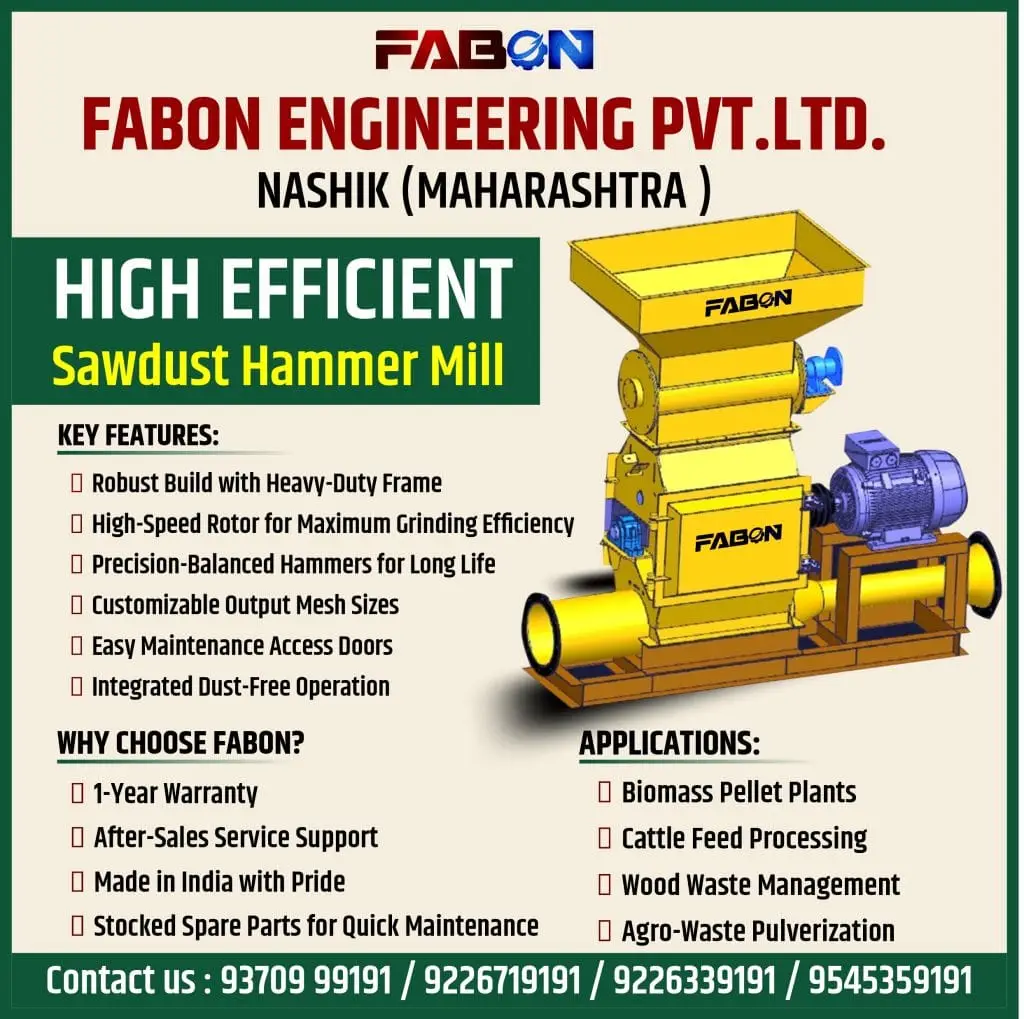
Biomass Hammer Mill by FABON Engineering, Nashik – Complete Guide, Working, Features, Applications, and Buying Checklist
Biomass size reduction is the first real “profit step” in any pellet plant, briquette unit, biomass boiler fuel project, or agro-waste processing line. If raw material is not properly crushed to the right particle size, your dryer will consume more energy, your pellet mill will choke or give uneven output, your briquette press will struggle to compact, and your final product will show poor density and inconsistent combustion. That’s exactly why a Biomass Hammer Mill becomes a core machine in modern renewable energy and agro-processing setups.
At FABON Engineering, Nashik, we manufacture heavy-duty Biomass Hammer Mills designed for continuous industrial use, stable production, and consistent output across a wide variety of biomass and agro residues. Whether your project is a biomass pellet plant, briquetting plant, boiler fuel preparation, animal bedding, or organic manure processing, a correctly sized and engineered hammer mill is what ensures your downstream machines work efficiently.
This detailed SEO article explains everything about Biomass Hammer Mill by FABON Engineering—how it works, types, components, power options, output, raw materials, maintenance, safety, selection checklist, and integration with a complete biomass line.
What is a Biomass Hammer Mill?
A Biomass Hammer Mill is a size reduction machine that converts bulky biomass materials into a smaller, uniform particle size using high-speed rotating hammers. The material enters the grinding chamber and is crushed by repeated impact of hammers against the material, followed by shearing and abrasion as the particles pass through a screen.
In simple words:
- Input: biomass (chips, straw, husk, stalk, shells, agro waste)
- Output: crushed biomass powder / granules (as per screen size)
- Purpose: prepare uniform material for pelletizing, briquetting, drying, feeding, or combustion
A hammer mill is widely used because it is:
- fast,
- robust,
- low-maintenance,
- easy to operate,
- highly adaptable for different biomass types.
Why Hammer Mill is Important in Biomass Pellet & Briquette Plants
In pellet plants and briquette plants, raw material consistency determines production stability. If the material is too long, too fibrous, or too uneven, it causes:
- overload in pellet mill,
- die choking,
- low pellet density,
- excess fines,
- high power consumption,
- belt and bearing stress,
- reduced die/roller life.
A properly selected biomass hammer mill ensures:
- correct particle size for pellet press/briquette press,
- better dryer efficiency,
- stable feeding in conveyors and mixers,
- consistent combustion quality (for boiler fuel),
- improved product density and finish.
Ideal particle size (general guidance):
- Pellet plant: typically 3–6 mm (depending on die hole size and raw material)
- Briquette press: usually < 10 mm (depending on press type)
- Boiler combustion fuel: depends on feeding system (screw/rotary/chain grate)
Biomass Hammer Mill by FABON Engineering, Nashik – Overview
FABON Engineering Pvt. Ltd., Nashik manufactures industrial biomass hammer mills for:
- Sawdust grinding
- Agro waste crushing
- Wood chips size reduction
- Straw and stalk grinding
- Husk, shells and fibrous residues
- Pre-processing for pellet mills
- Pre-processing for briquetting machines
- Fuel preparation for biomass boilers
Our hammer mills are engineered with:
- heavy-duty rotor and balanced shaft,
- hardened hammers and wear liners,
- robust bearings and dust protection,
- optimized airflow design for smooth discharge,
- multiple screen options to control output size,
- stable performance for long operating hours.
Working Principle of Biomass Hammer Mill (Step-by-Step)
Understanding the working of a hammer mill is important for correct selection and maintenance.
1) Feeding
Biomass enters the hammer mill through a hopper or screw conveyor. Feeding can be manual or automatic depending on plant design.
2) Impact Crushing
Inside the chamber, a rotor rotates at high RPM. Hammers mounted on the rotor strike the biomass repeatedly. This impact breaks the biomass into smaller particles.
3) Screening
A perforated screen is installed around the grinding zone. Only particles smaller than screen openings pass through; larger particles stay inside for further grinding.
4) Discharge
Crushed biomass exits from the bottom or side discharge, typically assisted by airflow (in some designs) or gravity. It can be sent to:
- cyclone,
- blower line,
- conveyor,
- mixer,
- dryer feeding system.
5) Collection (Optional)
For dust control and material handling, hammer mills often work with:
- cyclone separator,
- dust collector / bag filter,
- blower fan system.
Main Components of a Biomass Hammer Mill
A hammer mill’s durability depends heavily on its internal design and materials. Key components include:
1) Feed Hopper / Inlet
Designed to avoid backflow and ensure smooth feeding. Can be designed with safety baffle and magnetic trap.
2) Grinding Chamber
Heavy casing and wear liners protect the body from abrasion.
3) Rotor Assembly
A dynamically balanced rotor ensures:
- reduced vibration,
- longer bearing life,
- stable RPM,
- smoother grinding.
4) Hammers (Beaters)
Hammers are mounted to the rotor and do the main crushing work. Hammer quality affects:
- output capacity,
- power consumption,
- wear life.
5) Screens
Screens determine final particle size. Common screen sizes:
- 3 mm, 4 mm, 5 mm, 6 mm, 8 mm, 10 mm (and custom)
6) Bearings and Housing
High-quality bearings with proper seals are critical for long runtime and safety.
7) Motor & Drive System
Usually belt drive or coupling arrangement. Proper alignment is essential for smooth operation.
8) Base Frame & Access Doors
Strong frame reduces vibration and simplifies maintenance. Access doors allow easy screen and hammer replacement.
Types of Biomass Hammer Mills
Different biomass and plant capacities require different hammer mill configurations.
1) Gravity Discharge Hammer Mill
Material passes through screen and falls by gravity.
- Simple and cost-effective
- Suitable for many agro residues
- Often used in smaller capacity systems
2) Pneumatic Discharge Hammer Mill (Blower + Cyclone)
Airflow carries crushed material to cyclone/bag filter.
- Better dust control
- Faster discharge
- Excellent for sawdust and light biomass
3) Primary Crusher + Hammer Mill (Two-Stage System)
For bulky raw materials like logs, big chips, long stalks.
- Stage 1: shredder/chipper
- Stage 2: hammer mill
- Best for high TPH pellet plants
4) Fine Grinding Hammer Mill
For very fine output requirements.
- Smaller screen sizes
- Higher RPM design
- Used where powder-like output needed
FABON can guide customers to choose the right system based on raw material and target capacity.
Raw Materials Suitable for Biomass Hammer Mill
A well-designed biomass hammer mill can handle a wide variety of agro and wood residues, including:
Wood & Forestry Waste
- sawdust lumps
- wood chips
- wood shavings
- bark
- plywood waste (with care)
- furniture waste (after metal removal)
Agro Residues
- paddy straw / rice straw
- wheat straw
- soybean stalk
- cotton stalk
- maize/corn stalk
- sugarcane trash
- groundnut shells
- sunflower husk
- mustard stalk
- coconut shell (pre-crushing recommended)
Industrial Biomass
- bagasse (usually needs drying + proper feeding)
- coffee husk
- tea waste
- palm waste (depending on type)
Note: Very wet biomass is not ideal for hammer milling. If moisture is high, material becomes sticky and reduces capacity. In such cases, drying or pre-conditioning is recommended.
Particle Size Requirement for Pellets – Why Screen Selection Matters
In biomass pellet manufacturing, the particle size must match the pellet die specification.
General guidance:
- If pellet die hole is 6 mm, then particle size should generally be 3–5 mm
- If die hole is 8 mm, then particle size can be 4–6 mm
- If die hole is 10 mm, then particle size can be 5–8 mm (depending on material)
Proper screen selection delivers:
- smooth pelletizing,
- high density pellets,
- reduced power load on pellet mill,
- reduced fines generation.
Screen selection also affects:
- hammer wear,
- motor load,
- throughput.
Key Features of FABON Biomass Hammer Mill
When industries compare hammer mills, they typically focus on stability, wear life, and output consistency. Here are the core qualities customers expect from a reliable machine:
Heavy-Duty Construction
FABON designs hammer mills with strong casing and engineered base frame for stable operation.
Dynamic Rotor Balancing
Balanced rotor minimizes vibration and improves bearing life.
Replaceable Screens
Different screen sizes allow customers to change output particle size based on product requirement.
High Wear Resistance
Hammers and liners can be offered in hardened or wear-resistant material options.
Easy Maintenance Design
Quick access doors and modular parts reduce downtime.
Smooth Material Flow
Optimized internal design supports consistent feeding and discharge without choking.
Compatibility with Full Biomass Line
FABON hammer mills integrate easily with:
- shredders,
- dryers (flash/rotary/horizontal),
- cyclones,
- pellet machines,
- mixers,
- conveyors and storage silos.
How to Select the Right Biomass Hammer Mill (Buying Checklist)
Selecting a hammer mill is not only about motor HP. The correct selection depends on raw material characteristics and plant objective.
1) Raw Material Type
Ask:
- Is it woody or fibrous?
- Is it brittle like husk or shell?
- Does it contain sand/stone?
Fibrous materials may need:
- sharper hammer edge design,
- proper feeding method,
- pre-cutting or shredding.
2) Moisture Content
For grinding:
- ideal moisture is generally moderate and non-sticky
- very wet biomass reduces capacity and increases clogging risk
3) Input Size
If input size is too large (chips, stalks, shells), you may need:
- shredder or chipper before hammer mill
4) Required Output Size
Output size is controlled by:
- screen hole size,
- hammer tip speed,
- airflow and discharge system.
5) Required Capacity (kg/hr or TPH)
Always specify:
- target capacity,
- raw material type,
- hours of operation per day,
- downstream machine capacity.
6) Dust Control Requirement
If your plant needs clean operation:
- use blower + cyclone + bag filter system
7) Power Availability
Motor selection depends on:
- raw material hardness,
- required throughput,
- fine grinding requirement.
8) Wear Parts and Maintenance
Check availability and cost of:
- hammers,
- screens,
- liners,
- bearings.
FABON provides guidance and support for spare parts planning and preventive maintenance.
Installation & Layout Tips for Hammer Mill in Biomass Plant
Proper installation avoids frequent breakdowns and improves performance.
Foundation and Mounting
- Install on strong foundation
- Ensure level mounting
- Use vibration pads if required
Feeding System
For steady output:
- use screw conveyor or belt conveyor
- avoid sudden overload feeding
- install magnetic separator to remove metal pieces
Discharge System
For dust-free handling:
- use cyclone separator
- connect dust collector
- provide proper ducting and earthing
Electrical Safety
- provide correct MCC panel with overload protection
- use proper earthing
- follow lockout-tagout during maintenance
Maintenance of Biomass Hammer Mill (Daily, Weekly, Monthly)
Preventive maintenance improves uptime and reduces cost.
Daily Checks
- Check abnormal vibration/noise
- Check motor load and temperature
- Inspect feeding consistency
- Ensure no material build-up in discharge
Weekly Checks
- Check belt tension and alignment
- Inspect screens for clogging or damage
- Inspect hammer wear condition
- Clean dust points and ducts
Monthly Checks
- Check bearing lubrication
- Inspect rotor balancing symptoms
- Check liner wear
- Tighten foundation bolts and fasteners
When to Replace Hammers?
Replace hammers when:
- output reduces significantly
- power consumption increases
- hammer edges become rounded
- vibration increases due to uneven wear
Screen Replacement
Replace screen if:
- holes are enlarged
- cracks appear
- frequent choking happens even with good material
Common Problems in Hammer Mill and How to Solve Them
1) Low Output Capacity
Possible reasons:
- screen clogged
- wet/sticky raw material
- worn-out hammers
- feeding not steady
Solutions: - clean/replace screen
- reduce moisture / pre-dry
- replace or reverse hammers
- improve feeding system
2) Excessive Vibration
Possible reasons:
- rotor imbalance
- hammer broken or uneven wear
- loose foundation bolts
Solutions: - check hammer set
- tighten fasteners
- rotor balancing
3) High Power Consumption
Possible reasons:
- too fine screen size
- hard material
- blunt hammers
- feeding overload
Solutions: - increase screen size
- replace hammers
- control feed rate
4) Frequent Screen Damage
Possible reasons:
- stones/metal entering
- wrong feeding method
Solutions: - install magnetic separator and stone trap
- improve raw material cleaning
Biomass Hammer Mill Applications in Industries
A biomass hammer mill is useful across many industries:
1) Biomass Pellet Manufacturing Plants
Used to prepare uniform material for pellet mills.
2) Briquette Manufacturing Plants
Used for pre-crushing and size reduction to improve compaction.
3) Biomass Boiler Fuel Preparation
Used to prepare biomass fuel suitable for feeding systems.
4) Organic Manure & Compost Processing
Used for grinding organic waste into manageable size.
5) Animal Bedding & Farm Waste Processing
Used to grind husk and straw residues.
6) Biomass Gasification / Pyrolysis Projects
Uniform particle size improves gasification performance.
Hammer Mill vs Shredder vs Chipper – What’s the Difference?
Many customers confuse hammer mill with shredder or chipper. Each has a specific role:
Shredder
- cuts and tears bulky materials into smaller pieces
- used for stalk, straw, big waste
- output is coarse
Chipper
- converts wood logs/branches into chips
- used for forestry waste preparation
Hammer Mill
- grinds chips/shreds into fine particles
- output can be controlled by screen size
- required before pelletizing in most cases
A complete pellet plant often uses:
Shredder/Chipper → Hammer Mill → Dryer → Mixer/Conditioner → Pellet Mill → Cooler → Packing
How FABON Supports Customers Beyond Machine Supply
Industrial customers don’t just need a machine—they need a complete solution. FABON Engineering typically supports customers with:
- raw material assessment guidance
- plant capacity planning support
- selection of screen size and configuration
- integration with dryers, conveyors, cyclones, and pellet mills
- operator training guidance (safe use + maintenance)
- spare parts and service support
For projects in India and export markets, FABON aims to provide reliable execution with a focus on long-term running performance.
FAQ – Biomass Hammer Mill (Most Asked Questions)
1) What is the use of hammer mill in a biomass pellet plant?
It grinds biomass into a uniform particle size required for smooth pelletizing and stable pellet quality.
2) Can hammer mill grind wet biomass?
Hammer mills work best with non-sticky biomass. Very wet material reduces output and may clog screens.
3) How to control particle size in hammer mill?
Particle size is mainly controlled using the screen hole size, along with rotor speed and airflow.
4) What screen size is best for pellet plant?
Commonly used screen sizes are 4 mm, 5 mm, and 6 mm, depending on pellet die size and raw material.
5) Why is my hammer mill vibrating?
Common causes are rotor imbalance, uneven hammer wear, broken hammers, or loose bolts.
6) How often should hammers be replaced?
It depends on material abrasiveness and operating hours. Replace when output reduces or hammers become rounded.
7) Does hammer mill require cyclone?
Not mandatory in all designs, but cyclone helps dust control and better material handling, especially for sawdust.
8) Can hammer mill handle straw and stalk?
Yes, but long fibrous raw material may need pre-cutting or shredding for best output.
9) What is the difference between fine grinding and coarse grinding hammer mill?
Fine grinding uses smaller screens and higher energy to produce finer particles, while coarse grinding uses larger screens for higher throughput.
10) Which industries use biomass hammer mill?
Pellet plants, briquette plants, biomass boiler fuel preparation, manure processing, and agro residue processing.
Conclusion: Choose the Right Biomass Hammer Mill for Stable Production
A Biomass Hammer Mill is not a “simple grinder”—it is a production-critical machine that affects your output rate, product quality, power consumption, and maintenance cost across the entire biomass plant. If you select the correct hammer mill capacity, screen size, and discharge system for your raw material, your plant will run smoother, your pellet mill will work with less load, and your final biomass fuel will be more uniform and market-ready.
If you are planning a biomass project and want stable production with reliable after-sales support, a Biomass Hammer Mill by FABON Engineering, Nashik is designed to meet industrial requirements with durability, performance, and integration-ready engineering.
SEO Extras (You can use on your website)
Suggested Focus Keywords
- Biomass Hammer Mill
- Hammer Mill for Biomass Pellets
- Hammer Mill for Agro Waste
- Hammer Mill for Sawdust
- Biomass Grinder Machine
- Biomass Crushing Machine
- Hammer Mill Manufacturer in Nashik
- Hammer Mill Supplier India
- Hammer Mill for Pellet Plant
- FABON Biomass Hammer Mill
Meta Title (60–65 characters)
Biomass Hammer Mill by FABON Engineering, Nashik | Best Grinder
Meta Description (150–160 characters)
Explore FABON Biomass Hammer Mill in Nashik: working, features, screens, applications, maintenance, and buying guide for pellet & briquette plants.
URL Slug
biomass-hammer-mill-fabon-nashik
Image Alt Text Ideas
- Biomass hammer mill machine by FABON Engineering Nashik
- Hammer mill for biomass pellet plant grinding
- Agro waste grinding hammer mill with cyclone
- Industrial hammer mill for sawdust and straw