
Coal Waste Powder to Biomass Pellets: Turning Fines Into Profitable, Cleaner Heat.
Coal waste powder (Coal fines, dust, and washery rejects) is usually considered a disposal problem. With the right binders and blending strategies, these fines can be densified as briquettes or co-pelleted with biomass to create a high-density, lower-emission solid fuel. This approach helps industries reduce costs, minimize waste, and align with India’s growing policy push for renewable energy.
What is “Coal Waste Powder”?
Coal waste powder—also called coal fines or dust—accumulates during mining, washing, and handling. If left unmanaged, it causes dust pollution, fire hazards, and water contamination. Converting these fines into briquettes or pellets transforms them into a clean, usable fuel with improved handling, storage, and combustion performance.
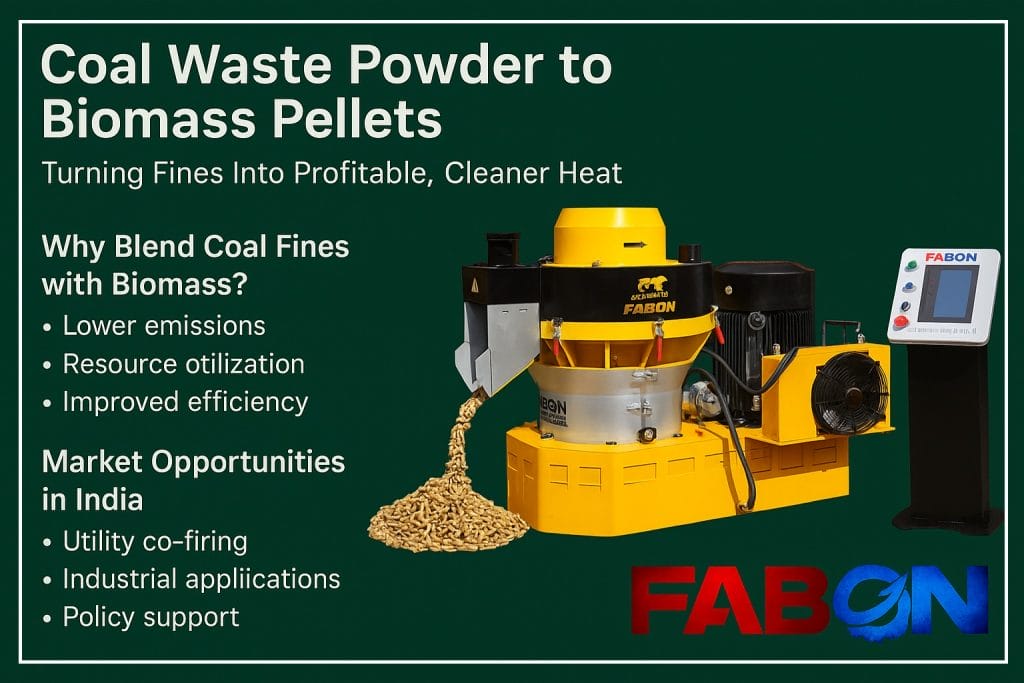
Why Blend Coal Fines with Biomass?
- Lower Emissions: Mixing biomass with coal fines reduces carbon footprint and pollutants. Biomass co-firing is already promoted in India’s power sector.
- Resource Utilization: It creates value from waste and agricultural residues such as rice husk, paddy straw, and sawdust.
- Improved Efficiency: Densified fuels burn more efficiently than loose coal fines, ensuring stable boiler operation and reduced losses.
Fuel Forms
- Composite Pellets (Biomass + Coal Fines): Biomass forms the base while coal fines add energy density. Torrefied biomass improves handling and compatibility.
- Bio-Coal Briquettes: Made by combining coal fines with biomass and binders like starch or molasses, shaped in roller presses for easy handling.
Process Flow
- Feedstock Preparation: Screen coal fines; shred, dry, and mill biomass to the right moisture level.
- Formulation & Binders: Select binders (starch, molasses, lignosulfonates) for strength and water resistance.
- Densification: Use pellet mills or briquette presses to compress the mixture.
- Cooling & Curing: Allow pellets/briquettes to harden and stabilize.
- Testing: Check density, durability, calorific value (GCV), ash content, and emissions compliance.
Market Opportunities in India
- Utility Co-Firing: Indian power plants are blending biomass with coal for cleaner energy, with growing demand for torrefied biomass pellets.
- Industrial Applications: Boilers, furnaces, kilns, and dryers can use composite briquettes/pellets to cut costs and emissions.
- Policy Support: Government initiatives encourage biomass utilization and discourage open dumping of coal fines.
Benefits
- Cost savings compared to fossil fuels like diesel or LPG.
- Reduced environmental impact and compliance with pollution norms.
- Better handling, storage, and transportation of fines.
- New revenue streams from what was previously waste.
FAQs
Q1: Can composite pellets be supplied to power plants?
Yes, but utility tenders often demand 100% biomass pellets. Composite fuels are better suited for industrial boilers and furnaces.
Q2: What percentage of coal fines can be used?
The ratio depends on fuel quality, ash content, and customer requirements. Pilot testing is recommended.
Q3: Which binder is best?
Starch, molasses, or lignosulfonates are common. The choice depends on cost, desired strength, and resistance to moisture.
SEO Optimized Details
- SEO Title: Coal Waste Powder to Biomass Pellets: Process, Benefits & Market (India 2025)
- Slug: coal-waste-powder-biomass-pellets
- Meta Description: Learn how coal fines can be converted into biomass pellets or briquettes with binders. Explore process, benefits, and India-specific market opportunities.
- Focus Keyphrase: coal waste powder biomass pellets
- Secondary Keywords: coal fines briquetting, bio-coal briquettes, biomass co-firing, torrefied biomass India, binders for pellets, GCV of composite pellets