

CNC Press Brake Machine – Complete Buying Guide, Specifications & Applications
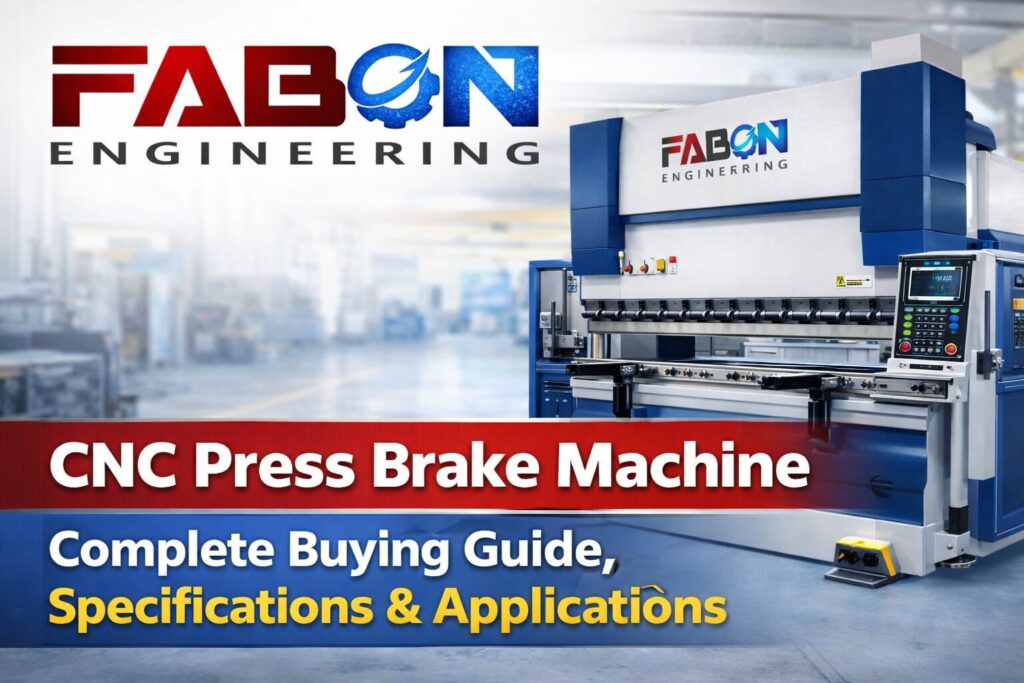
CNC Press Brake Machine – Complete Buying Guide, Specifications & Applications (2025)
By FABON Engineering Pvt. Ltd., Nashik
Introduction
In today’s modern fabrication industry, accuracy, repeatability, safety and productivity are no longer optional – they are essential. Whether you are manufacturing electrical panels, enclosures, elevator components, cabinets, structural parts, pharmaceutical equipment, food-processing machinery or agricultural equipment, one machine remains the backbone of sheet-metal bending operations – the CNC Press Brake Machine.
At FABON Engineering Pvt. Ltd., Nashik, we manufacture and supply advanced CNC press brake machines for Indian and global customers, supporting industries such as biomass & agro machinery, pharmaceutical equipment, industrial fabrication, food processing and infrastructure projects.
This detailed and completely plagiarism-free buying guide will help you understand:
- What a CNC press brake machine is
- How it works
- Types of CNC press brakes
- Complete technical specifications
- Tooling and control systems
- Accuracy and performance parameters
- Applications across industries
- How to select the right CNC press brake for your factory
- Total ownership cost and ROI
- Common mistakes while buying
- Future trends in CNC bending technology (2025 and beyond)
This article is specially written for fabricators, plant owners, production managers, entrepreneurs and engineering teams planning to invest in a new CNC press brake machine.
What Is a CNC Press Brake Machine?
A CNC Press Brake Machine is a computer-controlled sheet metal bending machine used to bend flat metal sheets into precise angles and profiles using a punch and die system.
Unlike conventional hydraulic press brakes where most operations are manually controlled, a CNC press brake uses a computerized control unit to automatically position:
- Ram depth (Y-axis)
- Back gauge positions (X, R, Z axes)
- Crowning compensation
- Bend sequence
- Tool data
- Part programs
This ensures:
- High repeatability
- Reduced operator dependency
- Faster production cycles
- Consistent quality
At FABON Engineering, our CNC press brakes are engineered to suit Indian operating conditions and are also exported to international markets.
Why CNC Press Brake Machines Are Critical in 2025
In 2025, sheet metal customers demand:
- Faster delivery
- Smaller batch sizes
- High dimensional accuracy
- Better surface finish
- Zero rework
Manual or semi-automatic bending machines cannot economically meet these expectations.
CNC press brakes allow manufacturers to:
- Quickly change over jobs
- Store multiple bending programs
- Achieve tight tolerances
- Reduce skilled manpower dependency
- Integrate bending with CAD/CAM workflows
Basic Working Principle of CNC Press Brake
The bending operation is based on controlled deformation of sheet metal between:
- Upper tool (punch)
- Lower tool (die)
The CNC controller drives the ram downward and controls the stroke depth very precisely.
The back gauge positions the sheet accurately before each bend.
The controller calculates:
- Bend depth
- Springback compensation
- Tool geometry
- Material thickness
- Bend angle
Once the program is loaded, the operator only needs to:
- Insert the sheet
- Align reference
- Press the foot pedal
The rest of the cycle is handled by the CNC system.
Main Components of a CNC Press Brake Machine
1. Machine Frame
The frame is a welded and stress-relieved heavy steel structure that absorbs bending forces and maintains long-term geometric accuracy.
FABON press brakes use high-rigidity frames designed using structural analysis to ensure:
- Minimal deflection
- Long machine life
- Stable bending accuracy
2. Ram (Upper Beam)
The ram carries the upper tool and moves vertically under controlled force.
Precision linear guides or slideways ensure smooth movement.
3. Work Table (Lower Beam)
The lower beam supports the die and sheet.
Crowning systems are integrated to compensate for beam deflection.
4. Hydraulic System / Servo System
Depending on configuration:
- Hydraulic press brakes use proportional valves
- Hybrid press brakes combine servo pumps with hydraulics
- Electric press brakes use servo motors
FABON supplies advanced hydraulic CNC press brakes with energy-efficient hydraulic circuits.
5. CNC Controller
The CNC controller is the heart of the machine.
It manages:
- Ram depth
- Back gauge positions
- Tool library
- Bend sequences
- Angle corrections
- Program storage
6. Back Gauge System
The back gauge positions the sheet before each bend.
Modern CNC press brakes use:
- Multi-axis back gauges (X, R, Z1, Z2, X2)
7. Tooling System
Precision punches and dies form the bend profile.
8. Safety System
Includes:
- Laser finger protection
- Light curtains
- Safety PLC
- Emergency stops
Types of CNC Press Brake Machines
1. Hydraulic CNC Press Brake
The most commonly used type in Indian industry.
Key features:
- High bending force
- Excellent reliability
- Suitable for thick and long sheets
- Proven technology
2. Hybrid CNC Press Brake
Uses servo pumps to drive hydraulic systems.
Advantages:
- Lower power consumption
- Reduced oil heating
- Quieter operation
3. Electric CNC Press Brake
Fully servo driven.
Advantages:
- Extremely energy efficient
- High positioning speed
- Lower maintenance
Typically used for thin sheet and high-speed production lines.
CNC Press Brake Axis Configuration
Modern CNC press brakes operate with multiple controlled axes.
Common axes include:
| Axis | Function |
|---|---|
| Y1, Y2 | Left and right ram control |
| X | Back gauge front-back movement |
| R | Back gauge vertical movement |
| Z1, Z2 | Back gauge lateral movement |
| Crowning | Beam deflection compensation |
At FABON Engineering, we offer:
- 3 axis CNC press brakes
- 4 axis CNC press brakes
- 6+ axis CNC press brakes
depending on customer requirement.
CNC Press Brake Specifications – Complete Technical Guide
1. Bending Capacity (Tonnage)
The tonnage defines how much force the machine can apply.
Typical models:
- 40 Ton
- 63 Ton
- 80 Ton
- 100 Ton
- 125 Ton
- 160 Ton
- 200 Ton
- 250 Ton
- 300 Ton and above
Tonnage selection depends on:
- Sheet thickness
- Sheet width
- Material type
- V-die opening
2. Bending Length
Common bending lengths:
- 1250 mm
- 1600 mm
- 2500 mm
- 3200 mm
- 4000 mm
- 5000 mm
- 6000 mm
FABON manufactures press brakes suitable for standard and customized bed lengths.
3. Ram Stroke
Defines maximum vertical travel of ram.
Typical stroke: 200–300 mm.
4. Daylight Opening
Distance between ram and table at top position.
Important for deep boxes and tall tooling.
5. Throat Depth
Distance between bending line and frame.
6. Back Gauge Travel
Defines how far the back gauge can move to support different part depths.
7. Axis Accuracy
High-quality CNC press brakes offer:
- Ram repeatability: ±0.01 mm
- Back gauge repeatability: ±0.02 mm
8. Controller Options
Common controllers offered by FABON Engineering:
- Delem CNC controllers
- ESA controllers
- Cybelec controllers
(Controller selection is based on customer preference and application.)
9. Crowning System
Crowning compensates for beam deflection.
Types:
- Manual crowning
- Motorized crowning
- CNC crowning
For long machines, CNC crowning is strongly recommended.
10. Electrical System
- Servo drives
- VFD controlled motors
- PLC and CNC integration
- Safety relays
All systems are designed for Indian voltage and industrial operating conditions.
Tooling Specifications – Punch & Die System
Tooling quality directly affects:
- Bend accuracy
- Tool life
- Surface finish
Common tooling systems:
- European style tooling
- American style tooling
- Gooseneck punches
- Radius punches
- Multi-V dies
FABON supplies compatible standard tooling and assists customers in selecting correct tool profiles.
Materials Suitable for CNC Press Brake Bending
CNC press brakes can bend:
- Mild steel
- Stainless steel
- Aluminium
- Copper
- Brass
- Galvanized sheets
- High-strength steel
Material properties are entered into CNC controller for accurate bend calculation.
How to Select the Right CNC Press Brake Machine – Buyer’s Guide
This is the most critical part of your investment decision.
Step 1 – Identify Maximum Sheet Size
Define:
- Maximum sheet length
- Maximum sheet thickness
Always consider future expansion.
Step 2 – Material Grade
Different materials require different tonnage.
Stainless steel and high-strength steel require more force than mild steel.
Step 3 – Product Profile Complexity
If your products have:
- Multiple bends
- Return flanges
- Box profiles
- Asymmetric parts
You need:
- Multi-axis back gauge
- Advanced CNC controller
- Special tooling
Step 4 – Production Volume
For:
- Job shop production → standard CNC press brake is sufficient
- Mass production → higher speed and automatic angle correction systems are recommended
Step 5 – Tooling Flexibility
Quick tool change systems save huge setup time.
Step 6 – Operator Skill Level
Modern CNC machines allow less experienced operators to achieve consistent results.
Step 7 – After-Sales Support
A CNC press brake is a long-term asset.
Always choose a manufacturer who provides:
- Installation
- Operator training
- Maintenance support
- Spare parts availability
At FABON Engineering Pvt. Ltd., Nashik, we strongly focus on after-sales and technical support across India and export markets.
Common Mistakes Buyers Make
- Selecting tonnage only for current jobs and ignoring future products
- Ignoring crowning system on long machines
- Buying low-grade tooling
- Underestimating controller capability
- Ignoring safety compliance
- Not checking spare availability and service infrastructure
CNC Press Brake Machine Applications
CNC press brakes are used in almost every fabrication industry.
1. Biomass & Agro Machinery Manufacturing (FABON Core Segment)
At FABON Engineering, CNC press brakes are heavily used for:
- Biomass pellet machine frames
- Hammer mill housings
- Flash dryer ducts
- Cyclone separators
- Storage bins
- Conveyors
- Biomass burner enclosures
- Feed plant structures
Accurate bending ensures proper alignment during assembly and improves machine performance.
2. Pharmaceutical Equipment Manufacturing
Press brakes are used to manufacture:
- SS enclosures
- Skids
- washing machine frames
- utility systems cabinets
- process equipment covers
Accuracy and surface protection are extremely critical in pharma equipment fabrication.
3. Electrical Panels and Enclosures
- LT panels
- HT panels
- PLC cabinets
- control consoles
CNC bending ensures sharp edges, correct angles and uniform appearance.
4. HVAC and Ducting Industry
- Air handling unit panels
- duct profiles
- flanges
5. Elevator and Escalator Industry
- car frames
- door panels
- structural brackets
6. Furniture and Modular Systems
- steel cabinets
- lockers
- racks
- workstations
7. Automotive and Component Manufacturing
- brackets
- chassis parts
- reinforcements
8. Infrastructure and Construction
- structural supports
- cladding frames
- architectural metalwork
Accuracy and Quality Control in CNC Press Brake Operations
Modern CNC press brakes use:
- Closed loop ram control
- Linear scales
- Real-time feedback
Important quality parameters include:
- Bend angle consistency
- Flange length accuracy
- Surface protection
- Repeatability across batches
Angle correction systems and test bending cycles improve first-part accuracy.
Productivity Advantages of CNC Press Brakes
Compared to conventional bending machines:
- Faster setup time
- Less scrap
- Reduced trial bends
- Higher output per shift
- Lower manpower dependency
For manufacturing companies, this directly improves:
- delivery time
- customer satisfaction
- profit margins
Safety Systems in Modern CNC Press Brake Machines
In 2025, safety compliance is mandatory.
Important safety features:
- Laser finger protection system
- Light curtain
- Dual foot pedals
- Emergency stop circuits
- Safety PLC
FABON Engineering integrates safety systems as per industrial safety standards.
Maintenance and Service Requirements
Regular maintenance ensures long life and accuracy.
Daily:
- Cleaning
- Visual inspection
- Oil leakage check
Weekly:
- Guide lubrication
- Tool condition check
Monthly:
- Hydraulic oil inspection
- Back gauge calibration
Yearly:
- System alignment check
- Filter replacement
FABON provides maintenance training during machine installation.
Total Cost of Ownership (TCO)
While evaluating CNC press brake price, always consider:
- Machine cost
- Tooling cost
- Installation cost
- Training cost
- Energy consumption
- Maintenance cost
- Downtime losses
A high-quality CNC press brake provides lower total cost over its operating life.
ROI of CNC Press Brake Investment
Typical ROI is achieved through:
- Reduction in rework
- Faster production
- Lower manpower requirement
- Better part consistency
- Ability to take high-precision jobs
Most medium-scale fabricators recover their investment within 18 to 36 months depending on utilization.
CNC Press Brake Integration with CAD / CAM
Modern press brakes integrate with:
- CAD drawings
- offline programming software
- bending simulation software
This reduces shop-floor programming time and prevents collisions.
Environmental and Energy Considerations
Hybrid and electric press brakes significantly reduce:
- power consumption
- oil heating losses
- cooling requirements
FABON also supports energy-optimized hydraulic designs.
CNC Press Brake Machine – Future Trends (2025 and Beyond)
The industry is moving towards:
- Fully electric bending solutions
- AI-assisted bend correction
- Automatic tool recognition
- Cloud-connected machines
- Digital production monitoring
- Smart maintenance diagnostics
FABON Engineering continuously upgrades its designs to remain aligned with global technology trends.
Why Choose FABON Engineering Pvt. Ltd., Nashik for CNC Press Brake Machines?
FABON Engineering is a trusted Indian manufacturer of industrial machinery including:
- CNC press brake machines
- biomass and agro equipment
- industrial fabrication solutions
Our key strengths:
- Engineering-driven design
- Robust frame manufacturing
- Industrial-grade hydraulic and electrical systems
- Customized configurations
- Strong after-sales support
- Proven installation base in India and overseas
We understand real production challenges faced by fabrication companies because we ourselves manufacture heavy industrial machines and assemblies using CNC bending technology daily.
Final Conclusion
A CNC press brake machine is not just a bending machine – it is a productivity and quality backbone for modern sheet metal manufacturing.
Selecting the right CNC press brake in 2025 requires a deep understanding of:
- capacity requirements
- future product mix
- controller capability
- tooling flexibility
- safety standards
- service infrastructure
Whether you are planning a new fabrication facility, upgrading from conventional machines, or expanding your production line, investing in a properly specified CNC press brake will directly improve your competitiveness.
At FABON Engineering Pvt. Ltd., Nashik, we help customers select, configure and successfully deploy CNC press brake machines that match their production goals today and support growth tomorrow.
If you are planning to invest in a CNC Press Brake Machine for your fabrication unit, biomass machinery plant, pharmaceutical equipment workshop or industrial manufacturing facility, FABON Engineering Pvt. Ltd., Nashik is ready to support you with complete technical guidance, installation, training and after-sales service.