

CNC Press Brake Applications in Sheet Metal Fabrication Industries
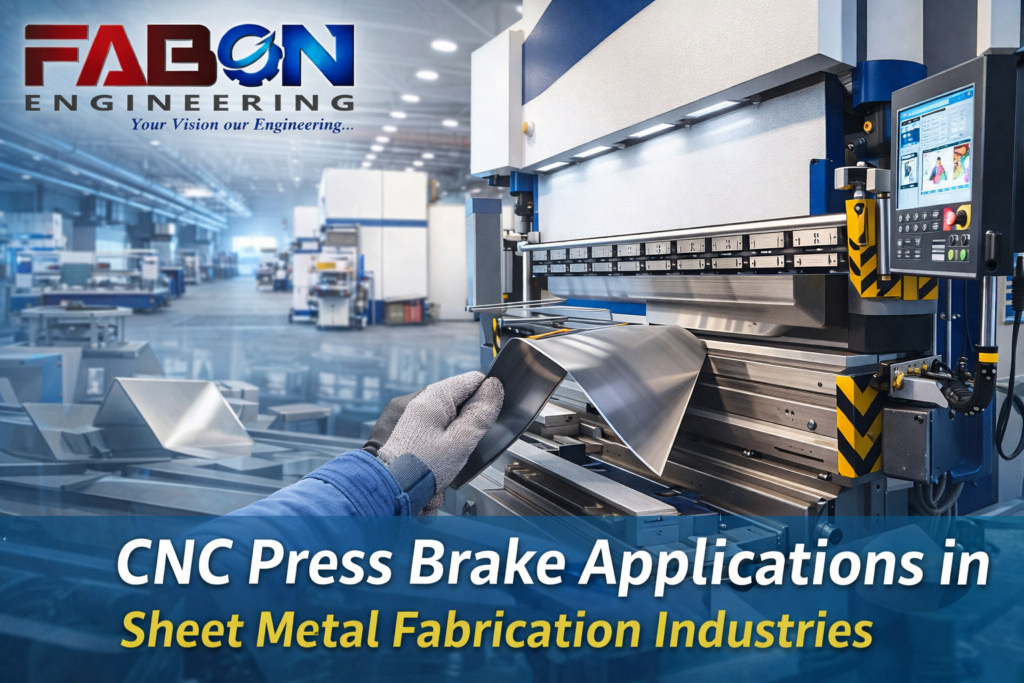
CNC Press Brake Applications in Sheet Metal Fabrication Industries by FABON Engineering Pvt. Ltd.
Introduction
Sheet-metal fabrication is one of the most important manufacturing processes across modern industries. From electrical panels and industrial enclosures to heavy engineering structures, HVAC systems, automotive parts and pharmaceutical equipment, bending accuracy, repeatability and productivity directly decide the quality and commercial success of fabricated components.
At the center of this bending operation stands the CNC Press Brake machine.
A CNC press brake is no longer just a bending machine. It has evolved into a precision forming system capable of producing complex geometries with tight tolerances, automated back-gauging, programmable angle control and integrated safety systems.
This detailed article explains:
- What a CNC press brake actually does in fabrication
- How it is applied in different sheet-metal industries
- Which bending operations are performed
- What technical capabilities are required for each application
- And how fabrication companies can improve productivity and quality using the right press brake configuration
This article is especially useful for:
- job-shop fabricators
- OEM manufacturers
- EPC companies
- plant owners
- and engineering consultants.
1. Role of CNC Press Brake in Modern Sheet-Metal Fabrication
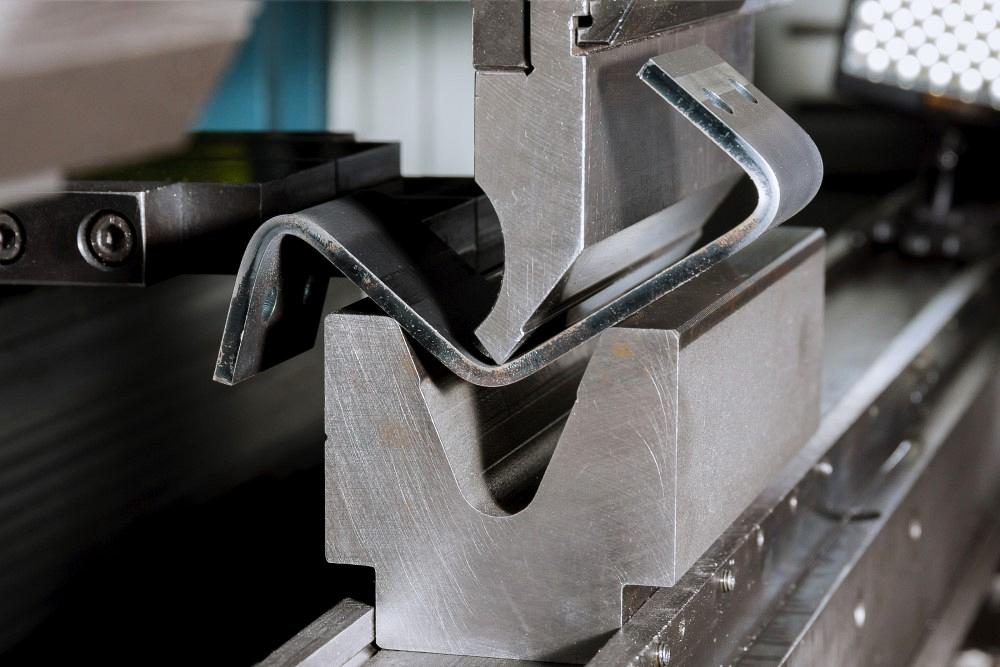
A CNC press brake is designed to plastically deform flat metal sheets into specific angular and profile shapes using a controlled punch and die system.
The key difference between conventional press brakes and CNC press brakes lies in:
- programmable axes control
- automatic back gauge positioning
- angle correction and compensation
- repeatability over large batch sizes
Modern fabrication plants require:
- short setup time
- frequent job changeover
- flexible batch sizes
- high dimensional accuracy
CNC press brakes perfectly match this manufacturing requirement.
2. Core Bending Operations Performed on CNC Press Brakes
Before understanding industry-wise applications, it is essential to understand the main bending operations.
2.1 Air bending
Air bending is the most widely used press brake application.
The punch does not bottom into the die. The bend angle is created by controlling ram depth.
Advantages:
- one die for multiple angles
- low tooling cost
- high flexibility
Most sheet-metal job shops rely primarily on air bending.
2.2 Bottom bending
In bottom bending, the sheet touches the bottom of the die.
Advantages:
- better angle repeatability
- suitable for thicker materials
This method is used when dimensional consistency is more critical than flexibility.
2.3 Coining
Coining involves extremely high tonnage and forces the material to conform exactly to the punch and die.
Advantages:
- very accurate angles
- negligible spring-back
This operation is generally used for:
- precision parts
- electrical components
- small brackets and fittings.
2.4 Multi-step bending
Complex profiles such as:
- box sections
- hat channels
- U-profiles
- deep formed flanges
are produced using multiple sequential bends.
CNC programming makes this practical and repeatable.
3. Application of CNC Press Brakes in Electrical Panel & Enclosure Manufacturing
One of the largest users of CNC press brakes is the electrical and automation industry.
Typical components include:
- control panels
- junction boxes
- server racks
- PLC cabinets
- power distribution enclosures
Key bending requirements
- consistent flange dimensions
- square geometry
- high surface finish
- minimum distortion
Common operations
- side wall bending
- door panel folds
- mounting flange bends
- frame sections
CNC press brake advantages
- programmable back gauges ensure identical cabinet depths
- multiple bend sequences stored as programs
- minimal operator dependency
This sector demands high repeatability with moderate material thickness (1 mm to 3 mm).
4. Applications in HVAC Ducting and Air-Handling Equipment Industry
HVAC manufacturing involves extensive sheet-metal forming.
Typical parts:
- air ducts
- plenums
- air-handling unit panels
- filter frames
- damper blades
CNC press brake usage
- long sheet bending with crowning compensation
- continuous production of rectangular duct profiles
- repetitive angle bending at high speed
Key challenges
- long bending lengths
- thin sheet distortion
- maintaining straightness
Modern CNC press brakes use:
- hydraulic or mechanical crowning
- synchronized Y1-Y2 control
to maintain uniform bending angle over full machine length.
5. CNC Press Brake Applications in Automotive & Auto-Component Manufacturing
The automotive sector uses CNC press brakes for:
- brackets
- mounting supports
- reinforcement plates
- battery tray components
- structural sub-assemblies
Typical materials
- mild steel
- high-strength steel
- galvanized steel
- aluminium alloys
Special requirements
- tighter tolerances
- higher production volume
- quick tool change
- multiple part variants
CNC press brakes with:
- fast back gauge systems
- multi-axis control
- offline programming
allow automotive suppliers to manage frequent model changes efficiently.
6. Application in Industrial Machinery and Equipment Manufacturing
Industrial machinery manufacturers produce:
- machine covers
- guarding panels
- structural frames
- housings
- mounting plates
CNC press brake roles
- bending of thicker plates
- forming stiffeners
- precise angular positioning
This application often requires:
- higher tonnage
- larger daylight
- deeper throat depth
Press brakes in this segment are normally equipped with:
- heavy-duty frames
- large stroke cylinders
- multi-V die setups.
7. Applications in Pharmaceutical and Food Processing Equipment Fabrication
This segment requires:
- stainless steel fabrication
- hygienic design
- smooth edges and surfaces
Typical components
- machine covers
- operator panels
- process enclosures
- control cabinets
CNC press brake importance
- accurate bending of SS sheets without surface damage
- ability to form narrow flanges
- repeatable bends for modular assemblies
Special tooling with:
- polished punches
- protective film
- radius-controlled dies
is commonly used.
8. CNC Press Brake Applications in Infrastructure and Construction Fabrication
Construction and infrastructure projects demand:
- trays
- brackets
- supports
- façade panels
- architectural elements
Key challenges
- mixed material thickness
- frequent design changes
- project-based manufacturing
CNC press brakes help fabricators:
- quickly adjust programs
- handle varied batch sizes
- maintain consistent geometry across site deliveries.
9. Application in Solar Structure and Renewable Energy Fabrication
Renewable energy projects require:
- mounting structures
- cable trays
- inverter frames
- equipment enclosures
CNC press brakes are used to produce:
- C-channels
- Z-profiles
- custom brackets
High repeatability is essential because:
- structure alignment affects installation speed and reliability.
10. CNC Press Brake Applications in Furniture and Modular Systems Manufacturing
Modern commercial furniture and modular partition systems rely heavily on sheet-metal frames.
Typical components:
- workstation frames
- support brackets
- cable management trays
- drawer systems
CNC press brake benefits
- complex aesthetic shapes
- tight dimensional consistency
- smooth visual lines
This sector often uses:
- thin sheets
- decorative surfaces
- powder-coated finishes
Hence, bending accuracy and surface protection become critical.
11. CNC Press Brake Applications in Electronics and IT Infrastructure Industry
Electronics and IT infrastructure manufacturers use CNC press brakes to fabricate:
- server racks
- telecom cabinets
- data center enclosures
Critical factors
- uniformity
- interchangeability of parts
- precise hole-to-bend relationship
CNC back gauges and programmable stop fingers help achieve this consistently.
12. Heavy Engineering and Power Equipment Fabrication
In heavy engineering workshops, press brakes are applied to:
- electrical transformer enclosures
- switchgear housings
- equipment covers
- structural support frames
Typical challenges
- thicker sheets (5 mm to 16 mm)
- longer forming lengths
- higher tonnage demand
CNC press brakes used here generally feature:
- synchronized multi-cylinder systems
- heavy-duty tooling
- deflection compensation systems.
13. Defence and Aerospace Support Fabrication
Although primary aerospace forming is usually done on specialized equipment, CNC press brakes are extensively used for:
- ground support equipment
- mounting structures
- instrumentation enclosures
- service carts
Key requirements
- high repeatability
- documentation of programs
- traceability of dimensions
CNC press brakes integrate well with digital production systems.
14. Typical Profiles Produced Using CNC Press Brakes
Common profiles across industries include:
- L-angles
- U-channels
- box sections
- hat channels
- Z-profiles
- stepped flanges
- return flanges
Using staged bending, almost any custom profile can be produced.
15. Importance of Back Gauge Systems in Fabrication Applications
Back gauge accuracy directly determines:
- flange length
- part squareness
- repeatability
Modern CNC press brakes typically provide:
- X-axis (depth positioning)
- R-axis (vertical movement)
- Z1 and Z2 axes (left–right positioning)
Advanced machines offer:
- 4 to 6 axis back gauge systems.
This is especially useful for:
- asymmetric parts
- offset flanges
- irregular hole patterns.
16. CNC Press Brake Tooling and Its Role in Applications
The right tooling defines the quality of the finished component.
Common tooling types
- standard punches
- gooseneck punches
- acute angle punches
- radius punches
- sectional punches
Die types
- single V dies
- multi-V dies
- hemming dies
- radius dies
In multi-industry fabrication, sectional tooling allows fast changeovers and flexible job planning.
17. Accuracy and Repeatability Requirements Across Industries
Different industries demand different bending tolerances.
| Industry | Typical angular tolerance |
|---|---|
| Electrical enclosures | ±0.5° |
| HVAC ducting | ±1° |
| Automotive components | ±0.3° |
| Pharma & food equipment | ±0.5° |
| Electronics racks | ±0.3° |
CNC press brakes with:
- closed-loop control
- angle sensors
- crowning systems
help maintain consistency.
18. CNC Press Brake and Industry 4.0 Integration
Modern fabrication plants increasingly integrate CNC press brakes with:
- ERP systems
- job tracking software
- offline programming platforms
This enables:
- digital job cards
- program transfer
- real-time production monitoring
- tool management
Such digital connectivity improves:
- machine utilization
- quality traceability
- production planning accuracy.
19. Productivity Improvement Using CNC Press Brakes
Compared to conventional bending machines, CNC press brakes improve:
- setup time by 40–60%
- scrap reduction
- operator dependency
- first-off accuracy
This is crucial for:
- job-shop fabricators
- contract manufacturers
- short batch production environments.
20. Safety Systems and Their Importance in Industrial Applications
Modern press brake applications demand high safety standards.
Typical safety devices include:
- laser safety systems
- light curtains
- safety PLCs
- foot pedal controls with dual channels
These systems allow:
- high operator safety
- uninterrupted productivity
- compliance with international standards.
21. Selecting the Right CNC Press Brake for Your Application
While selecting a CNC press brake, the following must be evaluated:
- maximum sheet thickness and length
- material type
- required tonnage
- typical part geometry
- number of daily job changes
- future expansion plans
An under-sized machine leads to:
- tooling limitations
- poor productivity
- frequent outsourcing.
22. Application-Focused Machine Configuration
Different industries demand different configurations:
- electrical and HVAC → fast back gauges, long bed length
- automotive and electronics → higher axis count, faster controls
- heavy engineering → higher tonnage, deeper throat, stronger frames
Therefore, application-driven configuration is more important than simply selecting capacity.
23. How FABON Engineering Supports Fabrication Industry Applications
FABON Engineering Pvt. Ltd. designs and supplies CNC press brake machines specifically configured for:
- electrical enclosure manufacturing
- industrial equipment fabrication
- pharmaceutical and food machinery fabrication
- infrastructure and renewable energy sectors
FABON provides:
- application study and machine selection
- tooling recommendation
- layout planning
- operator training
- after-sales service and spares support
This approach ensures the press brake is aligned with actual production requirements, not only catalog specifications.
24. Future Trends in CNC Press Brake Applications
The next generation of CNC press brake applications will focus on:
- automated part handling
- robotic bending cells
- real-time angle correction
- digital twin programming
- fully integrated production lines
As fabrication becomes increasingly digital and flexible, CNC press brakes will remain one of the most critical forming technologies in the sheet-metal industry.
Conclusion
CNC press brakes play a fundamental role in almost every segment of the sheet-metal fabrication industry.
From electrical enclosures and HVAC systems to automotive components, pharmaceutical equipment, renewable energy structures and heavy engineering assemblies, their applications continue to expand with the growing demand for:
- accuracy
- flexibility
- productivity
- and digital manufacturing integration.
By selecting application-oriented machine configurations and adopting modern CNC bending technology, fabrication companies can significantly improve quality, reduce operational cost and remain competitive in a rapidly evolving manufacturing environment.
For manufacturers and fabricators looking to upgrade or expand their bending operations, CNC press brakes are no longer optional equipment—they are a strategic investment in long-term production capability.