

ROI (RETURN ON INVESTMENT) OF BIOMASS PELLET PLANT.
INTRODUCTION
The demand for biomass pellets in India and across the world is growing faster than ever. With rising fuel prices, strict emission norms, and government support, industries are rapidly shifting toward biomass-based heating systems. This shift is creating a massive business opportunity for entrepreneurs, farmers, industries, and energy companies.
1. Understanding the Biomass Pellet Industry in 2025
Biomass pellets have replaced more than 3 million tons of coal in India between 2022 and 2024, and the demand is projected to cross 10 million tons by 2030. Industries using pellets include:
- Food processing units
- Hotels & commercial kitchens
- Textile industries
- Boilers & hot air generators
- Pharma industries
- Chemical & dyeing plants
- Power plants (NTPC co-firing)
- Export markets (Europe & Asian countries)
This massive and consistent demand ensures a profitable long-term business for pellet manufacturers.
2. Why Biomass Pellets Are in High Demand (2025-2030)
2.1. Fuel Cost Savings (50–60% cheaper than LPG & diesel)
Industries are cutting their heating expenses by switching to biomass pellets.
2.2. Low Emissions (Meets Government Norms)
Pellets have 0.5–1% ash, making them cleaner than coal.
2.3. Government Push
- NTPC co-firing
- Renewable energy targets
- Subsidies for biomass processing
2.4. Farmer Income Support
Agricultural waste becomes revenue instead of burning.
2.5. Ease of Storage & Handling
Higher energy density and uniform fuel size.
This ensures stable demand for at least the next decade.
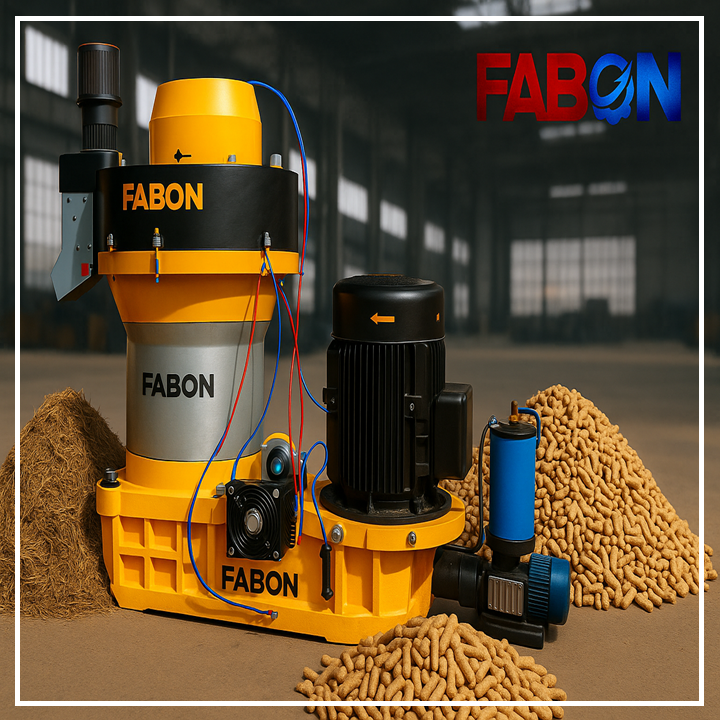
3. Types of Biomass Pellet Machines (FABON Range Overview)
FABON Engineering manufactures a complete range:
3.1. Flat Die Pellet Machines
For small farms & startups: 100 kg/hr – 500 kg/hr.
3.2. Ring Die Pellet Machines (Industrial)
1 TPH | 1.5 TPH | 2 TPH | 3 TPH
3.3. Fully Automatic Pellet Plants
With hammer mill, dryer, conveyors, cooler, screener, storage silos, etc.
FABON Advantages:
- Heavy-duty structure
- 1-year warranty
- 20+ hours/day continuous operation
- Best energy efficiency in India
- Lowest maintenance costs
- After-sales support PAN India
4. Project Investment Requirements (Example: 1 TPH Plant)
4.1. Machinery Investment
| Machine | Amount (INR) |
| FABON 1 TPH Ring Die Pellet Machine | 23–28 Lakhs |
| Hammer Mill | 4–6 Lakhs |
| Flash/Rotary Dryer | 9–15 Lakhs |
| Cooler & Screener | 2–4 Lakhs |
| Conveyors | 2–3 Lakhs |
| Electrical Panel & Cabling | 1–3 Lakhs |
| Installation & Commissioning | 1–2 Lakhs |
Total Machinery Cost: 40–55 Lakhs (depending on configuration)
5. Operational Cost Breakdown per Ton of Pellets
5.1. Raw Material Cost
Rice husk / sawdust / wood waste: ₹2,000–₹3,500 per ton
5.2. Power Consumption
For 1 TPH plant, approx. 70–80 units/hour
Electricity cost: ₹6–8 per unit
Total: ₹450–550 per ton
5.3. Manpower Cost
2–3 workers
Cost per ton: ₹150–200
5.4. Maintenance & Consumables
Dies, rollers, grease, etc.
Cost per ton: ₹100–150
5.5. Packing Bags
₹80–120 per ton (optional)
Total Manufacturing Cost per Ton
₹3,200 – ₹4,500 per ton
6. Revenue & Profit Per Ton Calculation
Selling Price of Pellets in 2025
- Industrial heating: ₹9 – ₹12 per kg
- Export: ₹13 – ₹17 per kg
Average selling price considered: ₹10 per kg (₹10,000 per ton)
Profit Calculation
Selling Price per Ton: ₹10,000
Manufacturing Cost per Ton: ₹3,800 (average)
✔ Profit per Ton = ₹6,200
✔ Profit Margin = 60–65%
7. Overall Monthly ROI Calculation
For 1 TPH Plant
Operating hours: 8 hours/day
Production: 8 tons/day
Monthly production: 8 × 30 = 240 tons
Monthly Profit
240 tons × ₹6,200 profit/ton
= ₹14,88,000 (~15 Lakhs profit)
8. Payback Period – How Long to Recover Investment?
Machinery Investment: 50 Lakhs
Monthly Profit: 15 Lakhs
✔ Payback = 3.3 Months
Even if productivity is 50–60%, payback is 6–8 months, making it one of the fastest-payback manufacturing businesses in India.
9. Factors That Increase ROI
A. Using a High-Efficiency Machine (FABON advantage)
Better die compression, lower power consumption, maximum output.
B. Low Raw Material Cost
If you source from furniture factories or sawmills, raw material cost reduces.
C. Consistent Quality
High-density pellets sell for a premium.
D. Additional Revenue Streams
- Pellet burner installations
- AMC contracts
- Selling carbon emission credits (future opportunity)
10. FABON Engineering Advantages for Higher ROI
1. Lowest Power Consumption in Market
Saves ₹3–5 lakhs annually.
2. Heavy-Duty Ring Die & Rollers
Longer lifespan → lower maintenance cost.
3. 1-Year Warranty + On-Site Support
Zero downtime, consistent output.
4. 20+ Hours Continuous Operation
Higher productivity = higher revenue.
5. CNC-manufactured precision parts
Better compression, higher pellet density.
6. Large After-Sales Service Network
Support PAN India.
11. Case Studies: Real-World ROI with FABON Machines
Case Study 1 – West Bengal (Rice Husk Pellets)
- Machine: FABON 1 TPH
- Daily Production: 9 tons
- Profit/month: ₹17 Lakhs
- Payback: 3 months
Case Study 2 – Rajasthan (Napier Grass Pellets)
- Machine: FABON 2 TPH
- Profit/month: ₹28 Lakhs
- Payback: 2.5 months
Case Study 3 – Maharashtra (Wood Pellets)
- Machine: FABON 1.5 TPH
- Profit/month: ₹20 Lakhs
- Payback: 4 months
12. Government Policies That Boost ROI
MNRE Subsidies
Supports biomass processing & rural energy.
NTPC Pellet Procurement Policy
Purchasing 20 million tons annually for co-firing.
State-Level Benefits
Some states offer:
- Capital subsidies
- GST benefits
- Electricity duty exemption
- Priority in land allotment
This directly improves profitability.
13. Common Mistakes Investors Make
- Buying cheap Chinese machines → High maintenance & low ROI
- Underestimating moisture control → Low pellet density
- Not planning raw material logistics
- Ignoring power load requirement
- Poor marketing strategy
FABON provides a ready business setup plan to avoid these mistakes.
14. Why FABON Biomass Pellet Machines Offer the Best ROI
- Manufactured in India with European standards
- 1-year warranty
- 20 hours/day performance
- Best compression ratio
- Optimized die design
- Lowest operational expenses
- Long-life parts
- PAN India service support
- Complete plant automation available
FABON = Highest Productivity + Lowest Cost = Maximum ROI
15. Conclusion – Is It Worth Investing in a Pellet Plant in 2025?
YES.
With rising fuel demand, sustainability pressure, and government support, biomass pellets are one of the fastest-growing renewable businesses. A pellet plant offers:
- High profitability
- Fastest payback period
- Low maintenance
- Huge market demand
- Long-term sustainability
FABON Engineering’s machines are designed for maximum ROI, high production, and long lifetime.
If you want a 1 TPH, 2 TPH, or 3 TPH pellet plant, FABON provides complete turnkey solutions.
16. FAQ – Return on Investment After Using a Biomass Pellet Machine
Q1. How much profit can I earn per month from a pellet plant?
₹10–30 Lakhs depending on plant size and raw material cost.
Q2. What is the payback period of a pellet machine?
3–8 months depending on production and market rates.
Q3. Which pellet machine gives the highest ROI?
FABON Ring Die Pellet Machines due to low maintenance and high output.
Q4. What raw material is most profitable?
Rice husk, sawdust, wood powder, groundnut shells, bamboo dust.
Q5. Is pellet business suitable for rural areas?
YES—easy raw material availability, low labor cost, government schemes.
Q6. Can pellets be exported?
Yes, Europe, UAE, and Asian countries have high demand.
Q7. Do I need a dryer?
If raw material moisture > 12%, a dryer is mandatory for high-quality pellets.
Q8. How does FABON support new investors?
Site visit, machine selection, plant layout, installation, training, and service.