

Comparison of Biomass Fuel vs Fossil Fuels (Coal Oil Gas) Availibility
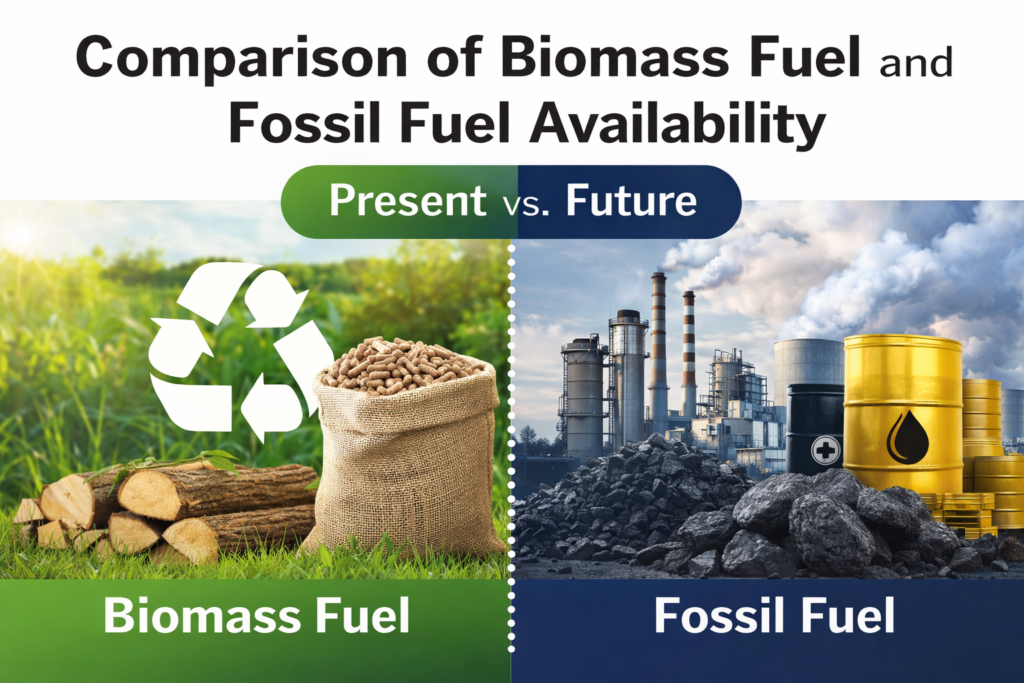
Present Situation and Future Outlook
Energy availability is one of the most critical factors for industrial development and economic growth. For more than a century, industries have relied heavily on fossil fuels such as coal, oil, and natural gas, which currently supply about 80% of the world’s energy demand.
However, increasing environmental concerns, rising fuel prices, and limited reserves are forcing the world to explore renewable alternatives such as biomass energy.
This comparison explains how biomass fuel and fossil fuels differ in terms of availability today and in the future.
1. Availability of Fossil Fuels
Present Availability
Fossil fuels are formed from ancient plant and animal remains that were buried and transformed under heat and pressure over millions of years.
Major fossil fuels include:
- Coal
- Petroleum (Oil)
- Natural Gas
These fuels are currently widely used because they provide high energy density and stable supply infrastructure.
Current Energy Share
Globally:
- Fossil fuels supply around 80% of global energy consumption.
- They power industries, electricity generation, transportation, and heating systems.
Because of their high energy output and established distribution networks, fossil fuels remain dominant in the global energy system.
Future Availability of Fossil Fuels
One of the biggest challenges with fossil fuels is that they are non-renewable resources.
This means once they are extracted and consumed, they cannot be regenerated within human timescales.
Estimated Remaining Reserves
At current consumption levels:
- Oil reserves may last about 50 years
- Natural gas may last about 50–60 years
- Coal reserves may last 100–150 years
These estimates can change depending on consumption rates and new discoveries, but overall fossil fuels are finite and declining resources.
Future Challenges of Fossil Fuels
Several factors will limit fossil fuel availability:
- Depletion of reserves
- Increasing extraction costs
- Environmental regulations
- Carbon emission restrictions
- Global shift toward renewable energy
Because of these issues, many countries are gradually reducing fossil fuel dependence.
2. Availability of Biomass Fuel
Present Availability
Biomass fuel is derived from organic materials such as agricultural residues, forestry waste, and energy crops.
Common biomass sources include:
- Sawdust
- Rice husk
- Bagasse
- Corn stalk
- Napier grass
- Agricultural residues
- Wood chips
Unlike fossil fuels, biomass is renewable and continuously produced through agriculture and forestry activities.
Currently:
- Biomass accounts for about 14% of global energy consumption.
- In many developing countries, biomass already provides a significant portion of energy supply.
Biomass is widely used for:
- Industrial heating
- Electricity generation
- Biofuels
- Biomass pellets and briquettes
Future Availability of Biomass Fuel
The future availability of biomass fuel is considered very promising because it is renewable.
Biomass resources can be continuously regenerated through:
- Agriculture
- Forestry
- Energy crops
- Waste recycling
Experts consider biomass one of the most widely available renewable energy sources worldwide.
Most countries can produce biomass locally because agricultural residues and organic waste are widely distributed.
Additionally, the use of modern bioenergy technologies is growing rapidly and may double its share in global energy consumption by 2030 in clean-energy scenarios.
3. Key Differences in Availability
| Factor | Fossil Fuels | Biomass Fuel |
|---|---|---|
| Resource Type | Non-renewable | Renewable |
| Formation Time | Millions of years | Seasonal / annual |
| Global Distribution | Uneven | Widely available |
| Long-Term Supply | Limited reserves | Continuous regeneration |
| Dependence | Imported in many countries | Locally produced |
| Sustainability | Depleting | Sustainable if managed |
4. Environmental Impact and Sustainability
Availability is not the only factor; sustainability also matters.
Fossil fuels release large amounts of carbon dioxide and greenhouse gases, which contribute to climate change.
Biomass also releases CO₂ during combustion, but the plants used for biomass absorb nearly the same amount of CO₂ during growth, making it close to carbon-neutral.
Because of this, biomass is considered a cleaner alternative to fossil fuels.
5. Future Energy Trends
Global energy systems are gradually transitioning toward renewable sources.
Major trends include:
- Expansion of renewable energy
- Reduction in fossil fuel dependence
- Increase in bioenergy usage
- Government support for clean energy
Energy experts believe that biomass will play an important role in industrial heating, power generation, and biofuel production in the coming decades.
Industries such as:
- Thermal power plants
- Cement factories
- Food processing units
- Industrial boilers
are already switching from fossil fuels to biomass pellets and briquettes.
6. Industrial Perspective
From an industrial viewpoint, biomass offers several advantages in terms of fuel availability.
Fossil Fuel Issues
- Imported fuel dependency
- Price volatility
- Supply disruptions
- Environmental regulations
Biomass Advantages
- Local raw material availability
- Stable fuel supply
- Lower cost
- Renewable resource
Because of these factors, many industries are adopting biomass pellet burners and biomass boilers as alternatives to coal, diesel, and LPG.
Conclusion
The comparison between biomass fuel and fossil fuels clearly shows a major difference in long-term availability and sustainability.
Fossil fuels currently dominate global energy consumption, but they are finite resources that may become scarce within the next century.
On the other hand, biomass fuel is renewable and widely available, as it is produced from agricultural and forestry residues that regenerate every year.
As the world moves toward cleaner and more sustainable energy systems, biomass is expected to play an increasingly important role in replacing fossil fuels, especially in industrial heating and power generation.
Therefore, while fossil fuels may remain important in the short term, biomass energy represents a more sustainable and secure energy source for the future.